The Wiedemann–Franz law, which links electrical and thermal conductivity, is dramatically violated in ultraclean graphene. Experiments show electrical and thermal transport moving in opposite directions, with deviations exceeding 200× at low temperatures. The effect occurs at the Dirac point, where electrons form a low‑viscosity Dirac fluid whose transport follows a universal constant tied to the quantum of conductance. This finding reveals limits of classical transport laws and opens new opportunities for tabletop studies of extreme quantum phenomena and advanced sensors.
Ultraclean Graphene Breaks a Century-Old Rule: Wiedemann–Franz Law Violated by Over 200×
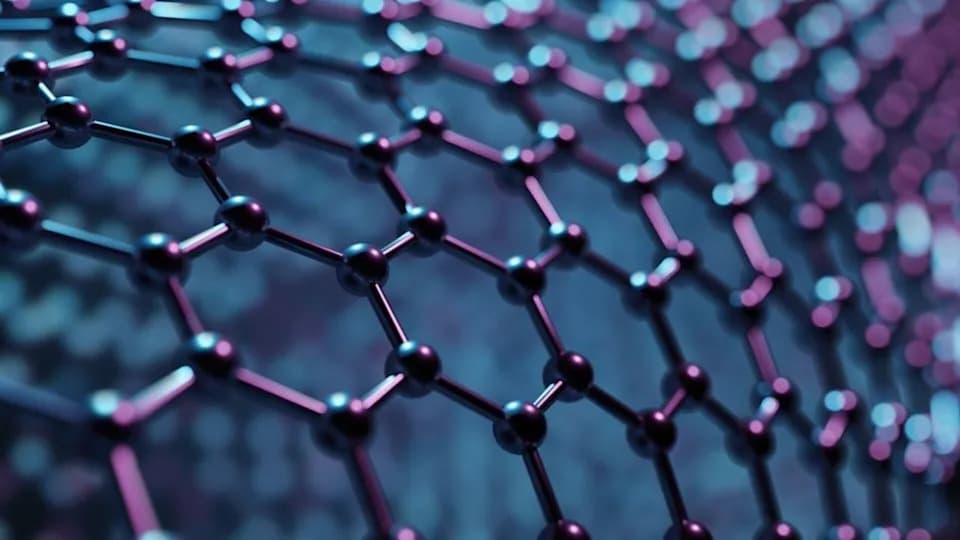
Credit: Technology Networks
Researchers have observed a dramatic breakdown of a long-standing rule in condensed-matter physics: the Wiedemann–Franz law. In ultraclean, single-layer graphene samples, electrical and thermal conduction no longer track one another — they move in opposite directions under certain conditions.
What the Experiment Showed
The team, from the Indian Institute of Science and Japan's National Institute for Materials Science, prepared exceptionally clean graphene to remove the usual effects of defects and impurities. By measuring electrical and thermal transport across a range of temperatures and carrier densities, they discovered that electrical conductivity can increase while thermal conductivity falls, and vice versa. At low temperatures the deviation from the Wiedemann–Franz prediction exceeded a factor of 200.
Why This Happens: The Dirac Point and a Collective Electron Fluid
The effect appears when the electron density is tuned to the Dirac point — graphene's critical point between metallic and insulating behavior. There, electrons stop behaving like independent particles and instead move collectively as a viscous electronic fluid known as a Dirac fluid. The researchers measured an extremely low viscosity for this fluid, making graphene one of the closest laboratory realizations of a near‑perfect fluid.

Google logo on a black background next to text reading 'Click to follow TechRadar'
"Since this water-like behavior is found near the Dirac point, it is called a Dirac fluid — an exotic state of matter that mimics the quark-gluon plasma," says Aniket Majumdar, first author and PhD student in the Department of Physics.
Universal Behavior and Fundamental Implications
Although charge and heat transport decouple in this regime, both channels appear to obey a universal constant that is independent of microscopic sample details and ties back to the quantum of conductance. This indicates the effect is rooted in fundamental quantum transport rather than sample-specific disorder.
Potential Applications and Outlook
Beyond its fundamental importance — revealing limits to classical laws when quantum mechanics and collective behavior dominate — the discovery opens practical possibilities. The Dirac fluid could be harnessed for highly sensitive quantum sensors that detect tiny magnetic fields or amplify very weak electrical signals. Moreover, ultraclean graphene offers a tabletop platform to explore phenomena usually reserved for extreme environments, from aspects of high-energy particle physics to questions related to black-hole thermodynamics.
Importantly, the researchers emphasize that these results do not invalidate physics broadly; instead, they clarify where textbook rules like the Wiedemann–Franz law cease to apply and new, quantum‑collective descriptions are required.
Help us improve.