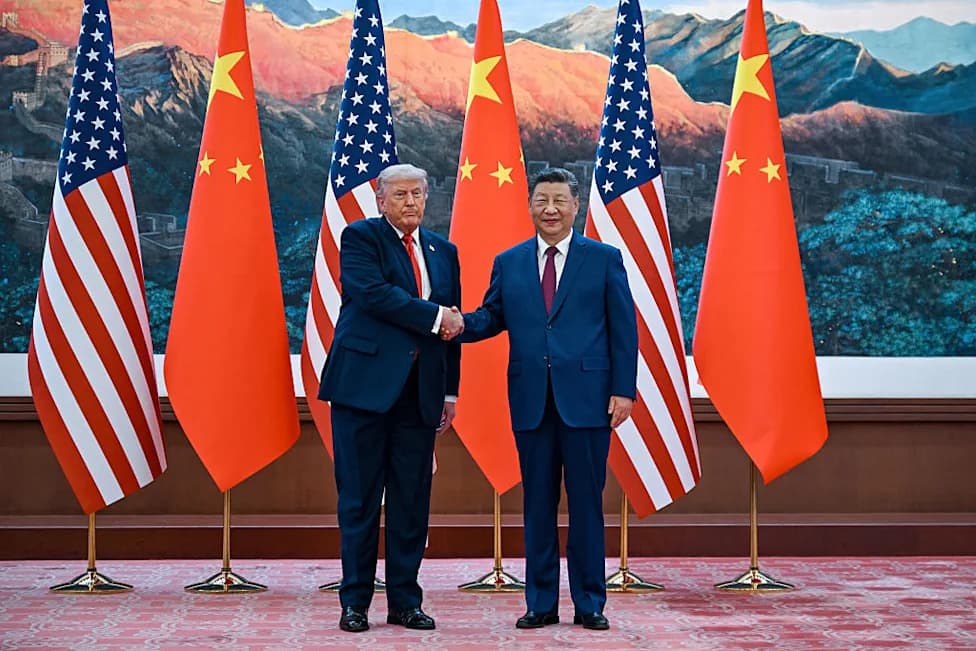
China has announced plans to further develop more than 11,000 islands it claims, describing the move as part of a long-term effort to strengthen maritime power, secure resources and reinforce territorial claims. The People's Daily urged upgrades to island infrastructure and connectivity, while Beijing continues expanding naval capabilities that date to Xi Jinping's 2012 policy agenda. Recent steps include declaring a nature reserve at Scarborough Shoal and maintaining year-round patrols from artificial bases, even as multinational drills led by the Philippines and the United States signal regional pushback.
China Plans Major Build-Up of Over 11,000 Islands to Strengthen Maritime Claims and Resources
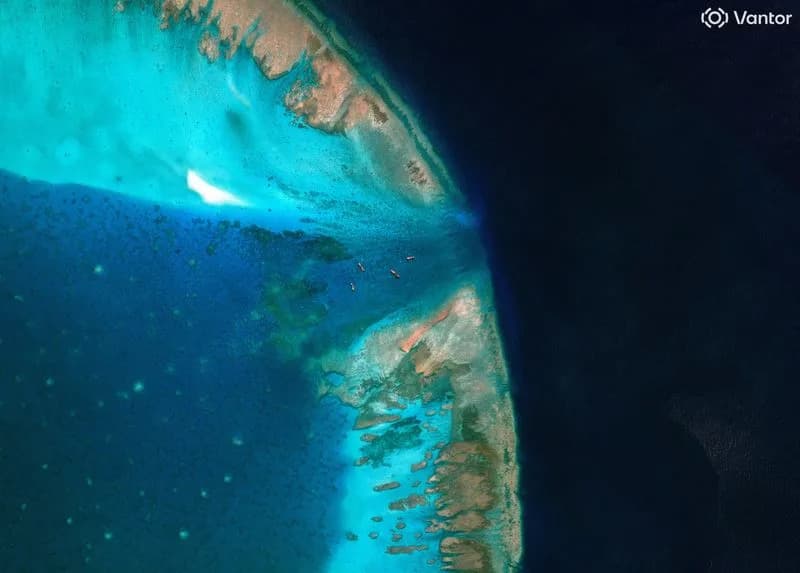
A satellite image of fishing vessels at the entrance, which is blocked by a floating barrier, to the disputed Scarborough Shoal, in the South China Sea, April 11, 2026. Vantor/Handout via REUTERS
BEIJING, April 23 (Reuters) - China announced on Wednesday plans to further develop more than 11,000 islands it regards as its own, framing the initiative as a long-term effort to improve governance, boost maritime power, secure natural resources and reinforce territorial claims.
Beijing has, over recent years, carried out extensive land reclamation across disputed waters in the South China Sea, constructing artificial islands, airstrips and facilities that critics say have a military purpose as well as civilian uses.
The People's Daily, the official newspaper of the Chinese Communist Party, published an article attributed to the party leadership at the Ministry of Natural Resources describing islands as a "strategic frontier" and a gateway to deep-ocean resources. The piece urged stepped-up protection of islands claimed by China through improved infrastructure, connectivity and access.
Naval Investment and Sovereignty Moves
China has poured billions into naval capabilities — from nuclear-powered submarines to aircraft carriers — in pursuit of a stated goal to become a "great maritime power," a policy priority under Xi Jinping since 2012. Last September, Beijing declared a national nature reserve at the disputed Scarborough Shoal, a move widely interpreted as an assertion of sovereignty over the atoll and a source of continued tension with the Philippines.
Regional Reactions and Activity
Gregory Poling of the Center for Strategic and International Studies (CSIS) said facilities on China’s artificial island bases have enabled Chinese law enforcement, naval and militia vessels to operate year-round, projecting presence up to 1,000 nautical miles from the Chinese coastline.
"The facilities on its artificial island bases have allowed Chinese law enforcement, naval, and militia vessels to spend every day of the year patrolling the waters of its neighbours up to 1,000 nautical miles from the Chinese coastline," said Gregory Poling.
Despite Beijing’s growing footprint in the South China Sea, rival claimants continue to act. A senior Taiwan official recently made a rare visit to Itu Aba (Taiping Island) in the Spratly chain; the island has a runway capable of supporting military resupply flights and a new wharf opened in 2023 that can host a 4,000-ton patrol ship.
This week, the Philippines, the United States and partner nations launched multinational military exercises across the Philippine archipelago, including maritime operations. The drills underline a collective response in a waterway that carries more than $3 trillion in annual ship-borne commerce.
Assessment
Analysts say China’s island-building and patrol activity have bolstered its ability to exert influence across the South China Sea, but some observers argue the strategy has delivered diminishing returns. Poling noted that Beijing "has not succeeded in stopping a single Southeast Asian energy project, resupply or construction mission, or the like, in at least four years."
Reporting by Ryan Woo and Xiuhao Chen; Editing by Clarence Fernandez.
Help us improve.