Republican lawmakers in Missouri, Oklahoma and South Dakota are pushing ballot measures to weaken or repeal voter‑approved Medicaid expansions. Proposed changes include adding work requirements, moving expansion from constitutional amendments into statutes, and allowing rollback if the federal matching rate falls under 90%. Supporters warn these moves would overturn voters’ decisions; proponents argue federal funding uncertainty and projected federal cuts justify reopening the question.
Republicans Move To Reopen Voter‑Approved Medicaid Expansions In Three States
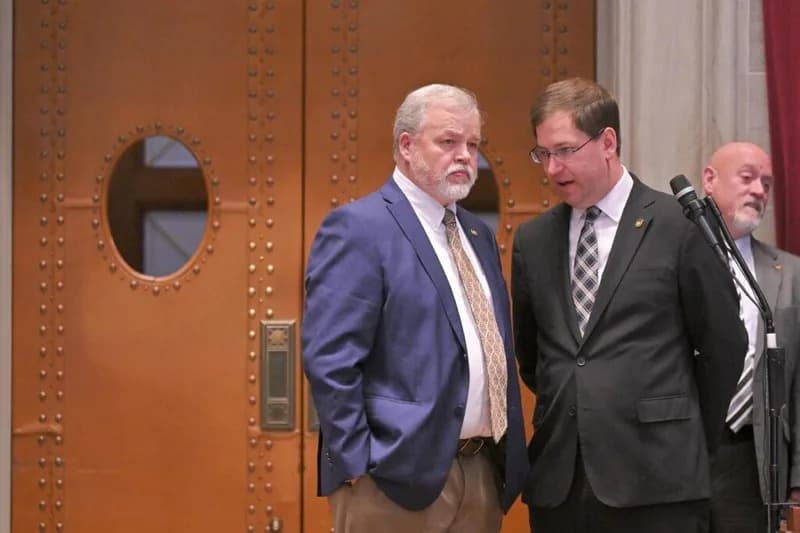
Missouri state Rep. Darin Chappell and House Majority Leader Alex Riley, both Republicans, confer in the Missouri House in March. Chappell is pushing a ballot measure proposal that would add work requirements for people covered under Medicaid expansion. Missouri is one of three states where GOP lawmakers want to ask voters to alter or scrap state constitutional amendments that expanded Medicaid. (Photo by Tim Bommel/Missouri House Communications)
Republican lawmakers in Missouri, Oklahoma and South Dakota are pursuing ballot measures that would weaken or undo Medicaid expansion provisions voters enshrined in state law. The proposals include adding work requirements, converting constitutional amendments into statutes, and allowing expansion to lapse if the federal matching rate falls below 90%.
Background
Voters in Missouri (2020), Oklahoma (2020) and South Dakota (2022) approved constitutional amendments to expand Medicaid under the Affordable Care Act, guaranteeing coverage for adults under age 65 who earn up to 138% of the federal poverty level — roughly $22,024 a year. Those state amendments were designed to bypass opposition in GOP-controlled legislatures.
What Lawmakers Are Proposing
The measures lawmakers are advancing differ by state but share a common goal: give legislatures more control or create conditions for rolling back expansion.
Oklahoma
Legislators are considering two possible ballot questions: one to remove the expansion from the state constitution and place it in statute, making it amendable by lawmakers; another to make expansion contingent on the federal Medicaid match remaining at or above 90%. Officials are debating whether to combine the two proposals for a special August election or include them on the regular November ballot.
South Dakota
Voters will face a proposed amendment change on the November ballot that would allow the state to end expansion if the federal matching rate drops below 90%.
Missouri
Missouri’s proposal is more complex. After voters approved expansion, the legislature initially refused to fund it and the state supreme court later ordered the legislature to pay for the program, citing amendment language that forbids adding "greater or additional burdens or restrictions" on expansion beneficiaries. The measure Republican lawmakers drafted would add work requirements mirroring federal rules enacted last summer and would delete the protections the court cited — language Democrats say would enable lawmakers to defund expansion.
"Most importantly, it’s actually taking away voter power, because the voters of Oklahoma have already decided this issue," said Amber England, who helped campaign for expansion in Oklahoma.
Federal Context And Funding Concerns
Under the Affordable Care Act’s Medicaid expansion, the federal government has covered 90% of the cost for newly eligible enrollees. Recent federal legislation cited by proponents of rollback is projected by the Congressional Budget Office to reduce federal Medicaid spending significantly over the next decade, and it includes new work requirements that advocates say will push people off rolls. That uncertainty over long-term federal funding is a central argument among lawmakers pressing to revisit expansion.
What’s At Stake
Supporters of expansion argue that returning these measures to the ballot would violate voters’ intent and put thousands at risk of losing coverage. Opponents counter that changing federal funding and projected costs justify reconsideration. The Fairness Project and other organizations that helped place the original measures on the ballot warn that converting expansion to statute or weakening constitutional language would effectively nullify the voter mandate.
Other states have used ballot initiatives to expand Medicaid without amending constitutions (Idaho, Maine, Nebraska and Utah). Several states have laws that would automatically end expansion if the federal match falls below 90% — including Utah, Arizona, Arkansas, Illinois, Indiana, Montana, New Hampshire, North Carolina and Virginia.
Stateline reporter Shalina Chatlani contributed reporting. For follow-up reporting, contact [email protected] or [email protected].
Help us improve.