The 2026 Breakthrough Prizes (US$3 million each) honored international teams for ultrahigh-precision measurements of the muon’s magnetic moment and several transformative gene-therapy advances. Fermilab, CERN and Brookhaven collaborators measured the muon’s g-factor to 127 parts per billion, but differing theoretical methods (lattice-QCD versus data-driven approaches) leave interpretation unsettled. Luxturna’s creators were recognized for restoring navigation and low-light vision in patients with RPE65-related retinal disease, while discoveries linking C9ORF72 to both FTD and ALS and identifying BCL11A as a target for sickle-cell therapies also won major prizes.
Muon Magnetic-Moment Precision and Gene-Therapy Milestones Share US$3 Million Breakthrough Prizes
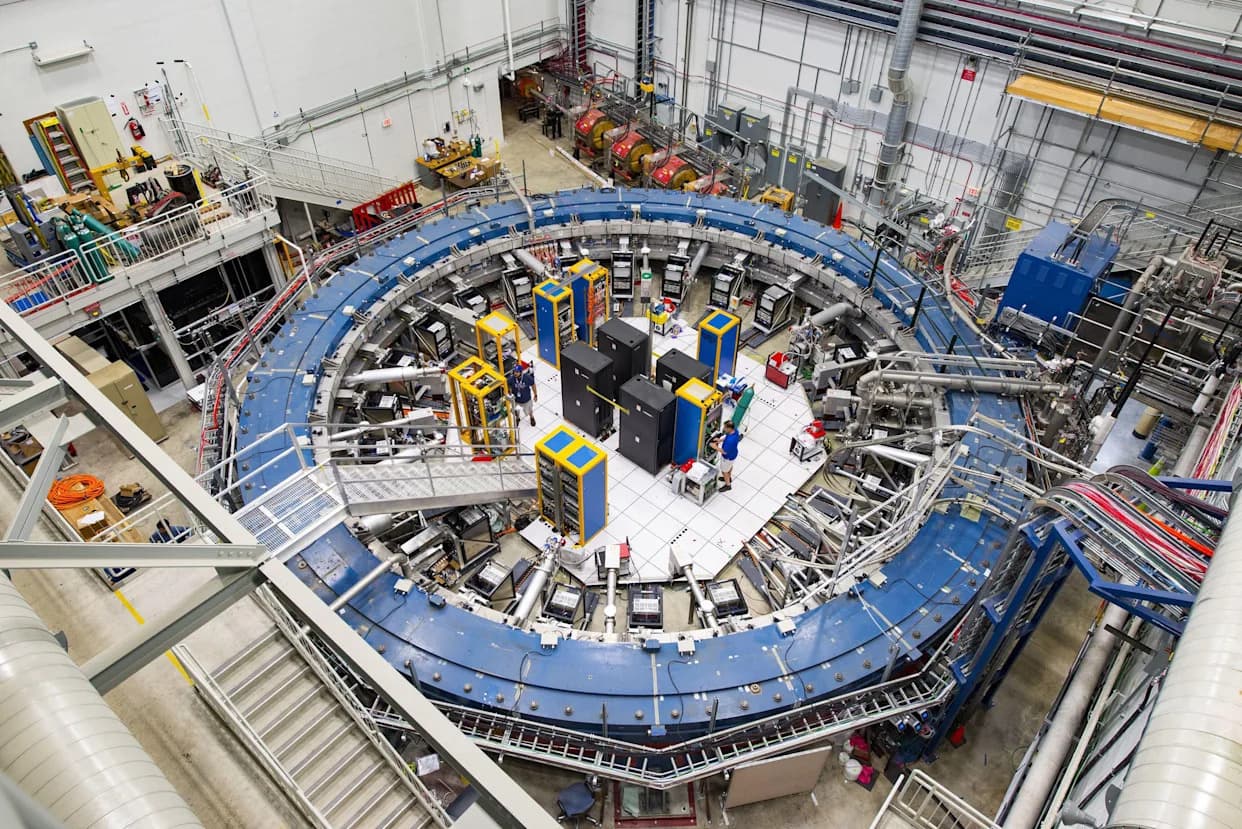
The Muon g−2 ring sits in its detector hall amidst electronics racks, the muon beamline, and other equipment at Fermi National Accelerator Laboratory in Batavia, Ill.(Reidar Hahn/Fermi National Accelerator Laboratory/DOE/UPI/Alamy Stock Photo)
Researchers behind ultra-precise measurements of the muon’s magnetic moment and teams responsible for major gene-therapy advances were among the recipients of this year’s US$3 million Breakthrough Prizes, announced on 18 April 2026.
Muon Measurement: Extraordinary Precision, Lingering Questions
Collaborators at Fermilab (Batavia, Illinois), CERN (near Geneva) and Brookhaven National Laboratory (New York) were honored for a long-running effort to pin down the muon’s magnetic moment — a tiny wobble in a magnetic field described by the particle’s g-factor. Fermilab’s final results, published last year, reported the muon’s g-factor with a precision of 127 parts per billion.
Although the experimental measurements line up with one set of theoretical predictions from the standard model, the interpretation remains unsettled. As David Hertzog, a Fermilab nuclear physicist, cautions, two independent theoretical approaches used to compute the standard-model prediction — broadly characterized as lattice-QCD calculations and data-driven dispersive methods — still disagree substantially. That tension keeps the door open for further study rather than declaring the question closed.
"It is astonishing that human beings can measure anything to such precision," said Tsutomu Mibe of Japan’s KEK laboratory, praising the international collaboration. The monetary prize will be shared among the several hundred scientists who contributed to the experiments.
Gene-Therapy Awards: Restoring Sight, Linking Diseases, Treating Blood Disorders
Three life-science prizes recognized landmark advances in gene-based medicine. Ophthalmologists Jean Bennett and Albert Maguire and physician Katherine High (all at the University of Pennsylvania) were honored for developing Luxturna, the first FDA-approved gene-augmenting therapy for an inherited retinal disease caused by mutations in the RPE65 gene.
In healthy vision, photons activate a molecule called 11-cis-retinal, which changes shape as part of phototransduction. In people with two defective RPE65 copies, that molecule stays deformed and progressive vision loss follows. Luxturna delivers a working RPE65 gene to retinal cells via an adeno-associated virus. Patients who received the treatment showed marked improvements in navigation and low-light vision within about 30 days, according to Katherine High.
Omar Mahroo of University College London called Luxturna "transformative" for a previously untreatable form of blindness and a paradigm shift for future ocular gene therapies.
Genetic Links and Gene-Editing Therapies
Neurogeneticist Rosa Rademakers (University of Antwerp) and neurologist Bryan Traynor (US National Institute on Aging) shared a prize for independently discovering that a mutation in the C9ORF72 gene can cause both frontotemporal dementia (FTD) and motor neuron disease, including amyotrophic lateral sclerosis (ALS). The finding was unexpected because FTD primarily affects the brain while motor neuron disease targets the spinal cord; understanding the shared mechanism remains a major research challenge.
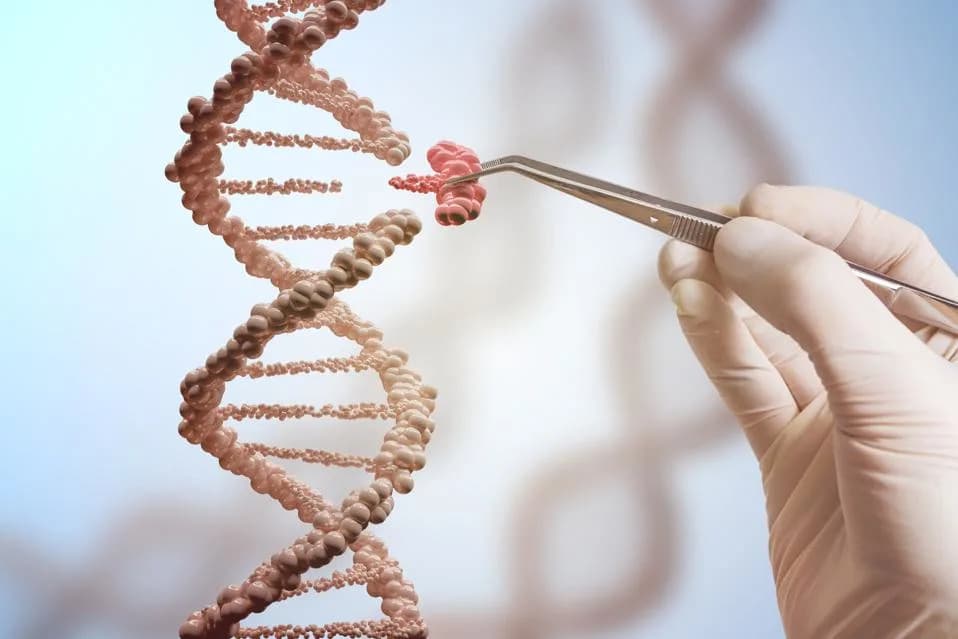
The final life-science award went to Stuart Orkin (Boston Children’s Hospital) and Swee Lay Thein (US National Heart, Lung, and Blood Institute) for identifying the role of the BCL11A gene in switching fetal haemoglobin to the adult form. Their work validated BCL11A as a therapeutic target and helped underpin Casgevy, the first FDA-approved gene-editing therapy for sickle-cell disease and β-thalassaemia.
Mathematics and Fundamental Physics
Frank Merle (CY Cergy Paris University) won the Breakthrough Prize in Mathematics for geometric methods that illuminate so-called "blow-up" behavior in nonlinear equations. His work shows how seemingly chaotic solutions can evolve into stable structures such as solitons, with implications across quantum physics and fluid dynamics.
Physicist David Gross (University of California, Santa Barbara) received a Special Breakthrough Prize in Fundamental Physics for his contributions to understanding the strong nuclear force, his work on string theory and long-standing advocacy for international scientific collaboration.
This article was reproduced with permission and was first published on April 18, 2026.
Help us improve.