
Machado aligned with Spain’s right on economic policy but avoided the Spanish government. She met leaders from the People’s Party and Vox in Madrid, receiving civic honors, yet analysts highlight deep social and organisational differences—particularly on abortion and the Venezuelan opposition’s cohesion. The trip signalled tactical international support but raised questions about Machado’s readiness for presidential-level diplomacy.
Machado Courts Spain’s Right: Economic Alignment Amid Clear Social Fault Lines
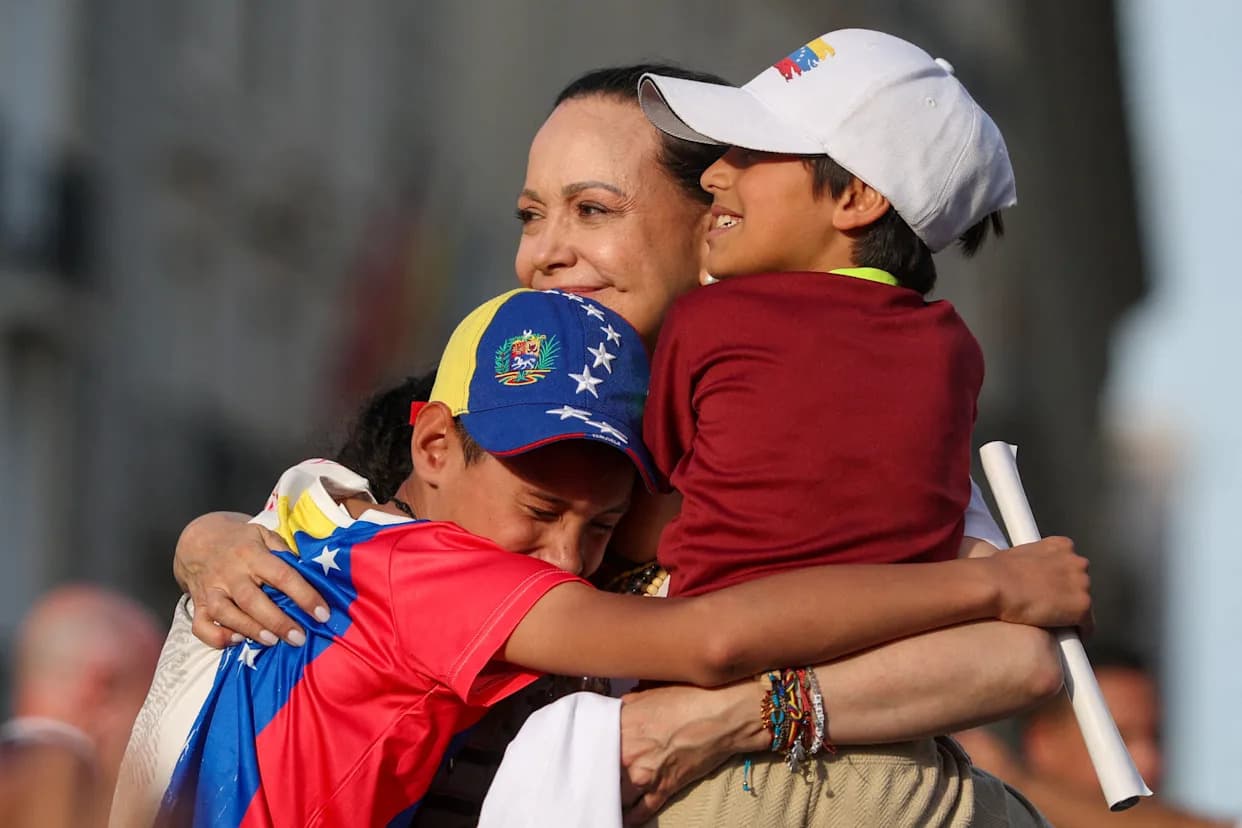
Venezuelan opposition leader Maria Corina Machado embraces children as she attends a rally with supporters, during her visit to Madrid, Spain, April 18, 2026 [Isabel Infantes/Reuters]
Madrid — Venezuelan opposition leader Maria Corina Machado used a high-profile visit to Spain to deepen ties with the country’s main right-wing parties, embracing shared economic views while making clear the limits of that alliance on social issues, analysts say.
Machado declined an invitation to meet Prime Minister Pedro Sánchez and other officials from Spain’s left-wing coalition, saying she did not want to engage while Sánchez hosted a summit of left-leaning Latin American leaders in Barcelona. “What has transpired in the past few hours at the meeting held in Barcelona with various political leaders from different countries is proof that such a meeting was not advisable,” she told a gathering in Madrid.
Instead, Machado held a series of talks with leaders of the conservative People’s Party (PP) and the far-right Vox party. On Friday she received an enthusiastic reception from PP leader Alberto Núñez Feijóo and Venezuelan émigrés in Madrid. The following day she met Isabel Díaz Ayuso, the populist conservative head of Madrid’s regional government, who presented Machado with Madrid’s gold medal. Madrid Mayor José Luis Martínez-Almeida, also of the PP, handed Machado the keys to the city ahead of a rally with Venezuelan supporters. Machado also met Santiago Abascal, leader of Vox.
Feijóo praised Machado’s commitment to freedom, saying she had defended liberty even at personal cost. “Spain knows well the value of freedom; it cost us dearly to obtain it. The generations of our parents and grandparents know what it is to live without freedom. That is why we cannot look the other way,” he said.
Despite the warm reception, commentators stress meaningful differences between Machado and Spain’s main conservative leadership. Often described as a liberal conservative and nicknamed Venezuela’s “Iron Lady,” Machado has admired Margaret Thatcher and moved toward the centre during Venezuela’s 2024 presidential campaign to broaden her appeal. Her coalition also includes more liberal factions, and analysts describe the Venezuelan opposition as fragmented compared with Spain’s more institutionalized PP.
“Machado is the leader of a small, disorganised opposition, while Feijóo is the head of the PP, which is a well-organised national political party,”
said Carlos Malamud, a Latin America expert at the Real Instituto Elcano in Madrid. Malamud added that Machado’s refusal to meet Sánchez did not project the sort of diplomatic flexibility expected of a presidential contender: “If Machado wants to be the president of Venezuela next year, she needs to be prepared to meet the head of the Spanish government, whoever that may be.”
The visit also highlighted convergences: analysts note Machado shares Spanish conservatives’ liberal economic outlook—favoring free trade and a smaller state—positions that align her with both Feijóo and Díaz Ayuso on economic policy. Yet on social issues the alignment breaks down. Ana Ayuso, a Latin America researcher at the Barcelona Centre for International Affairs, said Machado is more socially conservative: she opposes abortion broadly, is close to the Roman Catholic Church, and places greater emphasis on religious values than many Spanish conservative leaders.
In a 2024 interview with El País, Machado said she is generally opposed to abortion but would support changing Venezuela’s law to permit abortion in cases of rape. Venezuela’s current law allows abortion to protect the life of the mother or child; other terminations are illegal and can carry prison sentences.
Observers also noted Machado’s shifting international alignments. Ayuso said Machado initially courted support from circles aligned with former US President Donald Trump but later lost that backing when influential US conservatives endorsed other Venezuelan figures. Machado has since cultivated ties with US Senator Marco Rubio and other US policymakers who have supported her cause.
Finally, the role of former Spanish prime minister José Luis Rodríguez Zapatero—who has acted as a mediator with Nicolás Maduro’s government—remains contentious among Venezuelan opposition figures. Maduro has been indicted in the United States on drug- and corruption-related charges, which he denies; Zapatero’s mediation has drawn criticism from some opposition leaders who view his engagement as too conciliatory.
The Madrid visit underscored both the tactical benefits of international outreach for Machado and the limits of ideological convergence: strong agreement on economic policy, but clear and consequential divergence on social values and on the diplomatic stance toward Maduro’s government.
Help us improve.





















