A team of undergraduates at the University of Hamburg built a compact copper resonant cavity and operated it inside a 14 T superconducting magnet to search for axion dark matter near 16.6 µeV. Over a 71-hour campaign (effective 54.4 hours) they recorded 1.82 billion spectra but found no statistically significant signal. Their null result sets 95% confidence exclusions on axion-photon couplings down to 2.8 × 10⁻¹³ GeV−1 at peak sensitivity, improving previous limits in that narrow mass window and demonstrating that small, focused experiments can make meaningful contributions.
Undergraduates Build Compact Cavity Detector That Tightens Constraints on Axion Dark Matter
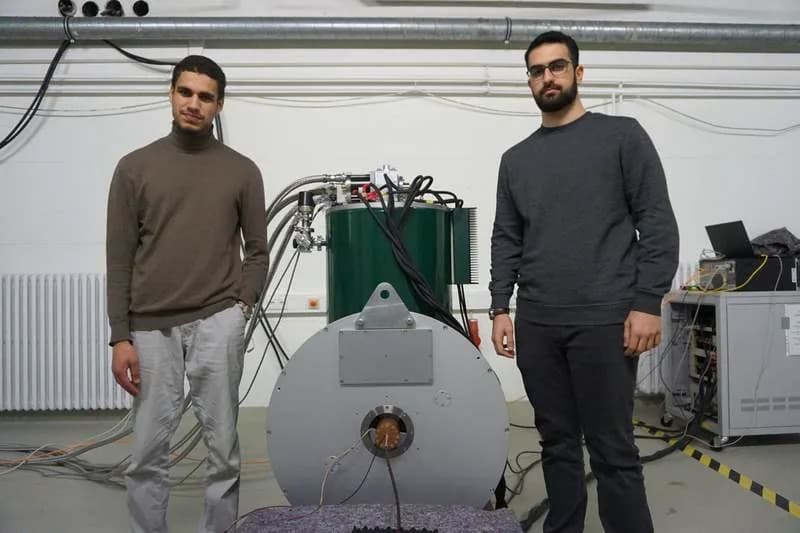
Salama (left) and Akgümüs (right) with the experimental apparatus. (CREDIT: Nabil Salama and Agit Akgümüs
Dark matter is thought to permeate the Milky Way and outnumber ordinary matter by a large margin, yet no direct detection has been confirmed. Against the backdrop of massive, high-cost collaborations, a team of undergraduate students at the University of Hamburg took a different approach: they built a compact resonant cavity detector and used it inside a powerful magnet to probe a narrow slice of the axion dark matter parameter space.
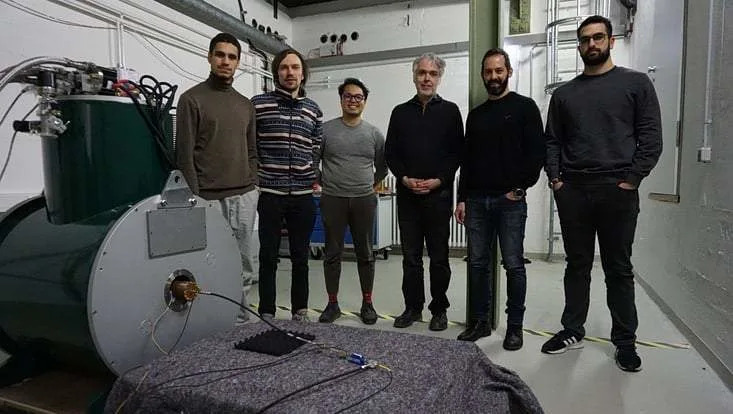
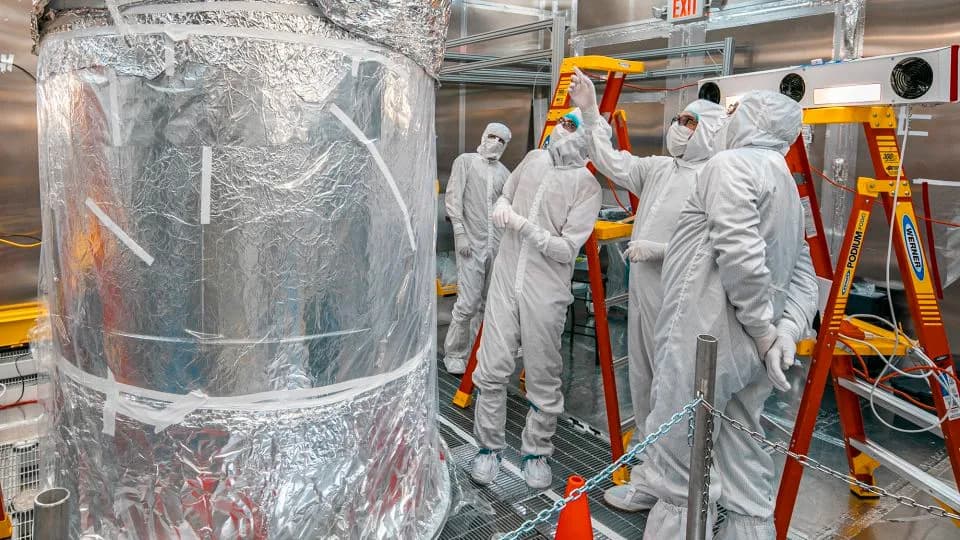
The project team with Dr. Le Hoang Nguyen (third left), Prof. Dr. Dieter Horns (middle) and Dr. Marios Maroudas (second right) who supported SPACE by operating the magnet. (CREDIT: AG Garutti)
Student-Led Experiment With Big Implications
The student team assembled a simplified but carefully engineered cavity detector from highly conductive copper, integrated it with receiver electronics and measurement instruments, and operated the apparatus in a superconducting solenoid magnet reaching 14 tesla. The work was supported by a student research grant through the University of Hamburg's Hub for Cross-disciplinary Learning, funding and equipment access from the Quantum Universe Cluster of Excellence, and technical guidance from researchers involved with the larger MADMAX experiment.
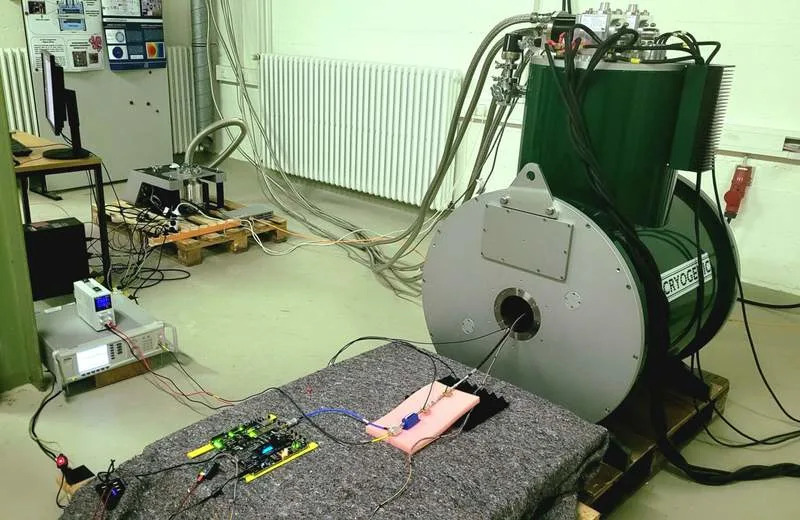
The experimental apparatus built and used by students at the University of Hamburg. (CREDIT: Nabil Salama and Agit Akgümüs)
Design and Measurement
The core device was a cylindrical cavity with an inner radius of about 28.5 mm and a length of 280 mm. It was tuned to resonate at 4.023 GHz—corresponding to an axion mass near 16.6 µeV. Over a 71-hour campaign (19–22 April 2024) the team recorded 1.82 billion power spectra, which equated to an effective measurement time of 54.4 hours after accounting for sampling details and dead time.
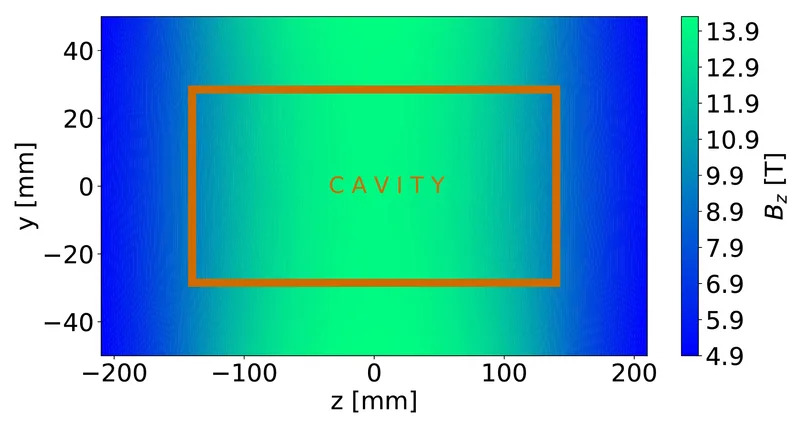
Magnetic field strength obtained from simulation inside and around the cavity (orange box) placed around z = 0 such that the peak field strength of 14T is achieved inside the cavity. (CREDIT: Journal of Cosmology and Astroparticle Physics)
Analysis and Results
Each spectrum was processed to remove smooth backgrounds, and weighted averaging was used to combine scans. The largest local excess in the raw scan reached 3.24σ, but after accounting for the full search (trials factor) the global significance fell to 0.84σ—a 20.1% probability that the excess arose from random fluctuations. In plain terms, no convincing axion signal was observed.
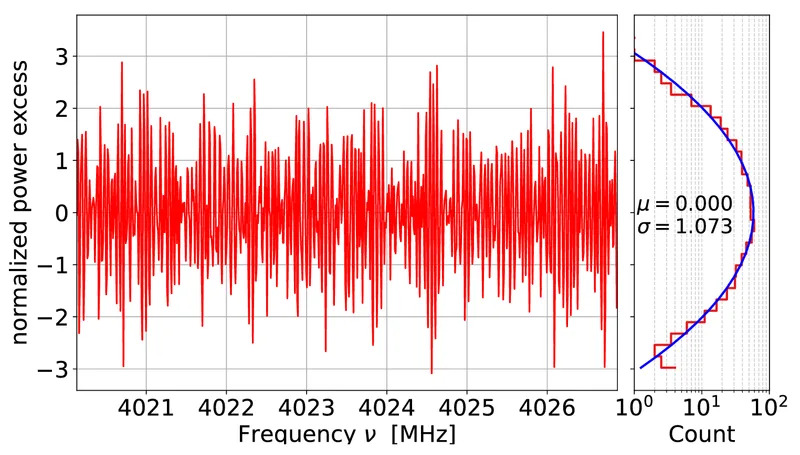
Normalized power excess (grand spectrum) as a function of frequency. No significant excess is detected. (CREDIT: Journal of Cosmology and Astroparticle Physics)
Because the result was null, the team set exclusion limits at 95% confidence: axion-photon couplings greater than 14.6 × 10⁻¹³ GeV−1 are excluded across the mass interval 16.626–16.653 µeV. At the experiment's peak sensitivity the limit tightens to 2.8 × 10⁻¹³ GeV−1. These constraints improve on previous bounds in the same mass window (for example, the CAST limit) by more than two orders of magnitude and bring this compact setup within a factor of 44 of the KSVZ benchmark sensitivity commonly cited in axion searches.
“The detector we built is essentially the simplest version of a cavity detector for dark matter,” said Nabil Salama, one of the authors and now an M.Sc. student in physics at the University of Hamburg.
Why This Matters
Null results are an essential part of experimental physics: they narrow the parameter space and help guide future searches. This student-led project demonstrates that a well-designed, small-scale experiment can produce competitive, publishable results and meaningfully inform the broader search for axion dark matter. Reviewers even suggested that once the axion mass is known, simplified versions of such setups could become feasible teaching-lab experiments.
The full research article is available in the Journal of Cosmology and Astroparticle Physics.
Help us improve.