Researchers treated the Earth–ionosphere cavity as a resonant detector and searched British Geological Survey magnetic-field data (2012–2022) for dark-matter signatures. They report 65 axion candidates (25 after tighter cuts) and up to 342 dark-photon candidates (31 after stronger filtering). Because the dataset comes from a single UK observatory, global measurements are needed to distinguish axions (which should vary with Earth's magnetic field) from dark photons (which would be uniform).
Scientists Turned Earth Into a Giant Dark-Matter Detector — Dozens of Unexplained Signals Found

(NASA Earth Observatory image by Joshua Stevens, using Suomi NPP VIIRS data from Miguel Román, NASA's Goddard Space Flight Center)
Physicists have repurposed the planet itself to hunt for dark matter, treating the cavity between Earth's surface and the ionosphere as a natural resonant detector. In a clever analysis of decade-long magnetic-field records, researchers report dozens of unexplained candidate signals that match theoretical predictions for two leading dark-matter candidates: axions and dark photons.
YouTube Thumbnail
How the Method Works
The idea rests on the Earth–ionosphere cavity acting like a giant electromagnetic resonator. If a population of axions or dark photons streams through Earth, they may induce extremely faint electromagnetic waves at frequencies set by the particles' masses. Because decades of prior work constrain likely axion masses to a relatively narrow band, the team focused on that specific frequency window.

Subscribe to ScienceAlert's free fact-checked newsletter
"We asked ourselves whether we could use the Earth itself as a giant detector," said theoretical physicist Atsushi Taruya, an author on the four papers. "The Earth–ionosphere cavity acts as a natural resonator that amplifies electromagnetic waves right around the mass range we wanted to probe."
What the Team Found
The researchers analyzed magnetic-field data recorded by the British Geological Survey from 2012–2022 at a UK observatory. After removing known backgrounds and noise, their axion search produced 65 candidates under initial selection criteria and 25 candidates after applying stricter statistical cuts. A separate search using similar techniques for dark photons returned up to 342 candidates with loose criteria, narrowing to 31 with stronger signal-to-noise thresholds.
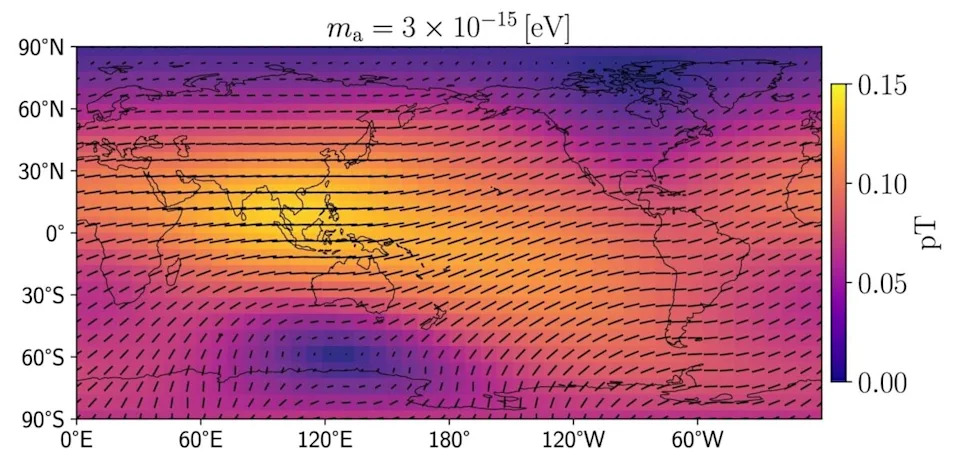
A map showing where axion signals (for a certain mass of axion) should be strongest (yellow) to weakest (purple), according to the strength of Earth's magnetic field. (Taruya et al.,PTEP, 2026)
Axions vs. Dark Photons — How To Tell Them Apart
Axions and dark photons would both produce weak electromagnetic signatures, but they have a key difference: axion-induced signals require Earth's magnetic field to convert into detectable photons, so the signal amplitude should vary with geomagnetic strength. Dark-photon signals would not depend on the geomagnetic field and therefore should appear with similar strength everywhere.
That difference suggests a straightforward test: coordinated measurements from many observatories distributed worldwide. If candidate signals scale with local magnetic-field strength (for example, weaker near the poles and stronger in regions like Southeast Asia), that would favor axions. If the signals are uniform worldwide, dark photons become a more likely explanation.
Limitations and Next Steps
Crucially, the current analysis relies on data from a single observatory in the United Kingdom, so it cannot test the predicted spatial variation. The candidates therefore require independent confirmation and careful exclusion of terrestrial or instrumental origins. The authors emphasize that their approach is a low-cost, complementary strategy to astronomical searches and lab experiments but that follow-up global measurements and cross-checks are essential before claiming a discovery.
Publication notes: The three axion papers appeared in Progress of Theoretical and Experimental Physics (PTEP), and the dark-photon analysis was published in Physical Review D.
Help us improve.