Vice President JD Vance publicly endorsed Hungarian Prime Minister Viktor Orbán during an official state visit, urging supporters to vote for him despite claiming not to influence the election. The endorsement reflected coordination at the highest levels of the Trump-aligned U.S. political network, yet Orbán suffered a clear defeat to opposition leader Peter Magyar. The episode highlights debates over foreign electoral intervention—research shows such efforts can shift vote shares modestly, but they cannot create genuine domestic support where it does not exist.
Opinion: Vance Acts as Trump’s Foreign Election Surrogate — U.S. Endorsement Fails to Deliver in Hungary
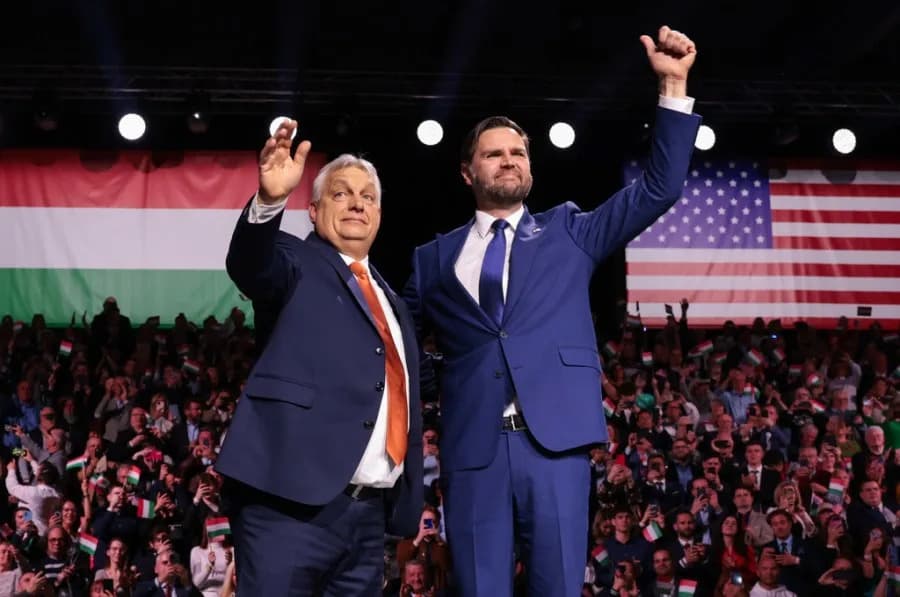
Seeing the vice president of the United States actively campaigning for the re-election of a foreign leader feels strikingly out of step with diplomatic norms. During an official two-day state visit to Hungary last week, Vice President JD Vance delivered an emphatic endorsement of Hungarian Prime Minister Viktor Orbán ahead of the country’s parliamentary vote.
Vance repeatedly told reporters he was not in Hungary to tell Hungarians how to vote, but his comments to a crowd of roughly 5,000 Orbán supporters at Budapest’s MTK Sportpark undercut that claim. He asked, “Will you stand for sovereignty and democracy, for truth and for the God of our Forefathers?” and then urged the crowd: “Then, my friends, go to the polls this weekend and stand with Viktor Orbán, because he stands for you, and he stands for all these things.”
Top-level U.S. coordination: The visit and public endorsement mirrored messaging from the highest levels of the Trump-aligned U.S. political network. In March, former President Donald Trump posted a social media video titled “A Complete and Total Endorsement” backing Orbán’s re-election. In February, Secretary of State Marco Rubio visited Hungary with a similar message. On election day, Donald Trump Jr. used X to urge “friends in Hungary” to back “my father’s good friend and ally” Orbán.
Despite those high-profile appeals for Orbán and his Fidesz party, the prime minister suffered a decisive defeat and soon conceded to opposition Tisza party leader Peter Magyar, acknowledging the results were “clear.”
Accusations of foreign interference and the EU response: In a joint press conference with Orbán, Vance accused the European Union of meddling in Hungary’s election, calling it “one of the worst examples of foreign election interference I have ever seen or even read about.” He was referring to EU financial penalties imposed over perceived backsliding on democratic norms—measures Vance framed as punitive, saying “the bureaucrats in Brussels have tried to destroy the economy of Hungary.” That framing overlooked the fact that the EU has been a major partner in Hungary’s economy for decades.
EU spokesman Thomas Regnier responded by stressing that “in Europe, elections are the sole choice of the citizens.” Peter Magyar also posted that “No foreign country may interfere in Hungarian elections. This is our country.”
“Gentlemen don’t read each others’ mail.” The oft-cited 1946 remark attributed to former Secretary of State Henry L. Stimson reflects a diplomatic norm: states should avoid overt interference in one another’s internal political contests. That norm frayed during the Cold War as espionage and covert meddling became more common, but it remains a touchstone in debates over contemporary conduct.
What the research shows: Political scientists refer to such activities as foreign electoral interventions—efforts by one government to influence another country’s vote. In his 2020 book Meddling in the Ballot Box, Dov H. Levin reports that between 1946 and 2000 the United States intervened in more national-level competitive executive elections than any other country. Of 938 contests studied, Levin finds the U.S. intervened in 81 and the Soviet Union or Russia in 36; together they influenced 117 elections—roughly one in nine—with about 68% of interventions conducted covertly rather than openly.
Levin concludes that interventions often matter: on average, interventions favoring one side raise vote share by about 3 percentage points—an effect that could have changed outcomes in many tight races. Scholars continue to debate the magnitude and real-world impact of specific cases, such as alleged Russian interference in the 2016 U.S. presidential contest.
Bottom line: I remain skeptical about heavy reliance on raw polling to quantify precisely how much external efforts alter voter behavior in any given contest. What the Trump-aligned outreach to Hungary demonstrated, however, is clear: vigorous foreign backing cannot manufacture domestic support where it does not already exist. The defeat of Orbán despite high-profile U.S. endorsements underlines the limits of external intervention in shaping electoral outcomes.
About the author: Don Wolfensberger is a 28-year congressional staff veteran whose career culminated as chief of staff of the House Rules Committee in 1995. He is the author of Congress and the People: Deliberative Democracy on Trial (2000) and Changing Cultures in Congress: From Fair Play to Power Plays (2018).
Copyright 2026 Nexstar Media, Inc. All rights reserved. This material may not be published, broadcast, rewritten, or redistributed. For the latest news, weather, sports, and streaming video, head to The Hill.
Help us improve.