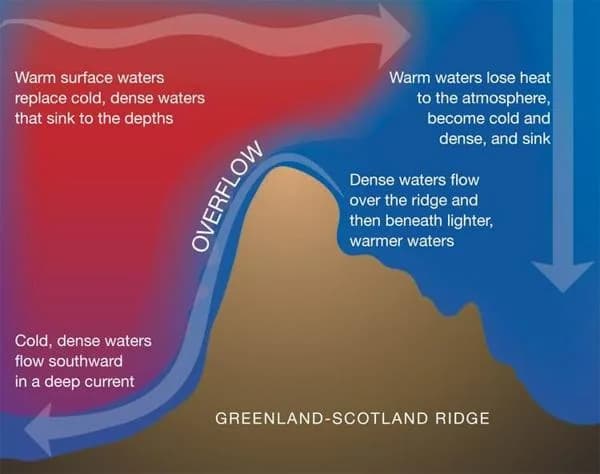
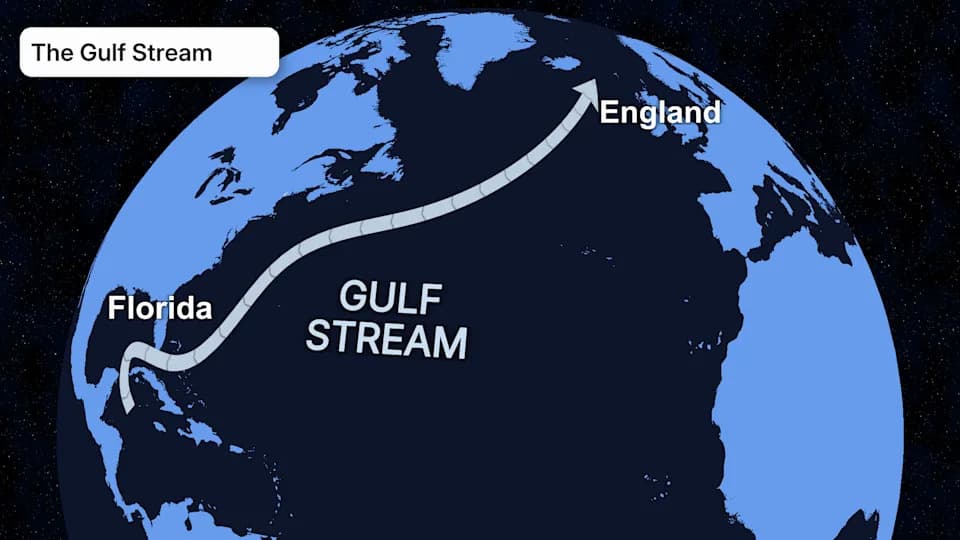
Two new studies strengthen evidence that the Atlantic Meridional Overturning Circulation (AMOC) is weakening and may be closer to a potential collapse than previously thought. A Science Advances analysis combining observations and models finds the AMOC could slow by more than 50% by 2100 — about 60% more weakening than the model average. Independent mooring data from the University of Miami show declines at four latitudes since 2004, reinforcing concerns that the system is moving toward a tipping point with major climate impacts.
Alarm Raised: Atlantic 'Conveyor Belt' (AMOC) Is Weakening — Collapse May Be Closer Than Thought
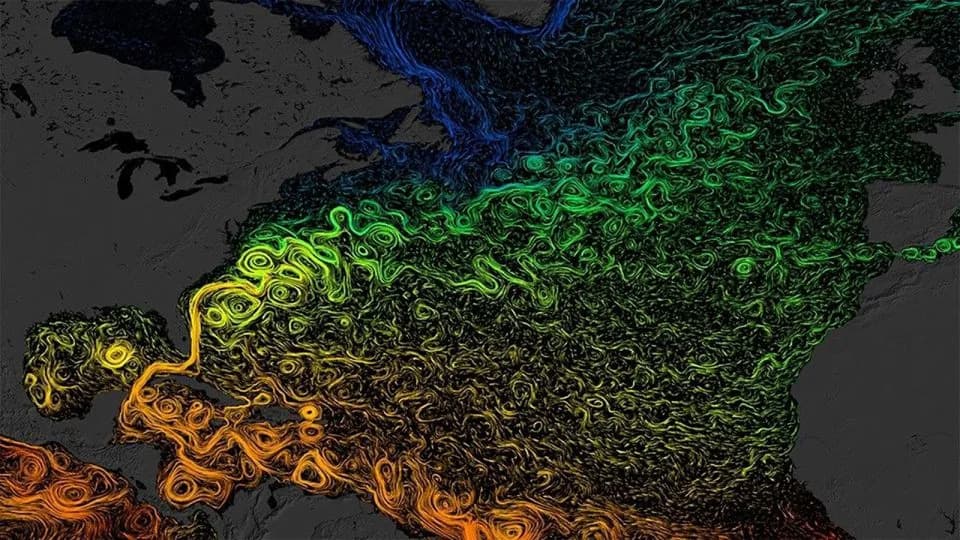
Visualization of ocean currents in the North Atlantic. The colors show sea surface temperature, where orange and yellow are warmer, green and blue are colder. - NASA Goddard Space Flight Center
Two new studies add striking evidence that the Atlantic Meridional Overturning Circulation (AMOC) — the ocean's vast "conveyor belt" that transports heat, salt and freshwater around the Atlantic — is weakening and may be closer to a catastrophic collapse than previously believed. Such a shutdown would have profound consequences for global climate, weather patterns and sea levels.
What the studies found
The first study, published in Science Advances, combined climate-model simulations with observational datasets (temperature, salinity and other ocean measurements) to project the AMOC's trajectory over coming decades. The authors conclude many models likely underestimate the decline: the AMOC could slow by more than 50% by 2100 — a weakening roughly 60% greater than the mean decline suggested by the set of climate models examined.
The second study, from researchers at the University of Miami, focuses on current observations. Using four long-running moorings along the western boundary of the North Atlantic that have measured temperature, salinity and current velocity since 2004, the team found consistent AMOC weakening at four different latitudes over the past two decades. Detecting concurrent declines at multiple sites strengthens the case that the circulation is losing strength in reality — not just in models.

People load water containers onto an animal in a drought-affected area of Kenya in August 2025. The collapse of the AMOC would bring catastrophic impacts including prolonged droughts across a swath of Africa. - Gerald Anderson/Anadolu/Getty Images
“The findings are important and concerning,” said Stefan Rahmstorf, an oceanographer at Potsdam University who was not involved in the studies. He noted that the models showing stronger weakening may be closer to reality and warned the AMOC could reach a tipping point by mid-century.
Why this matters
An AMOC collapse would reshape regional and global climates. Potential impacts include much colder winters in Europe, accelerated sea-level rise along the U.S. East Coast, and prolonged droughts across large parts of Africa. The last major AMOC shutdown occurred roughly 12,000 years ago; a similar event today would be highly disruptive.
Important caveats
Monitoring of the AMOC has been continuous only since about 2004, and the system is complex. The Science Advances analysis highlights additional uncertainty: many climate models still do not fully include projected meltwater input from Greenland, which could further weaken the AMOC if added. That omission means the studies' projections could be conservative.

Disko Bay, Greenland, on March 15, 2026. Melting ice is disrupting the balance of salinity that drives the AMOC. - Florent Vergnes/AFP/Getty Images
Expert interpretation
Shane Elipot, a physical oceanographer at the University of Miami and co-author of the observational study, described the western-boundary moorings as a "canary in a coal mine" for the broader circulation. René van Westen of Utrecht University called the observational results "strong evidence" the present-day AMOC is declining and cautioned that each incremental weakening raises the risk of passing a critical tipping threshold.
Bottom line
Both studies — one projecting the AMOC's future with a corrected model-to-observation approach, the other documenting recent real-world weakening — point in the same worrying direction: the AMOC is declining and the risk of a large, potentially irreversible shift appears higher than many previous projections suggested.
Help us improve.