The Wall Street Journal reports that U.S. intelligence assessments contradict Defense Secretary Pete Hegseth’s claims that Iran’s missile and air capabilities were obliterated. Officials say Iran still possesses thousands of ballistic missiles—including over 1,000 medium-range missiles—that could be recovered from underground storage. While U.S. and Israeli officials acknowledge major damage to launchers and facilities, intelligence suggests many systems may be repairable. The White House says objectives were met; the Pentagon declined to comment.
Leaked Intel Challenges Defense Secretary Hegseth’s Claims About Iran’s Missile Losses

Pete Hegseth has repeatedly declared U.S. domination of Iran—contrary to leaked intelligence assessments. / REUTERS
Leaked U.S. intelligence assessments published by The Wall Street Journal appear to contradict Defense Secretary Pete Hegseth’s public assertions that Iran’s missile and air capabilities have been effectively destroyed. Officials familiar with the intelligence say Iran still retains thousands of ballistic missiles that could be recovered from concealment or underground storage.
What The Intelligence Says
According to the report, while U.S. strikes have damaged or rendered unusable a significant portion of Iran’s missile infrastructure, large numbers of missiles and launchers remain recoverable. American and Israeli officials told the Journal that although Iran’s missile inventory may have been roughly halved, the country still holds thousands of medium- and short-range ballistic missiles—more than 1,000 medium-range missiles of an estimated 2,500 it had before the conflict.
"Their missile program is functionally destroyed, launchers, production facilities, and existing stockpiles depleted and decimated and almost completely ineffective," Hegseth told reporters, also asserting that "Iran’s air force has been wiped out."
U.S. intelligence, the Journal reports, paints a more cautious picture: many launchers described as damaged, destroyed, or trapped underground could potentially be repaired or extracted from subterranean facilities. That raises the possibility that Iran could reconstitute part of its missile capacity over time.
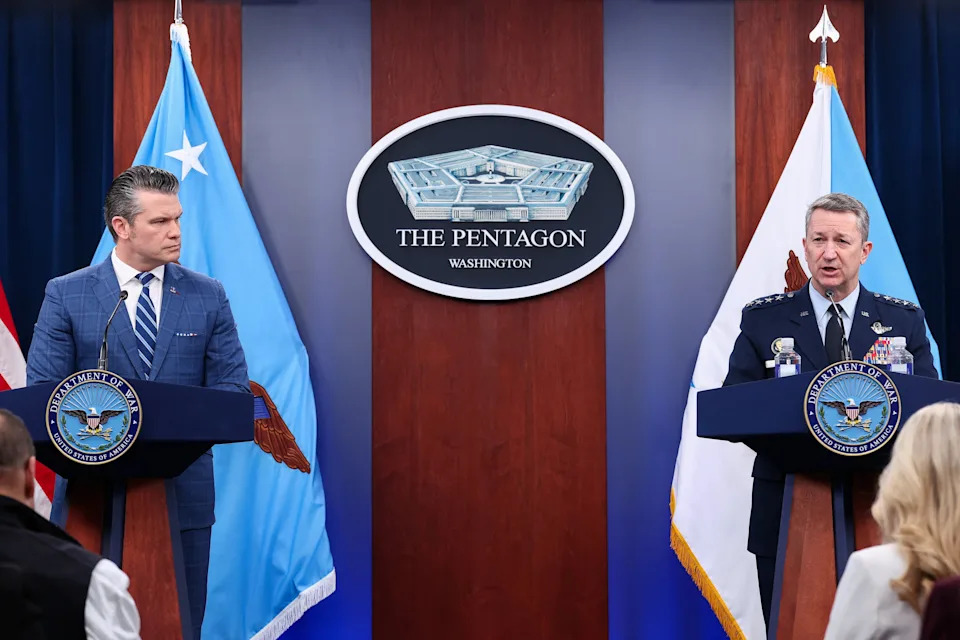
Gen. Dan Caine, chairman of the Joint Chiefs of Staff, similarly asserted that U.S. objectives in the Iran war have been met. / REUTERS
Official Statements And Strategic Goals
Joint Chiefs of Staff Chairman Dan Caine reiterated the administration’s three stated objectives in its campaign: to destroy Iran’s ballistic missile and drone capabilities, to neutralize the Iranian Navy, and to dismantle the defense industrial base so Iran cannot project power beyond its borders. White House spokesperson Anna Kelly told the Journal that those goals have been met and described the results as providing leverage in peace talks.
"This profound military success has allowed Vice President Vance, Special Envoy Witkoff, and Jared Kushner to negotiate with maximum leverage in order to end these threats to American troops and our homeland for good," Kelly said, referring to talks in Pakistan.
The Pentagon declined to comment to The Wall Street Journal. Analysts say the discrepancy between public claims and intelligence assessments underscores continuing uncertainty about the long-term status of Iran’s missile forces and the durability of U.S. military gains.
Why it matters: Even if a large share of Iran’s missile inventory has been degraded, the existence of recoverable weapons and repairable launchers means Tehran could retain a latent strike capability. That affects both short-term security calculations and negotiations aimed at ending hostilities.
Help us improve.