ALICE at the LHC has produced its clearest measurements yet of quark‑gluon plasma by studying particle flow in proton‑proton, proton‑lead and lead‑lead collisions. The team observed that baryons show stronger anisotropic flow than mesons at intermediate momenta, consistent with quark coalescence. Models that include coalescence match the data better, but some discrepancies remain. Oxygen collisions recorded in 2025 should help bridge system sizes and refine theoretical understanding.
LHC’s ALICE Reveals Clearest Evidence Yet of Quark‑Gluon Plasma — Even in Small Collisions
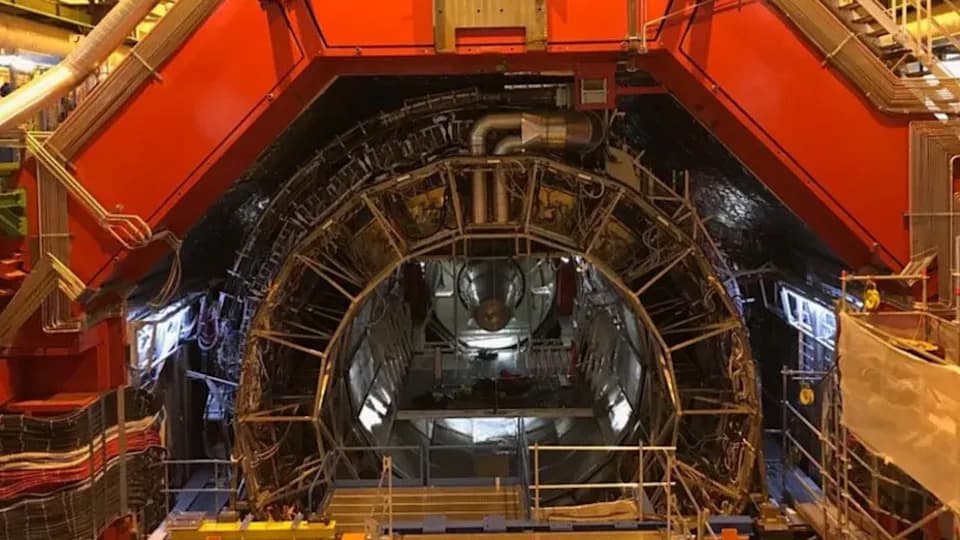
An image of the ALICE detector taken during LHC upgrades in 2019. | Credit: Robert Lea
The Large Hadron Collider's ALICE experiment has produced the most detailed observations yet of quark‑gluon plasma, the ultra‑hot primordial matter that filled the universe in the first moments after the Big Bang.
At CERN's nearly 17‑mile circular accelerator beneath the French Alps, ALICE researchers recreated this state by colliding heavy nuclei — including lead — at velocities close to the speed of light. The new results show a consistent pattern across proton‑proton, proton‑lead and lead‑lead collisions that sheds light on how the plasma forms and evolves.
What the ALICE Team Found
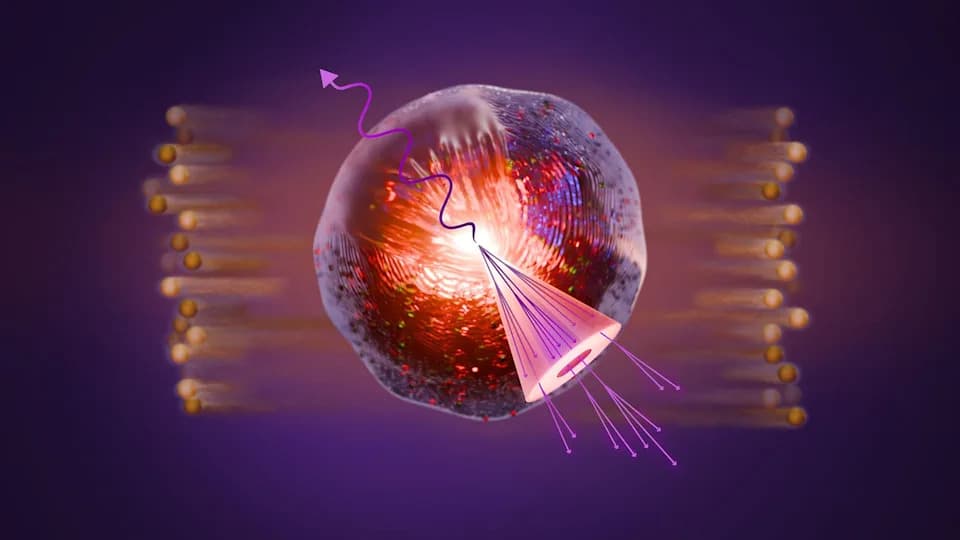
One key signature of quark‑gluon plasma is anisotropic flow: particles emerge preferentially in certain directions rather than uniformly. ALICE measured anisotropic flow for multiple identified particles and found that, at intermediate transverse momentum, baryons (three quarks) exhibit stronger flow than mesons (two quarks). This mass‑dependent pattern mirrors what is seen in large heavy‑ion collisions and points to a common underlying mechanism even in smaller collision systems.
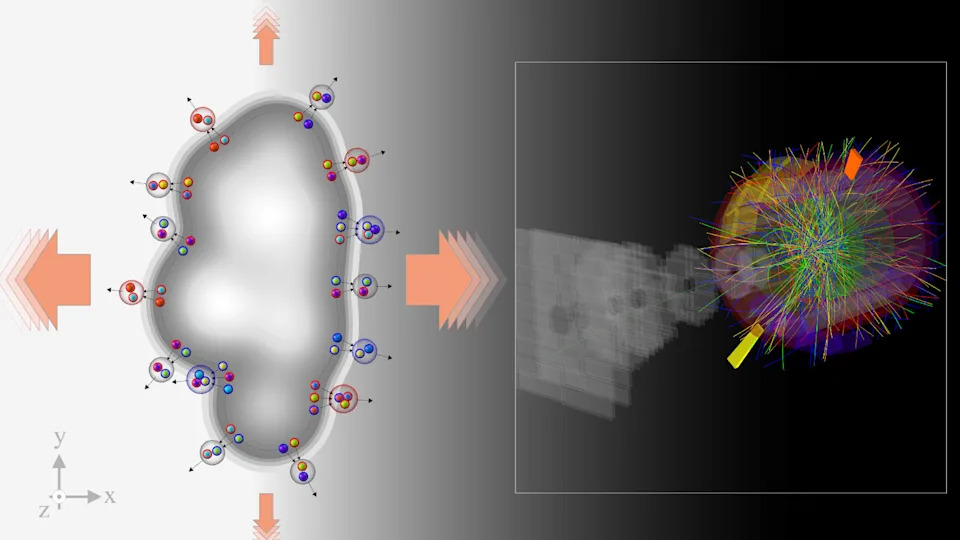
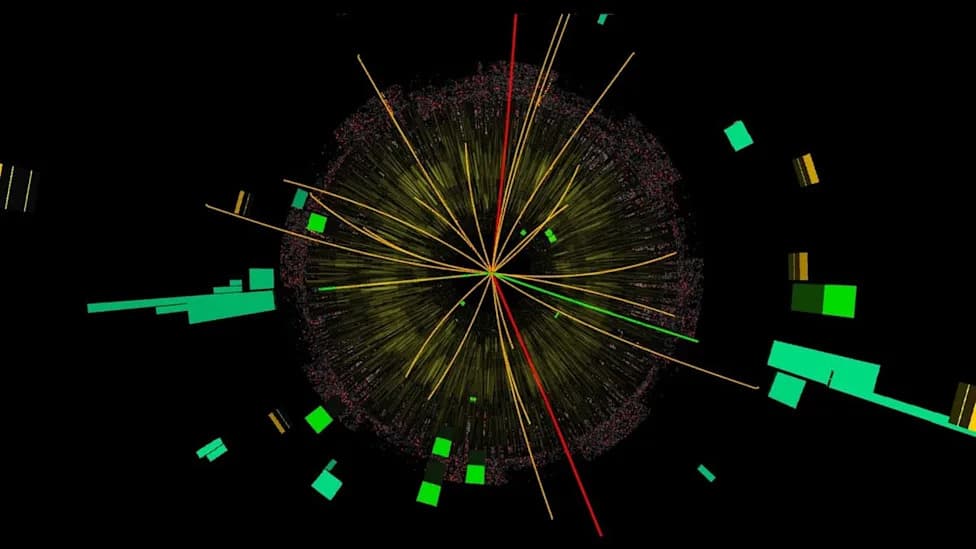
(Right) A proton–proton collision at the LHC in which many particles were created and tracked by the ALICE detector. (Left) Illustration of the anisotropic flow of mesons and baryons that ALICE has studied using data from such collisions, with the large arrows representing the preferred directions. | Credit: CERN/ALICE Collaboration
Quark Coalescence and Model Comparisons
Physicists interpret the baryon/meson flow difference in terms of quark coalescence: as the quark system expands, groups of quarks recombine to form hadrons, with baryons inheriting more collective flow because they contain more constituent quarks. The ALICE Collaboration compared their data to theoretical models and found that models including quark coalescence reproduce the observed flow pattern better than those that do not. However, notable discrepancies remain — even the best models do not fully capture all aspects of the measurements.
David Dobrigkeit Chinellato, Physics Coordinator for ALICE, said the observation is the first time this flow pattern has been seen for a wide momentum range and for multiple particle species in a subset of proton collisions that produce an unusually large number of particles. The result supports the idea that an expanding quark system can exist even when the collision system is relatively small.
The team suggests that collisions of intermediate‑sized nuclei could help resolve remaining differences between data and theory. ALICE plans to use oxygen collisions recorded in 2025 to bridge the gap between very small (proton) and very large (lead) systems and to refine understanding of how quark‑gluon plasma forms and evolves across system sizes.
Kai Schweda, ALICE Spokesperson, noted that oxygen runs will provide crucial insight into the nature and evolution of the quark‑gluon plasma across different collision systems.
The full study was published on March 20 in Nature Communications.
Help us improve.