The Kikai Caldera off Kyushu produced the largest known Holocene eruption (the Akahoya event) about 7,300 years ago. New marine seismic surveys image a large shallow magma chamber that now appears to be refilling with newly injected magma, and a lava dome has been building for roughly 3,900 years. Researchers propose a general magma re-injection model that may apply to other giant calderas such as Yellowstone and Toba, with implications for improved monitoring and eruption forecasting.
Kikai Caldera: The Giant Volcano That Is Quietly Refilling With Magma
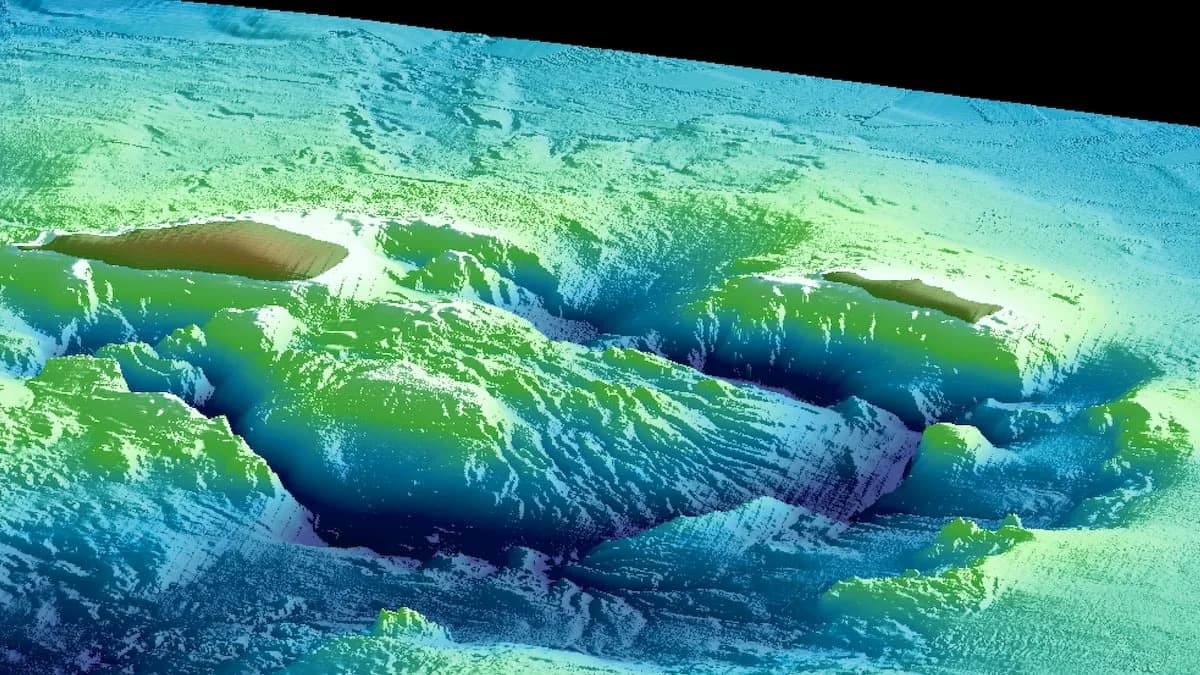
The Kikai Caldera. (Seama Nobukazu/CC BY 4.0)
About 7,300 years ago the Kikai Caldera, located off Kyushu, Japan, produced the Akahoya eruption — the largest known eruption of the Holocene. New marine geophysical surveys now reveal a vast shallow magma reservoir beneath the caldera that appears to be refilling with freshly injected magma. These findings shed light on how giant calderas recharge and could improve long-term eruption monitoring for Kikai and other supervolcano systems.
What Happened During the Akahoya Eruption
During the Akahoya event, Kikai ejected roughly 160 cubic kilometers (38 cubic miles) of dense-rock equivalent — more than 11 times the volume of Novarupta (1912) and 32 times that of Mount Pinatubo (1991). The eruption blanketed about 4,500 square kilometers with tephra and produced pyroclastic flows that traveled up to 150 kilometers (93 miles). Ash reached wide areas of Japan and even the Korean Peninsula. Although no written records exist, archaeologists believe the disaster had severe impacts on the Jōmon communities living in the region.

Subscribe to ScienceAlert's free fact-checked newsletter
How Scientists Studied the Submerged Caldera
Because most of Kikai lies below sea level, researchers from Kobe University and the Japan Agency for Marine-Earth Science and Technology (JAMSTEC) used marine seismic methods to probe beneath the seafloor. They deployed research vessels equipped with an air-gun array and dozens of ocean-bottom seismometers to generate and record controlled seismic waves. Analysis of the travel times and waveforms allowed the team to image subsurface structures and identify low-velocity zones consistent with molten material.
Key Findings: A Refilling Magma Chamber and a Growing Lava Dome
The seismic data reveal a large, shallow magma chamber beneath the caldera that corresponds in extent and position to the reservoir that fed the Akahoya eruption. Geochemical analyses indicate that the magma currently present has a different composition from Akahoya eruptive products, implying recent injection of new magma rather than just leftover melt. Independent studies also find evidence for the gradual construction of a lava dome within the caldera over the past ~3,900 years, consistent with ongoing recharge.
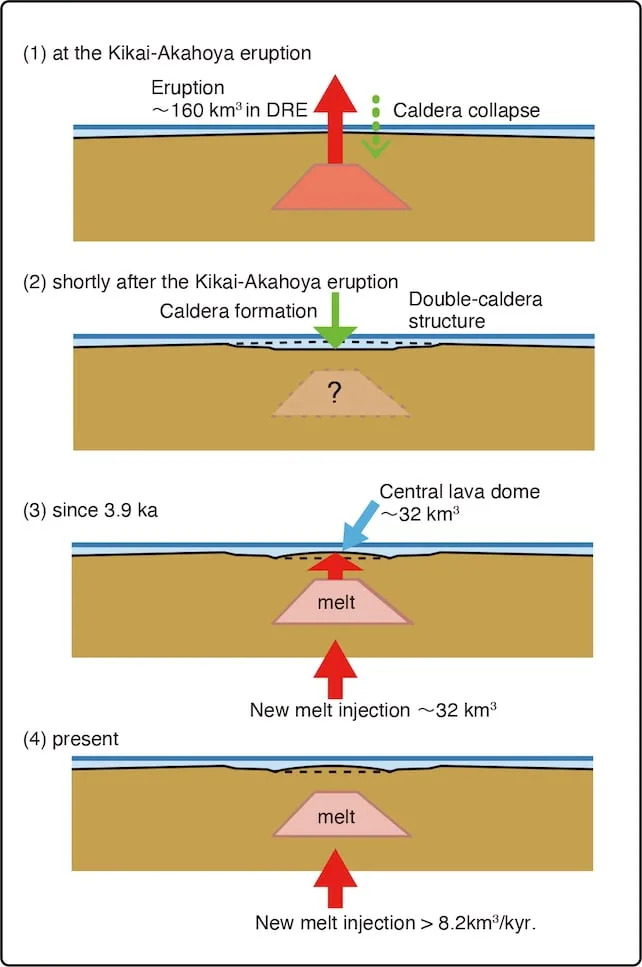
Results of this study and a previous study, in four distinct phases. (A. Nagaya et al.,Comm. Earth & Env.,2026/CC BY 4.0)
"We must understand how such large quantities of magma can accumulate to understand how giant caldera eruptions occur," says co-author Nobukazu Seama, a geophysicist at Kobe University. "We want to refine the methods that proved useful in this study to better understand re-injection processes and to monitor the indicators of future giant eruptions."
A Magma Re-Injection Model With Wider Implications
Based on their observations, the authors propose a general magma re-injection model for how large, shallow reservoirs beneath giant calderas are replenished. The model helps explain how systems like Kikai, Yellowstone and Toba can rebuild vast magma bodies over thousands of years and then remain dormant for long intervals before another major event. Improved imaging and monitoring techniques derived from this work could make it easier to detect precursory signals of renewed activity.
Why This Matters
Even relatively modest eruptions at historically cataclysmic systems can cause severe local and regional disruption today because of high population densities and modern infrastructure. Understanding recharge dynamics and refining marine and onshore monitoring will improve hazard assessment and provide earlier warnings for communities near caldera volcanoes.
Study: Communications Earth & Environment. Research teams: Kobe University and the Japan Agency for Marine-Earth Science and Technology (JAMSTEC).
Help us improve.