Kīlauea’s summit recorded nearly 100 earthquakes in 24 hours, prompting the National Park Service to temporarily close the Keanakākoʻi area, including Old Crater Rim Drive and nearby overlooks. The largest quake was magnitude 3.4 at 9:52 p.m. HST Wednesday, with the most intense seismicity between 8 p.m. Wednesday and 3 a.m. Thursday. Since about 3 a.m. Thursday, summit inflation has leveled off and earthquakes have decreased; USGS HVO reports a shallow magma intrusion and says the 55th eruptive episode may begin soon.
Nearly 100 Quakes Shake Kīlauea Summit; Keanakākoʻi Area Temporarily Closed
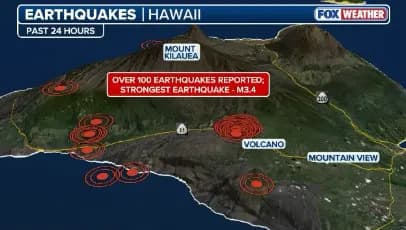
Over the past 24 hours, nearly 100 earthquakes were recorded beneath the summit of Kīlauea volcano.
Park officials closed portions of Hawaiʻi Volcanoes National Park on Thursday after instruments recorded nearly 100 earthquakes beneath the summit of Kīlauea volcano over a 24‑hour period. The closure is a precaution to protect visitors while scientists continue to monitor elevated seismic and volcanic unrest.
Closed areas: The temporary closure affects the Keanakākoʻi area, including Old Crater Rim Drive, the overlooks at Keanakākoʻi Crater and the Crater Rim Trail to Keanakākoʻi. The Devastation Trail parking lot remains open to visitors.
Seismic and Observational Details
Park and U.S. Geological Survey Hawaiian Volcano Observatory (HVO) data show nearly 100 earthquakes in the summit region during the most recent 24‑hour window. The largest event was magnitude 3.4, recorded at 9:52 p.m. HST on Wednesday. The strongest seismic activity occurred between about 8:00 p.m. Wednesday and 3:00 a.m. Thursday.
Since roughly 3:00 a.m. Thursday, summit inflation has stabilized and the rate of earthquakes has declined. A comparison of webcam imagery from before and after a shallow intrusion showed no new ground cracking and no lava erupting in a new location, according to the National Park Service.
Ongoing Eruptive Activity
HVO reports a shallow magma intrusion within the summit region near the existing eruption site and says the 55th episode of Kīlauea's ongoing eruptive activity could begin soon. Over the past day, the north vent experienced several overflows, including a small dome fountain and an overflow that lasted more than an hour. Observers also reported strong glow, intermittent spatter and large flames at the north and south vents; the west vent produced a glow and flames as well. No volcanic activity was detected in other areas of the park.
Park officials emphasized that the closures are precautionary. Rangers and scientists will continue to monitor seismic and volcanic conditions and will reopen affected areas when it is safe to do so.
Help us improve.