The genome begins assembling a three-dimensional framework much earlier in development than previously believed, researchers report. Using a low-input method called Pico-C on fruit fly embryos, the team found loops and domain boundaries form well before zygotic genome activation. A companion study in human cells shows that disrupting genome architecture triggers an immune-like inflammatory response, linking structural collapse to disease risk. The findings highlight a modular, staged assembly of chromatin that primes gene activity and preserves cellular health.
Genome Builds Its 3D Blueprint Before Genes Switch On, New Study Finds

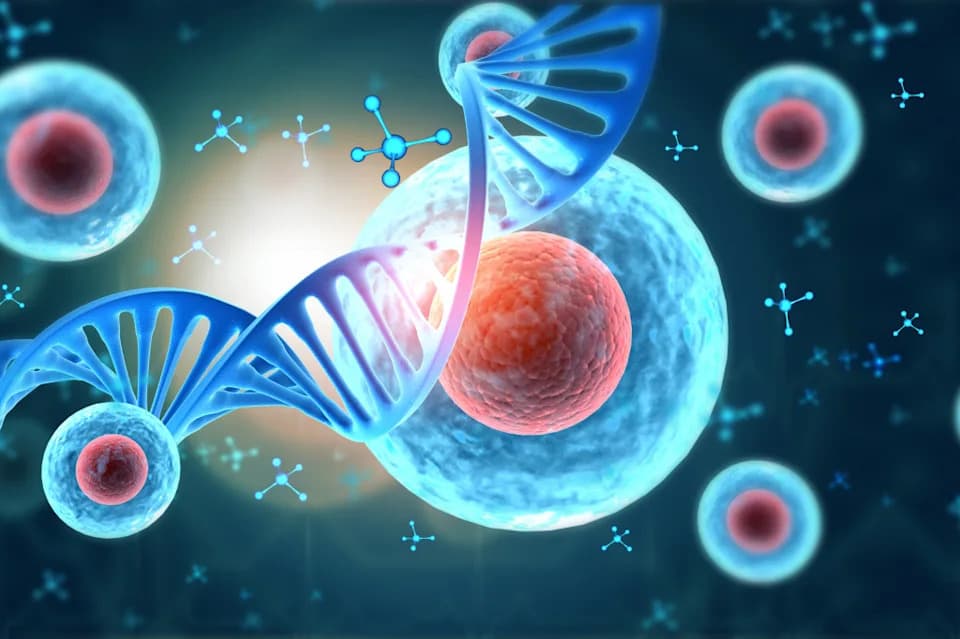
A new study reveals that DNA organizes into a complex 3D structure before genes activate, changing how scientists view early life. (CREDIT: Shutterstock)
Life begins with a precise, three-dimensional choreography inside the cell nucleus. Contrary to the long-held view that a newly fertilized egg starts in disarray, new research shows the genome begins assembling an organized 3D framework well before it activates its own genes.
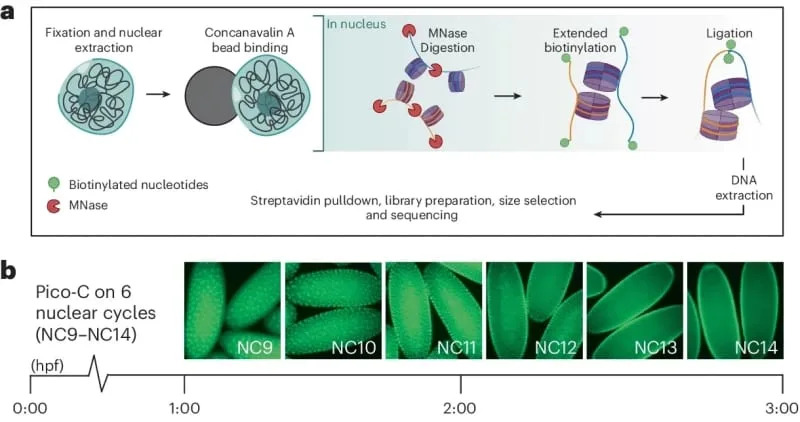
Pico-C enables sub-kilobase chromatin maps across six developmental stages during the establishment of genome architecture in Drosophila. (CREDIT: Nature Genetics)
A team led by Professor Juanma Vaquerizas at the Medical Research Council used a sensitive, low-input technique called Pico-C to map DNA folding at unprecedented resolution in the earliest stages of development. Their experiments in fruit fly embryos reveal that loops and domain boundaries form substantially earlier than previously thought, and that these features strengthen gradually as development proceeds.
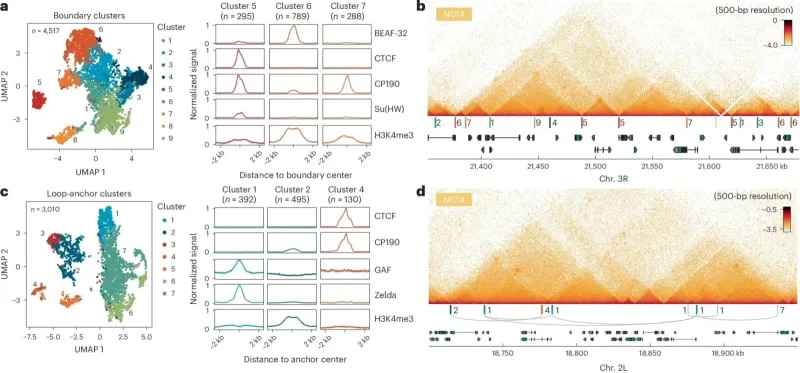
Diverse chromatin signatures anchor architectural features in the early embryo. (CREDIT: Nature Genetics)
“We used to think of the time before the genome awakens as a period of chaos,” says Noura Maziak, lead author of the study. “But by zooming in closer than ever before, we can see that it’s actually a highly disciplined construction site. The scaffolding of the genome is being erected in a precise, modular way, long before the ‘on’ switch is fully flipped.”
How the Study Was Done
The researchers focused on fruit fly embryos because they develop quickly, providing a clear window into early molecular events. Using Pico-C—which requires roughly ten times less material than older methods—the team produced high-resolution contact maps of chromatin folding across successive early stages. Those maps show loops that bridge distant genomic regions and boundaries that segregate functional neighborhoods into discrete domains.
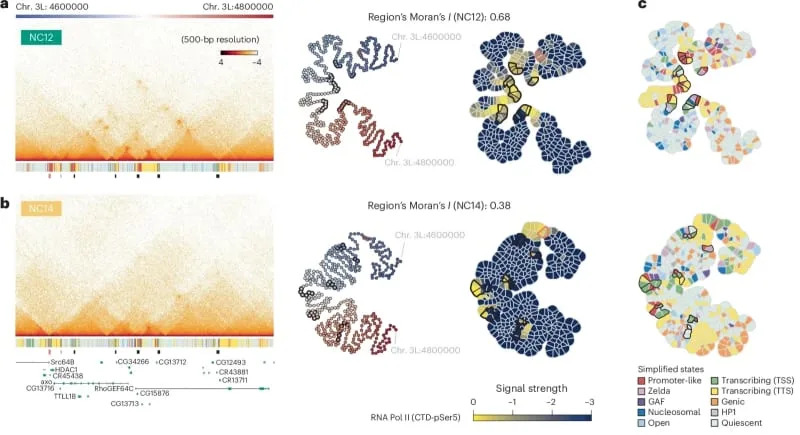
Fine-tuned Pol II regulation alters chromatin architecture in a cluster-specific manner. (CREDIT: Nature Genetics)
What the Findings Show
Key discoveries include:
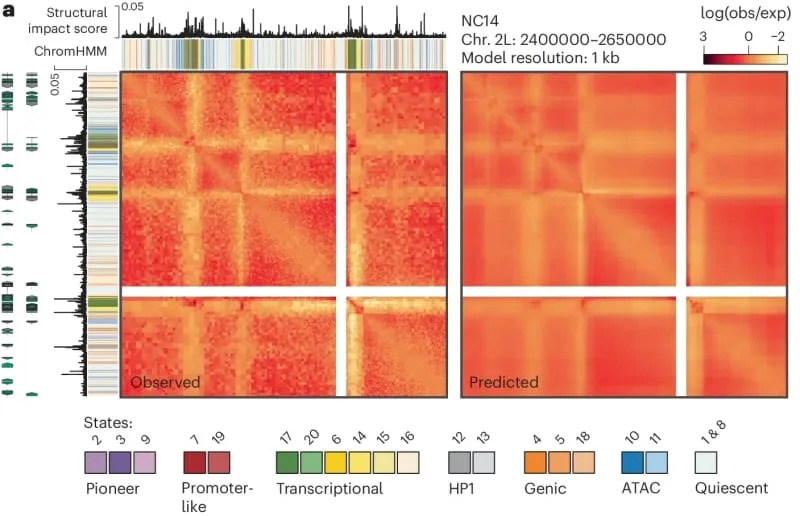
Modeling of chromatin architecture using Orca on Pico-C maps highlights promoter-linked state regions and reveals a diverse set of sequences associated with predicted architecture. (CREDIT: Nature Genetics)
- DNA loops and domain boundaries are established before zygotic genome activation (ZGA), the moment when the embryo starts using its own genome.
- The genomic architecture builds progressively: simple patterns appear first and refine into more complex, strongly defined structures as development advances.
- Organization follows a modular design—distinct regulatory inputs shape specific regions, enabling precise control of gene activity while maintaining overall resilience.
Companion Human-Cell Study
A companion study led by Professor Ulrike Kutay and colleagues at ETH Zürich examined what happens when the anchors that maintain 3D genome architecture are removed in human cells. The result: the structure collapses and cells mount an immune-like response, activating inflammatory pathways as if responding to a viral intrusion. This false alarm links structural failure to inflammation, a process that can contribute to disease if chronic.
Implications
Together, the studies suggest that genome architecture is assembled in advance to guide precise gene activation and to protect cellular health. Disruptions to this architecture may play roles in developmental disorders, cancer, and immune-related diseases. Because Pico-C works with far less input material, it opens new opportunities to study rare cell types and fleeting developmental stages and could ultimately inform therapies that aim to preserve or restore the genome’s spatial organization.
The research is published online in Nature Genetics. The original story appeared in The Brighter Side of News.
Help us improve.