Researchers report that fall armyworm moths use a combination of visual landmarks and the Earth’s geomagnetic field to guide nocturnal, multigenerational migrations. Controlled tethered‑moth experiments showed that aligned visual and magnetic cues produce coordinated group flight, while conflicts between cues caused disorientation. Lab‑reared and wild moths behaved similarly, indicating the navigation system is innate. These findings may inform future strategies to predict and manage agricultural pest outbreaks.
Study Finds Fall Armyworm Moths Use Earth's Magnetic Field Alongside Visual Landmarks to Navigate Night Migrations
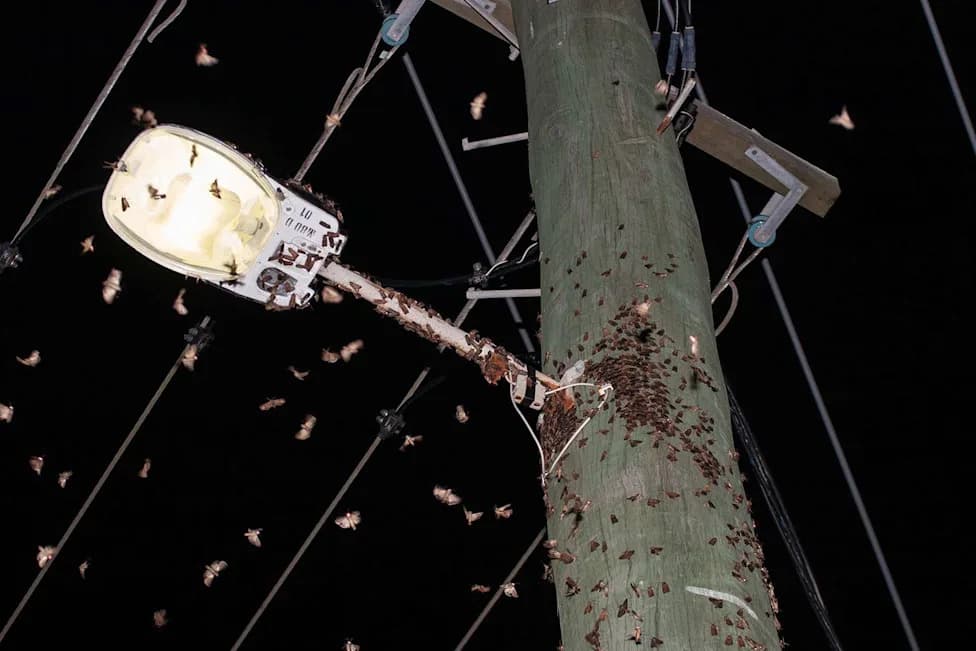
Moths flying around the light bulbs in front of the local wooden house.© NeagoneFo/Shutterstock.com
Researchers in China report experimental evidence that fall armyworm moths (Spodoptera frugiperda) combine visual landmarks and the Earth’s geomagnetic field to orient during long‑distance nocturnal migrations. The study, published in eLife on March 3, 2026, used controlled tethered‑moth experiments to test how visual and magnetic cues interact to produce coordinated flight.
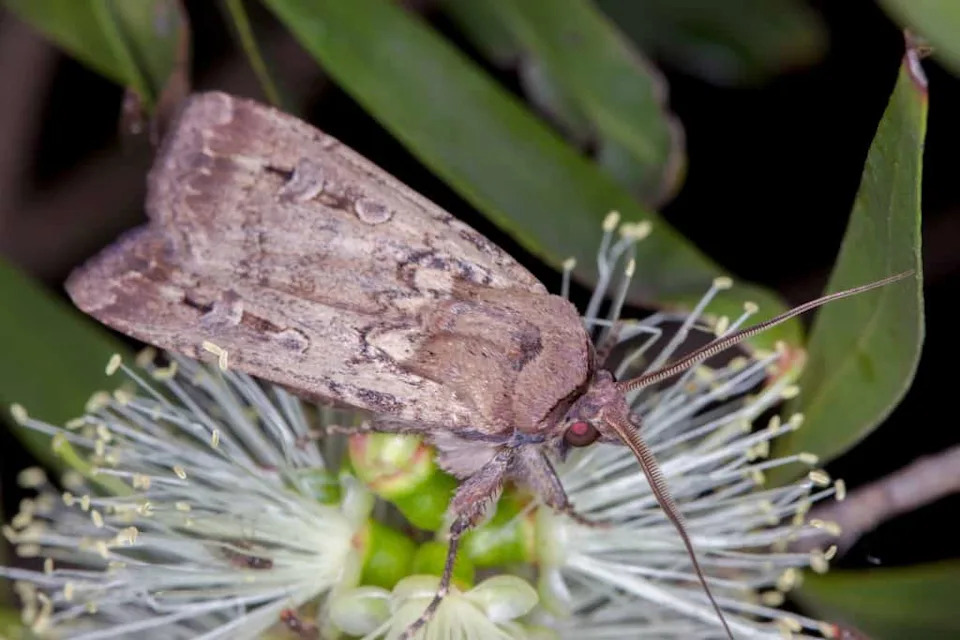
The bogong moth is known to rely on geomagnetic cues during their short migrations in Australia.©Andrew Allen Photography/Shutterstock.com(Andrew Allen Photography/Shutterstock.com)
Background
Nocturnal navigation is challenging, and some migrating insects may use multiple sensory systems to stay on course. Previous work has shown the Australian bogong moth integrates a magnetic compass with stellar and visual cues during its seasonal movements, but species that migrate across much larger latitudinal ranges might rely on different—or additional—mechanisms. The team at the State Key Laboratory of Agricultural and Forestry Biosecurity, Nanjing Agricultural University, set out to test whether the globally invasive fall armyworm uses magnetic information as a navigational aid.
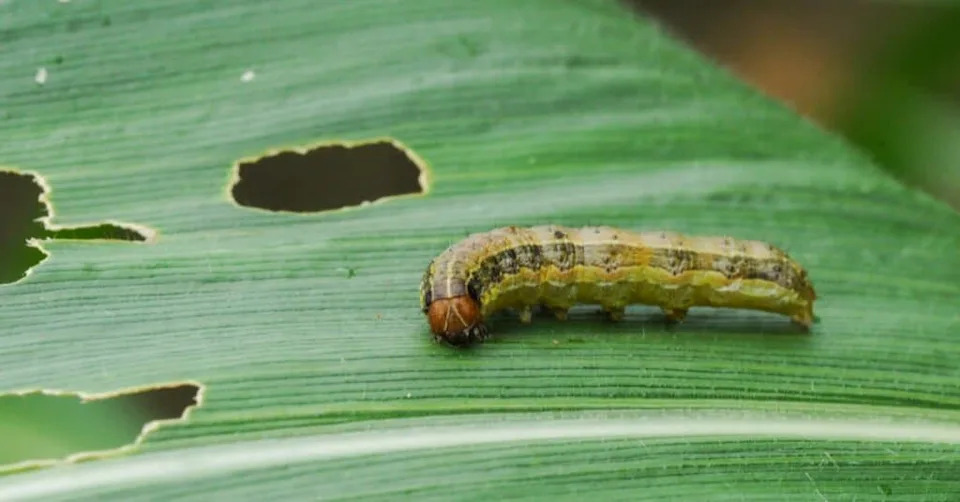
The fall armyworm, the larval form of the armyworm moth, is the most common armyworm found chewing plants in yards or pastures.©kale kkm/Shutterstock.com(kale kkm/Shutterstock.com)
Why the Fall Armyworm?
Spodoptera frugiperda undertakes multigenerational spring and autumn migrations and, in its larval stage, is one of the world’s most destructive crop pests. A better understanding of the sensory cues that guide its migrations could help researchers develop strategies to predict or mitigate pest outbreaks.

The Earth’s geomagnetic field is used by noctuid moths to navigate during seasonal migrations.©Piotr Krzeslak/Shutterstock.com(Piotr Krzeslak/Shutterstock.com)
Experimental Design
The researchers ran a four‑stage experiment using tethered moths in a controlled arena to compare responses to visual cues and manipulated magnetic fields:
- Stage 1 — Baseline: Visual and geomagnetic cues were aligned to mimic natural conditions. Moths flew together in the expected migratory direction.
- Stage 2 — Conflict: The magnetic field was rotated 180° while visual cues stayed the same. Moths initially followed visual cues but soon became disoriented when magnetic and visual information conflicted.
- Stage 3 — Realigned New Heading: Both visual and magnetic cues were rotated 180° and matched. Moths regrouped and flew coherently toward the new heading, showing they respond to a consistent cue set regardless of absolute orientation.
- Stage 4 — Return to Baseline: Both cues were restored to the original alignment; moths reoriented and resumed the baseline heading. Tests with lab‑reared and wild moths produced the same pattern, indicating the behaviour is innate rather than learned.
Key Findings
The experiments indicate that fall armyworm moths rely primarily on visual landmarks but also use the Earth’s geomagnetic field as a complementary orientation reference. When visual and magnetic cues were congruent, moths maintained coordinated flight; when cues conflicted, the group lost directional cohesion. The results suggest successful long‑distance migration in these noctuid moths depends on an interaction between visual and magnetic compasses.
“Gaining a better understanding of their migratory behaviors and the sensory basis for them could help inform future strategies for controlling some of these invasive pest species,” said Gao Hu, the study’s senior author at Nanjing Agricultural University.
Implications
Beyond improving our basic understanding of insect navigation, the findings have practical implications: mapping how fall armyworms orient could inform monitoring and control strategies for this economically important pest. The authors hope their work will prompt follow‑up studies to test whether other migratory noctuid species use the same mixed visual–geomagnetic system.
Study details: Co‑first authors Yi‑Bo Ma and Gui‑Jun Wan led the research, which appears in eLife (March 3, 2026).
Help us improve.