Researchers identified water-soluble ice-nucleating proteins in Mortierellaceae fungi that closely resemble bacterial InaZ proteins and were likely acquired by ancient horizontal gene transfer. These fungal INPs form membrane-free clusters stabilized by disulfide bonds and can nucleate ice at about −5°C to −8°C. Transferring a single fungal gene into yeast raised its freezing temperature from −26°C to ~−7°C. The soluble, robust nature of these proteins could enable applications in cryopreservation and controlled freezing technologies.
Fungal Proteins That Make Water Freeze: New Study Finds Soluble Ice-Nucleating Proteins in Mortierellaceae
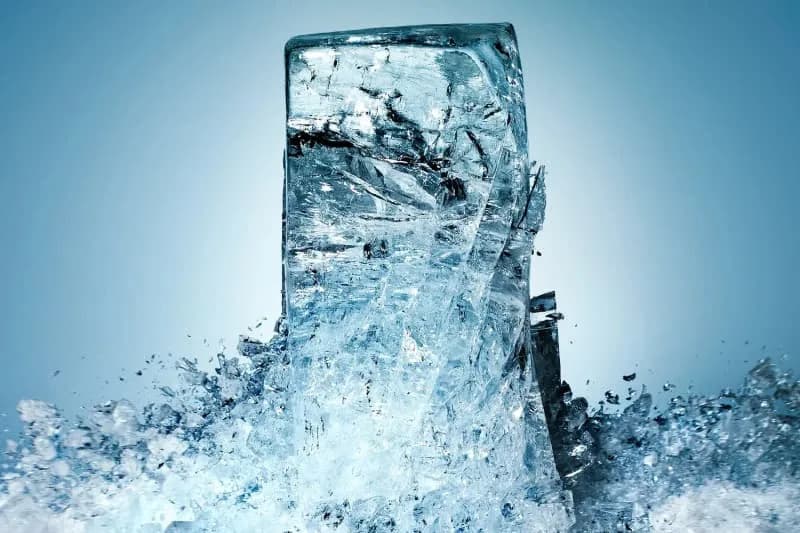
Scientists discovered fungi stole a bacterial ice-forming gene long ago, then evolved a more stable, water-soluble version with major potential for cryopreservation and cloud science. (CREDIT: Shutterstock)
New research reveals that certain fungi carry powerful ice-nucleating proteins (INPs) that can trigger ice formation at unexpectedly warm subzero temperatures. These proteins, found in Mortierellaceae fungi, resemble bacterial ice-nucleators but are water-soluble, stable, and able to form membrane-free clusters — traits that broaden their ecological role and potential technological uses.
Discovery and Evolutionary Origin
Researchers led by Konrad Meister (Boise State University and the Max Planck Institute for Polymer Research) sequenced genomes of ice-active Mortierellaceae isolates from polar expeditions, water and lichens. They discovered genes closely similar to the bacterial InaZ gene (best known from Pseudomonas syringae). Phylogenetic analyses and a bacterial-like chemical signature in the fungal gene point to ancient horizontal gene transfer from bacteria into a fungal ancestor, rather than independent evolution.
How Fungal INPs Work — And How They Differ From Bacteria
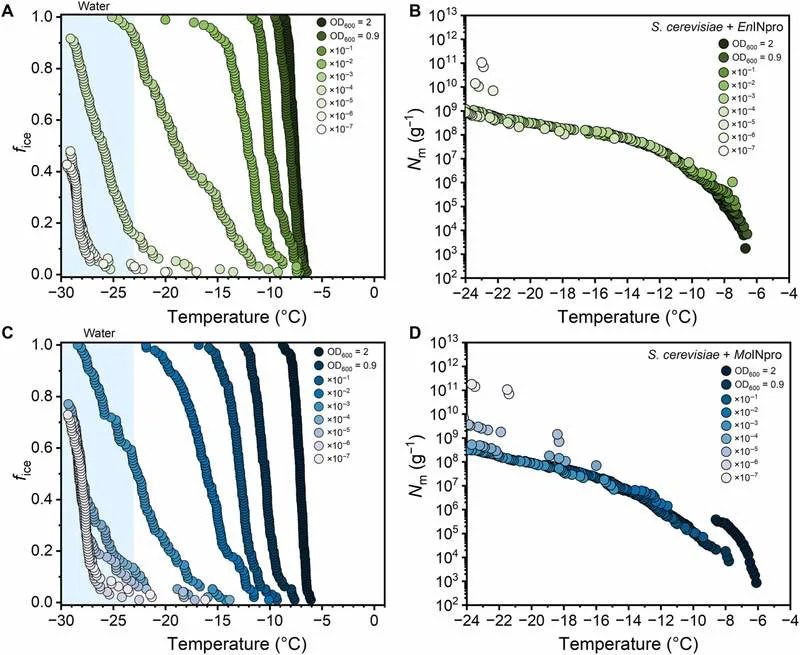
Ice nucleation activity of yeast strains expressing fungal INpros. (CREDIT: Science Advances)
Bacterial INPs are large, membrane-associated proteins that arrange water molecules into the linear patterns needed to nucleate ice; aggregation on a membrane typically supplies the necessary surface area. Mortierellaceae INPs use the same repetitive architecture to template ice but have evolved distinct structural features: they are water-soluble, form functional clusters in solution without membranes, and contain cysteine residues near the C-terminus that can form disulfide bonds to stabilize the protein fold.
Structural Modeling and Functional Tests
Using AI-based protein structure prediction, the team modeled assemblies of the fungal proteins and found that rows of three to five proteins aligned in parallel create a sufficiently wide surface to nucleate ice effectively. When such clusters form, they can nucleate ice at about -5°C to -8°C — competitive with the strongest known biological nucleators.
To confirm function, the researchers expressed two fungal genes in organisms that normally lack ice-nucleation activity (yeast and E. coli). Both transformed organisms became ice-active; in yeast, a single fungal gene shifted the freezing temperature from roughly -26°C to approximately -7°C, demonstrating a large gain in nucleation efficiency.
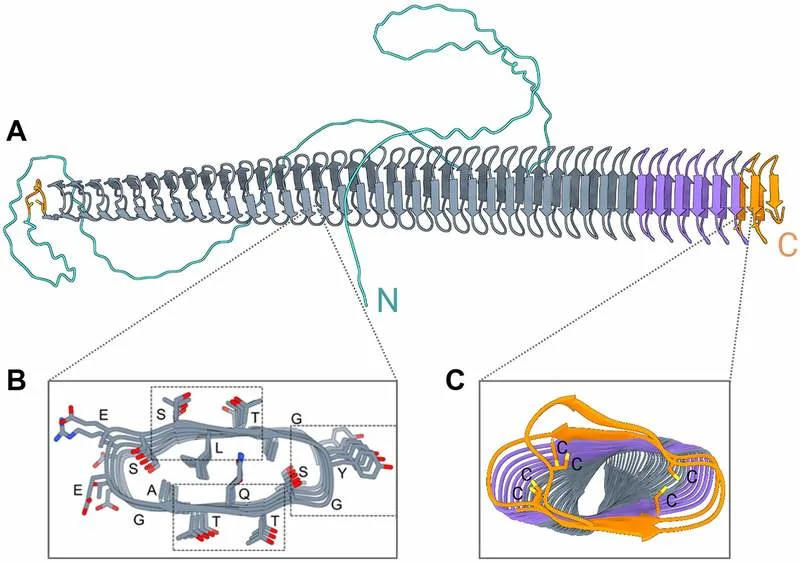
AlphaFold3 model of EnINpro and cross sections through the solenoid. (CREDIT: Science Advances)
Environmental and Practical Implications
Many Mortierellaceae are soil-dwelling. If their soluble INPs remain active at environmental concentrations, these fungi could play an underestimated role in atmospheric processes such as cloud formation and precipitation. Unlike membrane-bound bacterial INPs, water-soluble fungal INPs are easier to extract, handle, and formulate, opening practical opportunities in controlled freezing technologies (CFT).
One promising application is cryopreservation: controlled, predictable nucleation helps limit damaging, uncontrolled ice growth in cells, tissues, and organs. The fungal INPs’ tolerance to extreme pH and repeated freeze–thaw cycles makes them attractive for biotechnological and materials-science applications where durability matters.
Why Pure Water Can Stay Liquid to −40°C
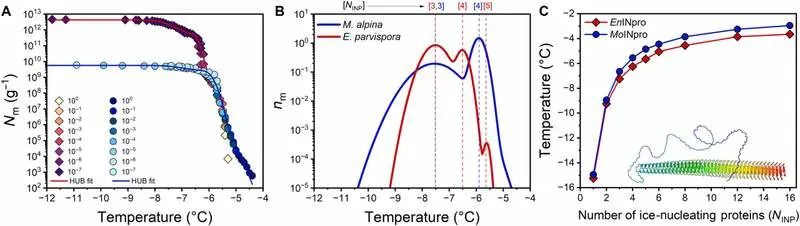
Freezing experiments with aqueous samples of fungal INs from M. alpina and E. parvispora. (CREDIT: Science Advances)
Ordinary tap water and commercial distilled water typically freeze around 0°C because dissolved minerals, gases, microscopic particles and container surfaces provide nucleation sites. Only under highly controlled laboratory conditions (extremely pure water, minimal surface contact, no disturbance) can water remain liquid down to about −40°C. Biological nucleators such as fungal and bacterial INPs provide the templates that trigger freezing at much warmer subzero temperatures.
Next Steps
Future work will resolve the high-resolution assembly of fungal INPs into functional clusters, determine effective environmental and application concentrations, and test performance in real-world CFT and cryopreservation settings.
Source: Study published in Science Advances by Konrad Meister and colleagues (Boise State University and Max Planck Institute for Polymer Research).
Help us improve.