BioPykrete is a reinforced ice composite combining ice, cellulose nanocrystals and a custom chimeric protein that binds both materials. Lab tests show it is about ten times stronger than ordinary ice and absorbs roughly 70 times more energy before failing, causing it to bend and deform rather than shatter. The material reached compressive strengths comparable to conventional concrete in initial tests, but it remains a proof of concept that requires further study for durability, freeze–thaw resilience and scalability.
BioPykrete — A 'Super Ice' Ten Times Stronger That Bends Rather Than Shatters
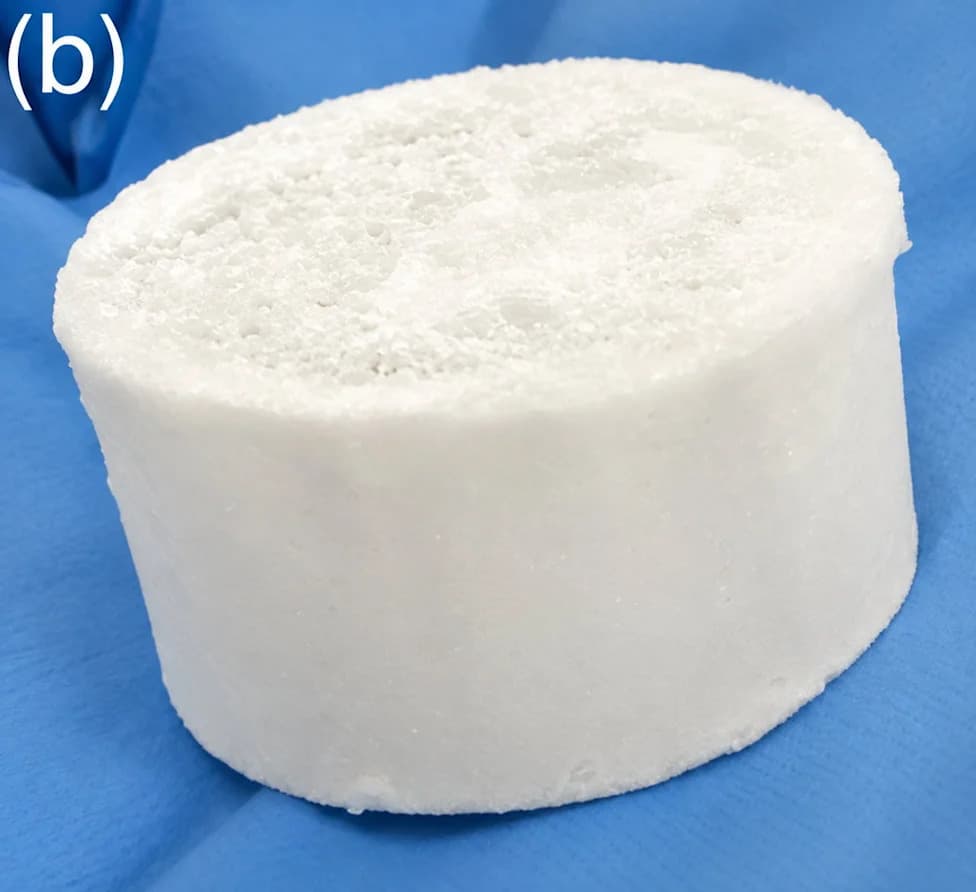
Testing the strength of super ice: A sample measuring 2 centimeters across and 1 centimeter high is placed in the compression-testing machine, which applies increasing pressure until the material begins to deform or break. (Chen Adar via SWNS)
Scientists in Israel report a reinforced ice composite, dubbed BioPykrete, that is roughly ten times stronger than ordinary ice and far less prone to catastrophic shattering. Made from ice, plant-derived cellulose nanocrystals and a purpose-built chimeric protein, the material bends and deforms gradually under load rather than failing suddenly — and in lab tests it reached compressive strengths comparable to conventional concrete.
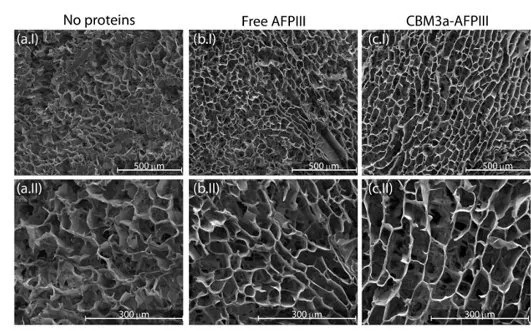
Inside the super ice: (ac) Scanning Electron Microscope images of freeze-dried samples reveal the network formed by tiny cellulose crystals. The top row shows the material magnified 40 times, and the bottom row 90 times. (d) The graph compares the size of the network's pores when the antifreeze protein AFPIII was added alone and when it was joined to the cellulose-binding protein CBM3a. Eight sample sections were analyzed for each material. (Yulia Baron and Dr. Liat Bahari via SWNS)
How It Works
BioPykrete builds on the wartime idea of Pykrete (ice mixed with wood pulp) but operates at the molecular scale. Researchers mixed water with cellulose nanocrystals — extremely small, stiff particles derived from plant cellulose — which self-assemble during freezing into a three-dimensional scaffold around microscopic ice domains. They then added an engineered chimeric protein that has one domain binding to ice and another binding to cellulose, effectively acting as molecular glue that ties the scaffold to the frozen matrix.
(Photo by Alina Autumn via Pexels)
Microscopic Structure And Evidence
Scanning electron microscope images of freeze-dried samples show a continuous cellulose network surrounding small ice pockets. The team compared variants using an antifreeze protein (AFPIII) alone versus a fusion with a cellulose-binding domain (CBM3a); results indicate that the protein linker reduces pore size and improves mechanical connectivity between the ice and cellulose phases.
(Photo by Federica Flessati via Pexels)
Mechanical Performance
In compression tests the composite was about 10 times stronger than unreinforced ice and absorbed nearly 70 times more energy before failing. The engineered protein roughly doubled both strength and energy absorption compared with an ice-and-cellulose mixture that lacked the protein bridge. According to the authors, the cellulose network and protein anchors slow or redirect crack propagation, so cracks are arrested or kept small rather than racing through the material.
Potential Uses And Limitations
The researchers suggest BioPykrete could one day offer a biodegradable, lower‑carbon alternative for some structures in Arctic, Antarctic and other extreme-cold environments where transporting concrete and steel is difficult or costly. However, the material is still a proof of concept: key open questions include long-term durability, behavior under repeated freeze–thaw cycles, slow deformation under sustained loads (creep), how cracks evolve over time, and the challenges of scaling production.
"We wanted to go beyond simply mixing fibers into ice and instead control how the different materials connect at the molecular level," said study leader Ido Braslavsky. "The result changes not only how strong the ice is, but also how it breaks. Instead of suddenly shattering, it can absorb much more energy and deform gradually."
The study is reported in the journal Colloids and Surfaces B: Biointerfaces. The team plans further experiments to map crack propagation, test alternate protein designs and freezing protocols, and evaluate real-world performance under repeated environmental cycling.
Help us improve.