New models from LMU and the Max Planck Institute show that moons orbiting free-floating planets could host surface liquid water for geologically long periods if surrounded by dense hydrogen atmospheres. Tidal heating from eccentric orbits supplies the energy while collision-induced absorption in high-pressure hydrogen traps heat without freezing out. Simulations produced habitable windows up to 4.3 billion years at 100 bars, 699 million years at 10 bars, and occasional warmth even at 1 bar; the scenarios could also support prebiotic chemistry through wet–dry cycles and ammonia-driven alkalinity.
Life Without a Sun? Hydrogen Atmospheres Could Keep Exomoons Habitable for Billions of Years
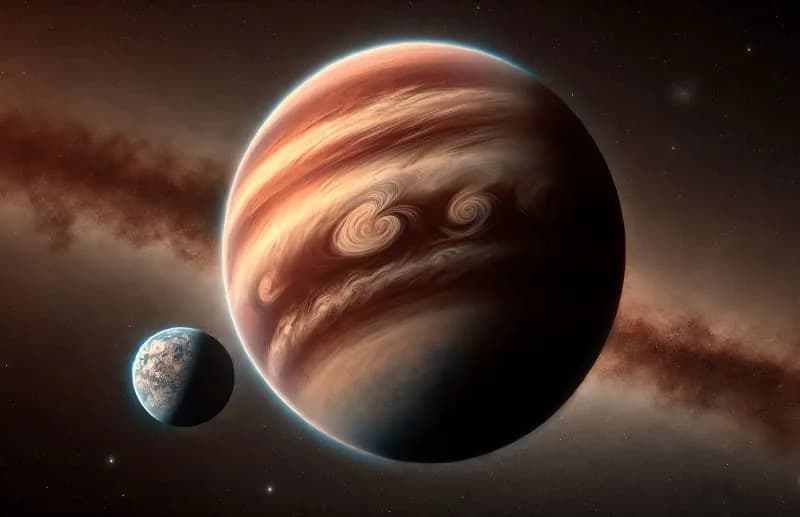
A realistic depiction of a free-floating gas giant planet and its Earth-like moon. (CREDIT: Dahlbüdding / DALL-E)
Some planets wander the galaxy untethered to any star. Ejected during the chaotic early stages of planetary formation, these free-floating planets drift through cold space with no sunlight to warm them. New modeling from researchers at the Excellence Cluster ORIGINS (Ludwig Maximilian University of Munich) and the Max Planck Institute for Extraterrestrial Physics shows that moons orbiting such planets could maintain surface liquid water for geologically long intervals if they possess dense hydrogen atmospheres.
How Tides and Hydrogen Combine to Keep Water Liquid
When a planet is thrown out of its system, any surviving moons often end up on highly elongated, eccentric orbits. Those repeated close approaches to the parent planet deform the moon, generating internal friction and heat in a process known as tidal heating. We already see this in our solar system: Jupiter’s moon Io is intensely volcanic because of tides, and Europa likely keeps a subsurface ocean for the same reason. In the starless systems modeled here, tidal heating supplies essentially all the available energy.
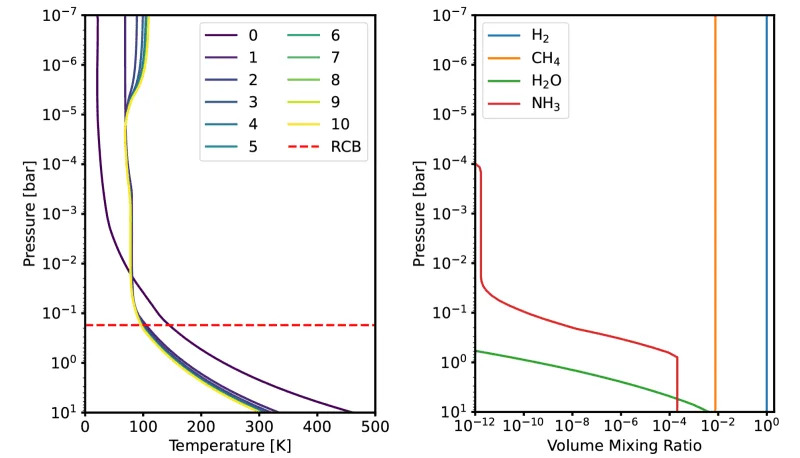
Left: Evolution of the pressure-temperature profile T(P) with the radiative-convective boundary (RCB) of the last step. Right: Final VMR profiles of all molecules with a maximum VMR>10−12. (CREDIT: Monthly Notices of the Royal Astronomical Society)
But heat alone isn't enough. An atmosphere must trap outgoing infrared radiation to keep the surface warm. Earlier studies focused on carbon dioxide as the insulating gas, but CO2 freezes out in the cold environments of free-floating planets and the greenhouse effect collapses. Dahlbüdding and colleagues instead modeled hydrogen-dominated atmospheres.
Collision-Induced Absorption: Hydrogen's Hidden Greenhouse
Under high pressure, hydrogen molecules frequently collide and form short-lived pairs that can absorb infrared radiation — a process called collision-induced absorption. At sufficient surface pressures, a hydrogen envelope becomes a surprisingly effective heat trap. Crucially, hydrogen does not condense at the frigid temperatures expected for free-floating planets, so the atmosphere remains intact rather than freezing out.
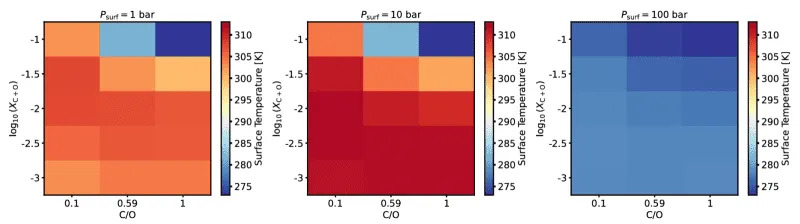
Surface temperatures Tsurf (𝑋C+O, C/O) for varying Psurf (from left to right: 1, 10, and 100bar). (CREDIT: Monthly Notices of the Royal Astronomical Society)
Model Results
The team ran coupled radiative-transfer and atmospheric-chemistry models across ranges of surface pressure and internal heat flux. Their key findings:
- With a 100-bar hydrogen atmosphere, modeled moons could sustain surface liquid water for up to 4.3 billion years.
- At 10 bars, habitable intervals reached as long as 699 million years.
- Even at 1 bar, about 20% of simulated moon orbits experienced at least some periods with surface liquid water.
In their dynamical simulations, 6,945 moon orbits survived the host planet’s ejection. Under the 100-bar scenario, 43% of those orbits reached habitable conditions at some point during their evolution.
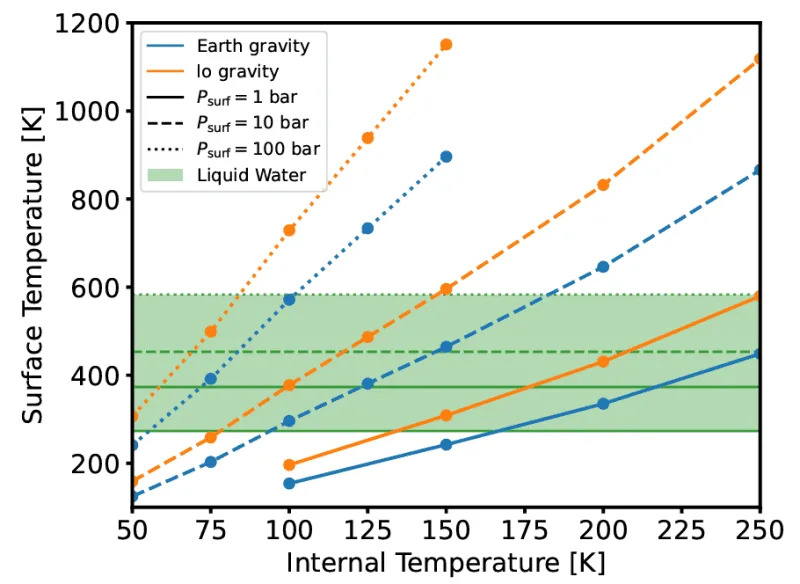
The surface temperature Tsurf is increasing with the tidally provided internal temperature Tint for Earth vs. Io-like gravity for 𝑋C+O=10−2 and C/O=0.59. (CREDIT: Monthly Notices of the Royal Astronomical Society)
“The cradle of life does not necessarily require a sun,” said lead author David Dahlbüdding, noting parallels with early Earth when hydrogen-rich conditions delivered by impacts may have helped prebiotic chemistry.
Implications for Prebiotic Chemistry
Tidal forcing is pulsed, not constant. On moons with shallow seas and exposed land, this can create wet–dry cycles that concentrate organic molecules during drying phases and allow chemical reactions to proceed when rehydrated — a plausible route for assembling long polymers like RNA. The team’s chemistry models also indicate that ammonia could form in nitrogen-bearing hydrogen atmospheres, providing alkaline conditions that favor polymerization and molecular replication. In this way, the atmosphere serves both as thermal insulation and as a chemical participant in potential prebiotic pathways.
Caveats and Future Work
The researchers emphasize several important uncertainties. Their models assume dry atmospheres and do not fully include cloud formation, which could add warming and extend habitable intervals. Conversely, very deep oceans might speed orbital circularization, shortening eccentricity-driven heating and reducing habitable lifetimes. Whether small moons can retain dense hydrogen envelopes over geological timescales — given atmospheric escape, impacts, and other loss processes — remains an open question. The team treats their modeled timescales as conservative lower limits.
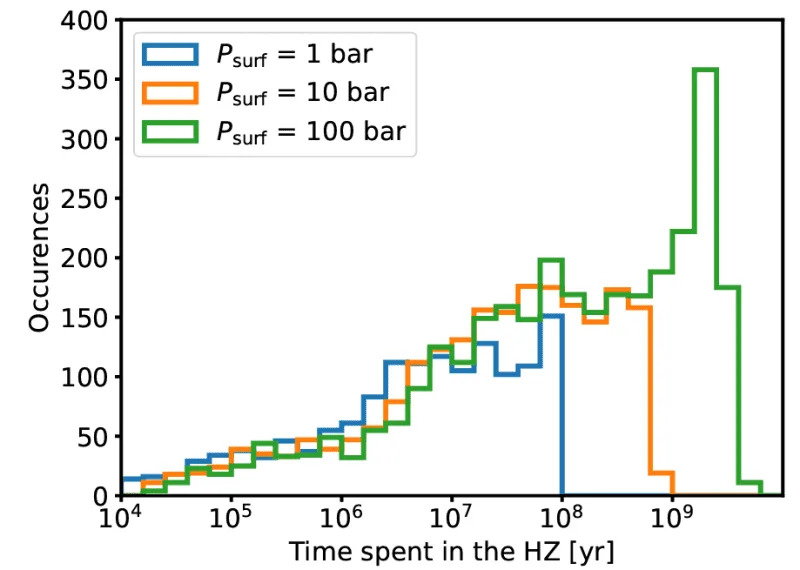
Updated time spent in the habitable zone for 𝑋C+O =10−2 and C/O=0.59 using the semi-major axis and eccentricity distribution and their evolution for Earth-mass moons. (CREDIT: Monthly Notices of the Royal Astronomical Society)
Observational Prospects
Free-floating planets may be common: current estimates suggest the Milky Way could host numbers comparable to its stars, possibly hundreds of billions. Detecting such moons directly is beyond current instruments, but future transit surveys and gravitational microlensing observations could reveal free-floating planets and, in favorable cases, their satellites. With theoretical signatures now predicted, astronomers will know what to look for as detection capabilities improve.
The galaxy’s dark stretches may be less barren than they appear. The study is published in Monthly Notices of the Royal Astronomical Society.
Help us improve.