New research shows newborns respond to rhythm and melody within moments of birth, suggesting some musical abilities are innate. Scientists now emphasize "musicality"—a multicomponent biological capacity that includes beat perception, pitch processing, timing expectations, and emotional response. Comparative studies, clinical cases, brain imaging, and emerging genomic data support the idea that musicality has deep evolutionary roots and may have preceded language.
Born Musical: New Study Shows Infants Detect Rhythm and Melody Immediately
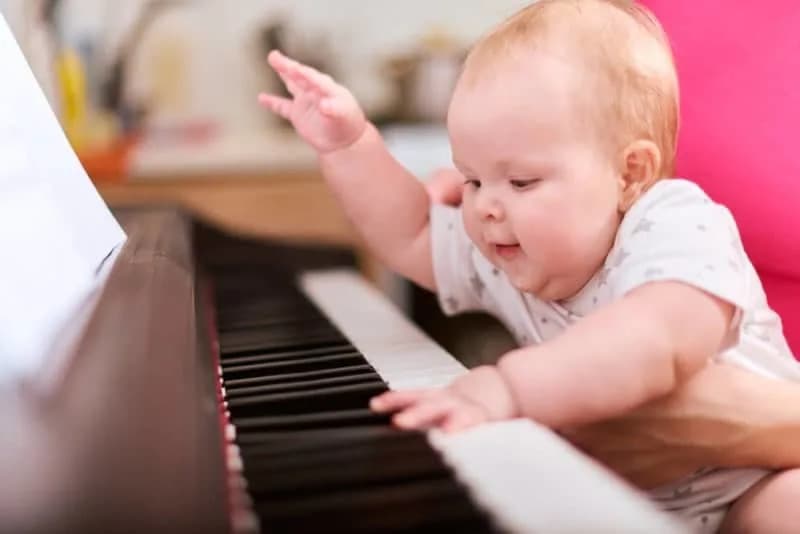
Research suggests humans may be biologically wired for music, with musical abilities appearing in infancy and across cultures. (CREDIT: Shutterstock)
Moments after birth—before an infant can speak, read, or walk—the newborn brain already responds to rhythm and melody. Researchers report that babies quickly detect regularities in timing and pitch, indicating that the human brain begins organizing sound in music-like ways long before language appears.
Infant Evidence: Early Sensitivity to Sound Structure
Multiple studies show that newborns can distinguish different rhythmic patterns and prefer certain melodic contours. Even before they understand words, infants form expectations about when sounds should occur and which pitches are likely to follow. These behaviors appear spontaneously rather than through explicit teaching, suggesting an inborn sensitivity to structured sound.
Henkjan Honing, a music-cognition professor at the University of Amsterdam, says: "Infants respond to rhythm and melody without being taught. That strongly suggests we are born with biological predispositions for musical structure."
Framing Music as "Musicality"
Researchers increasingly favor the term "musicality"—a biological capacity made up of components such as beat perception, pitch processing, timing expectations, and emotional response—over viewing music solely as a cultural art form. This multicomponent perspective treats musicality as a mosaic of cognitive abilities, each of which may have its own evolutionary history.
If a musical trait is found in humans and other primates, it likely existed in our common ancestor. (CREDIT: Wikimedia / CC BY-SA 4.0)
Cross-Cultural Patterns and Cognitive Biases
Across cultures, scholars have found recurring features in musical systems: similar pitch intervals, rhythmic constraints, and melodic shapes. These "statistical universals" point to shared cognitive biases in how human brains organize sound, rather than to simple accident or imitation.
Comparative and Clinical Evidence
Comparative cognition studies look beyond humans to identify which traits are ancient and which are uniquely human. For example, trained macaque monkeys can adapt tapping patterns to synchronize with complex human rhythms in laboratory settings, hinting at neural mechanisms for timing and beat perception. Songbirds and some marine mammals produce rhythmic and melodic vocalizations despite lacking human-like language systems, showing that components of musicality can evolve independently of speech.
Clinical observations support a partial neural separation between music and language. Brain imaging shows overlapping but distinct pathways for music and speech. Patients with severe aphasia may lose language yet retain musical skills, while individuals with congenital amusia struggle with musical pitch perception but can have normal language abilities.
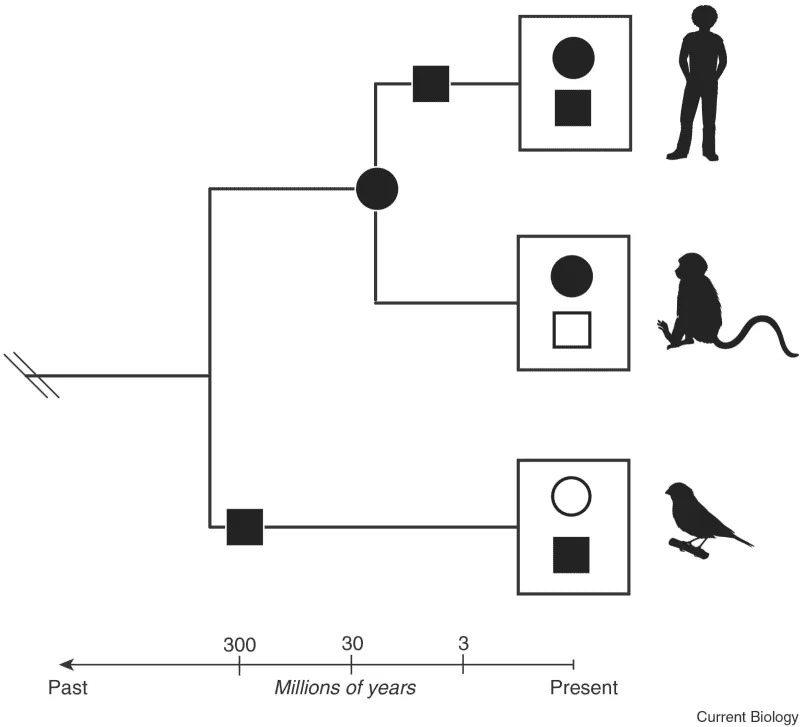
Diagrammatic representation of the comparative approach. It shows a hypothetical phylogenetic tree that illustrates the evolution of several traits that humans may share with monkeys and birds. Filled shapes represent a hypothetical trait (such as vocal learning or beat perception); open shapes indicate the absence of that trait. (CREDIT: Current Biology)
How Musicality Might Have Evolved
Rather than arising de novo, musicality may have formed by recombining older perceptual, motor, and emotional neural systems. Advances in genomics are beginning to identify genes linked to auditory processing, rhythm sensitivity, and vocal learning, allowing scientists to trace components of musicality across species and developmental stages.
Where Research Is Headed
The study of musicality now spans neuroscience, developmental psychology, genetics, and evolutionary biology. Scientists are asking precise, testable questions about how organisms detect patterns, perceive beats, and derive pleasure from structured sound. Recent findings—reported online in Current Biology (article 00140-5)—mark a shift from philosophical speculation to empirical investigation.
Source: The Brighter Side of News (original headline: "Humans are born musical, study finds").
Help us improve.