The comb jellies (ctenophores) are ancient, brainless animals that may nonetheless possess an early form of centralized neural processing. Using volume electron microscopy, researchers mapped the 3D cellular architecture around the aboral organ of Mnemiopsis leidyi and found a centralized nerve net plus 17 distinct cell types, 11 previously undescribed. The aboral organ connects directly to locomotory systems and may use vesicle-rich cells for volume transmission, suggesting greater complexity in early nervous systems. These findings raise new questions about ctenophore development and their place in animal evolution.
This Strange Comb Jelly Structure May Be an Ancestral Brain — 3D Study Reveals Unexpected Complexity
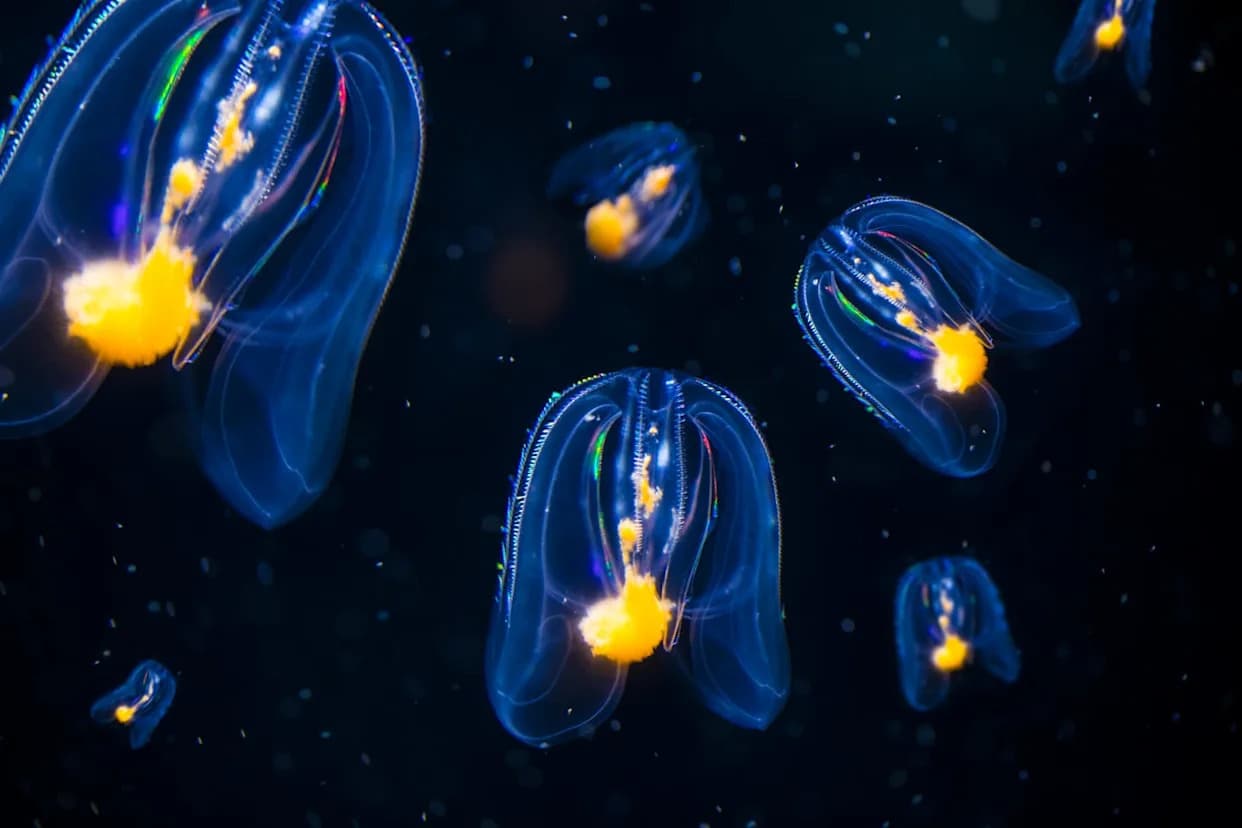
Weird comb jellies might have given rise to brainsLPETTET - Getty Images
Oblong, bioluminescent shapes drifting in the deep ocean have fascinated scientists for decades. These gelatinous animals—known as comb jellies or ctenophores—have existed for roughly 550 million years and, unlike many other animals, never evolved a conventional brain. New three-dimensional cellular mapping shows that a specialized structure they possess, the aboral organ, together with a surrounding centralized nerve net, may act as an early integrative neural center.
What the Study Did
Marine biologist Paweł Burkhardt of the University of Bergen and developmental biologist Maike Kittelmann of Oxford Brookes University used volume electron microscopy to create the first 3D cellular map of a ctenophore’s nervous structures. Their work, published in Science Advances, examined the species Mnemiopsis leidyi and revealed far greater organization around the aboral organ than previously recognized.
Key Findings
The researchers found a net of fused neurons centralized around the aboral organ that forms synaptic connections with efferent neurons. Those efferent neurons carry motor signals to the peripheral nervous system and link directly to locomotory structures such as the comb rows, indicating the organ’s role in coordinating behavior.
In total, the team identified 17 distinct cell types in and around the aboral organ, 11 of which had not been described before. Many of these cells are rich in vesicles—small, fluid-filled sacs—leading the authors to propose that the organ may use volume transmission, where neuroactive molecules diffuse through extracellular fluid to influence distant cells in addition to classic synaptic signaling.
Why It Matters
Genetic analyses have suggested ctenophores branched off very early in animal evolution—possibly before sponges—placing them among the most ancient animal lineages. If the aboral organ functions as an integrative neural hub, it suggests that early nervous systems may have been more centralized and complex than previously assumed. This challenges simple models of nervous system evolution and could reshape our ideas about how the first brains evolved.
Open Questions
Important mysteries remain. It is unclear why the aboral organ persists into adulthood in ctenophores, whereas related larval sensory organs in cnidarians or many bilaterians are transient. The molecular pathways that build and pattern the ctenophore nervous system also appear unique and need further study to determine whether the aboral organ and canonical brains share a common evolutionary origin or represent independent solutions to similar challenges.
“The presence of multiple and distinctive cell types identifies the aboral organ as a complex sensory organ capable of processing and integrating diverse sensory signals,” the authors wrote in Science Advances.
While definitive evolutionary answers will require more genomic and developmental data, Mnemiopsis leidyi and other ctenophores provide a valuable window into the deep past—and into the possible origins of complex neural processing.
Help us improve.