Pope Leo XIV issued a measured appeal for dialogue and an end to the U.S.-Israel war in Iran while mourning the death of Rev. Pierre El Raii in southern Lebanon. Two U.S. cardinals — Robert McElroy and Blase Cupich — publicly condemned the conflict, arguing it fails moral criteria and criticizing how it is being depicted in U.S. social media. Vatican officials and other church leaders warned against the detachment of modern remote warfare and the risks of endorsing preventive war. The Vatican’s new U.S. ambassador, Archbishop Gabriele Caccia, will face the task of clarifying the Holy See’s position amid rising tensions.
Pope Calls for Dialogue as U.S. Cardinals Denounce U.S.-Israel War in Iran
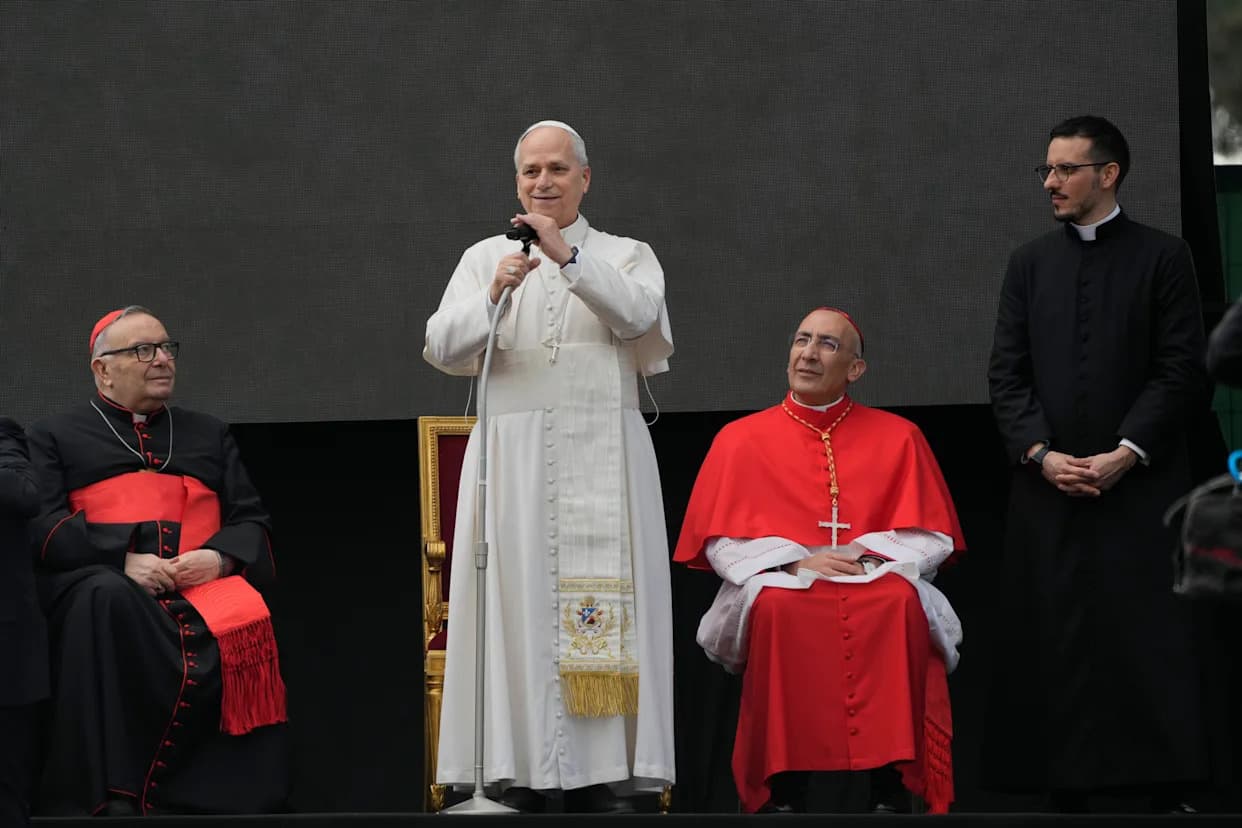
Cardinal Francesco Montenegro, left, and from right, Father Paolo Stacchiotti and Cardinal Baldo Reina listen to Pope Leo XIV during a visit to the parish complex of Santa Maria della Presentazione on the outskirts of Rome, Sunday, March 8, 2026. (AP Photo/Gregorio Borgia)
ROME — Pope Leo XIV on Monday issued a cautious appeal for an end to the U.S.-Israel war in Iran, urging diplomacy and dialogue even as two prominent U.S. cardinals publicly condemned the conflict and criticized how it has been presented to the public.
The Vatican spokesman, Matteo Bruni, released an evening statement expressing the pope’s “deep sorrow” after the Maronite priest, the Rev. Pierre El Raii, was killed in southern Lebanon. Vatican News reported that El Raii, pastor of Qlayaa, died in a bombing while attempting to rescue a wounded parishioner.
Bruni said the pope was praying for all victims, “especially the children,” and added that Leo “is following events with concern and prays for an end to hostilities as soon as possible.” In the days since the war began, the pope has repeatedly urged dialogue and diplomacy while speaking carefully to avoid inflaming political tensions.
Italian newspaper La Repubblica noted a contrast: the pope’s calls for negotiation and restraint versus political leaders who have invoked religious language and scripture to justify military action.
Several bishops, however, have been more direct in their criticism. Cardinal Robert McElroy, the archbishop of Washington, said the United States and Israel failed to meet the minimum moral criteria for a just war — including evidence of an imminent threat, clearly articulated objectives, and a reasonable expectation that benefits would outweigh harms.
“Lebanon may fall into civil war. The world’s oil supply is under great strain. The potential disintegration of Iran could well produce new and dangerous realities. And the possibility of immense casualties on all sides is immense,” McElroy said, concluding that Catholic teaching does not justify entry into this conflict.
Cardinal Blase Cupich, archbishop of Chicago, condemned White House social media posts that spliced action‑movie clips with real footage of the war.
“A real war with real death and real suffering being treated like it’s a video game — it’s sickening,” Cupich said. “Our government is treating the suffering of the Iranian people as a backdrop for our own entertainment, as if it’s just another piece of content to be swiped through.”
Other church leaders echoed these concerns. Cardinal Pablo Virgilio David, vice president of the Federation of Asian Bishops' Conferences, warned that remote, computerized warfare risks detaching operators from the human consequences of their actions.
The Vatican, which traditionally maintains diplomatic neutrality, has also criticized the rationale for preventive attacks. Cardinal Pietro Parolin, the Vatican secretary of state, cautioned that recognizing a unilateral right to “preventive war” without an overarching legal framework could set the world ablaze.
The Holy See’s newly appointed ambassador to the United States, Archbishop Gabriele Caccia, will soon be responsible for articulating the Vatican’s position in Washington and balancing relations with U.S. bishops and the U.S. administration. Vatican commentator Massimo Faggioli noted that Caccia must navigate tensions between the Vatican’s diplomatic stance and the U.S. political rhetoric surrounding the conflict.
Associated Press note: AP religion coverage receives support through the AP’s collaboration with The Conversation US, with funding from Lilly Endowment Inc. The AP is solely responsible for this content.
Help us improve.