
The U.S. will deploy the Merops counter-drone system to the Middle East after the platform proved effective against Russian attack drones in Ukraine. Merops intercepts hostile drones with smaller autonomous drones and uses AI to operate when communications are jammed, providing a compact, lower-cost alternative to expensive missile interceptors. Most systems will be supplied by Perennial Autonomy and will be placed at multiple sites, including locations without U.S. troops, to bolster defenses against large inventories of inexpensive Iranian Shahed drones.
U.S. To Deploy Merops Anti-Drone System To Middle East After Proven Success In Ukraine
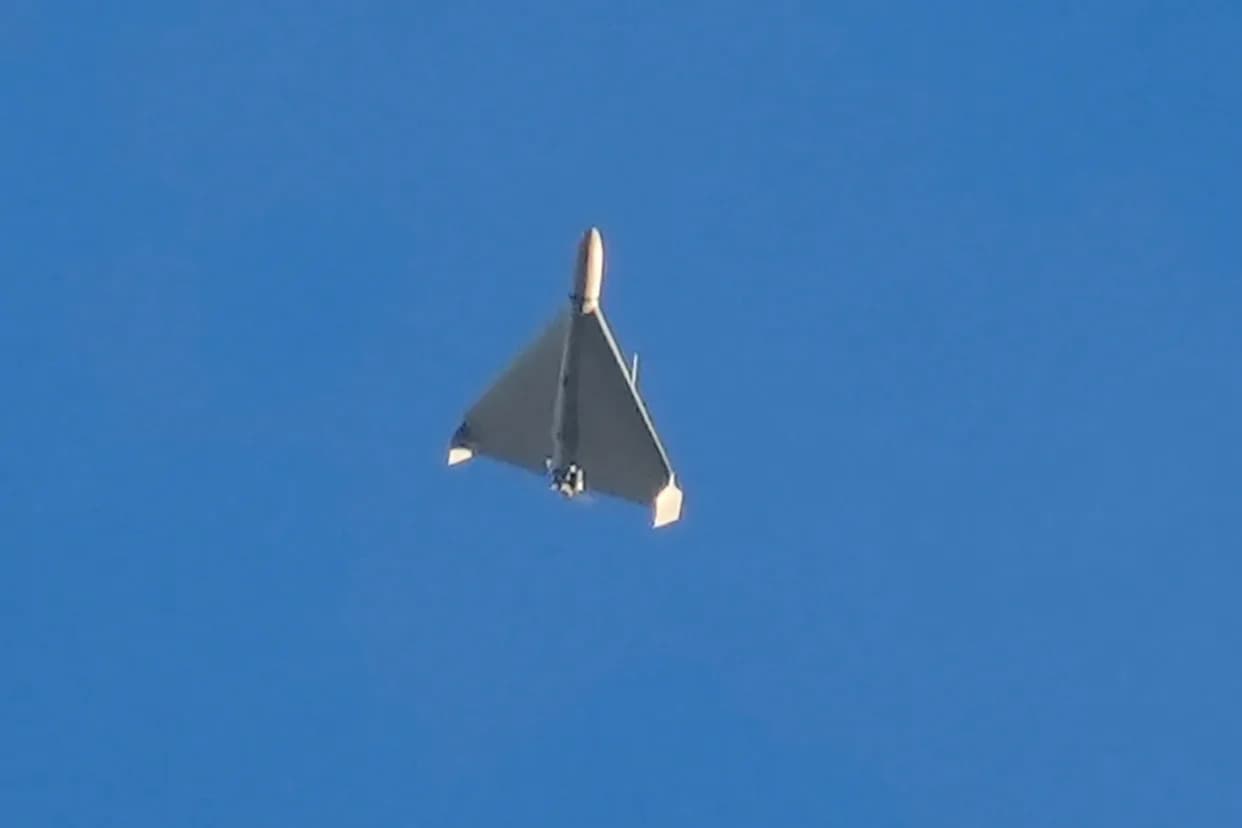
An Iranian Shahed exploding drone launched by Russia flies through the sky seconds before it struck buildings in Kyiv, Ukraine, on Oct. 17, 2022. (Efrem Lukatsky/AP)(Efrem Lukatsky)
Two U.S. officials told The Associated Press that an American anti-drone system called Merops, which proved effective against Russian attack drones in Ukraine, will be sent to the Middle East to strengthen defenses against Iranian-made drones.
What Merops Is And How It Works
Merops is a compact counter-drone platform that intercepts hostile drones with smaller defensive drones. The system is small enough to fit in the bed of a midsize pickup truck, can identify and track small aerial targets, and uses artificial intelligence to navigate autonomously when satellite links and electronic communications are degraded or jammed.
Why The System Is Being Deployed
U.S. defense officials say existing missile defenses such as Patriot and THAAD are effective against missiles but are not a cost-efficient answer to waves of inexpensive Iranian Shahed drones. Drones are difficult to detect on radars calibrated for high-speed missiles and can be mistaken for birds or civilian aircraft. Merops is designed to spot and neutralize those small, slow-moving targets at far lower cost than firing an interceptor missile that can cost hundreds of thousands of dollars against a drone reported to cost under $50,000.
Operational Context
Merops was put into service in NATO-member Poland and Romania last November after Russian attack drones crossed NATO airspace, and officials say lessons learned from those deployments and from systems used in Ukraine informed the decision to send the platform to the Middle East. The systems will be deployed to multiple sites across the region, including locations where U.S. troops are not present. Most of the units will be supplied directly by Perennial Autonomy, the manufacturer backed by former Google CEO Eric Schmidt.
“It’s really, really expensive to take down a cheap drone,” said Rep. Jim Himes, the top Democrat on the House Intelligence Committee, describing the problem as a “math problem” for U.S. defenses.
Ukrainian President Volodymyr Zelenskyy said the U.S. had asked Ukraine for help combating Iran’s Shahed drones; a U.S. defense official confirmed Merops is part of that assistance. When asked about Ukraine’s role, former President Donald Trump told Reuters, “Certainly, I’ll take, you know, any assistance from any country.”
Defense officials acknowledged in private briefings that stopping waves of Iranian-launched drones remains challenging and some targets in the Gulf region remain vulnerable. Defense Secretary Pete Hegseth said, “This does not mean we can stop everything, but we ensured that the maximum possible defense and maximum possible force protection was set up before we went on offense.”
Industry leaders echoed calls to accelerate deployment of counter-drone technologies. Michael Robbins, president and CEO of AUVSI, said lessons from Ukraine and the Middle East show the U.S. must speed fielding advanced systems so forces and civilians can be protected without “spending a million dollars to stop a $50,000 threat.”
Help us improve.





















