Mexico announced Plan Kukulkan, a security operation that will deploy just over 99,000 personnel — including about 20,000 military and 55,000 police — to protect fans during the 2026 World Cup in Guadalajara, Mexico City and Monterrey. The move follows violent reprisals after the Feb. 22 army raid that killed Jalisco New Generation Cartel leader Nemesio "El Mencho," which left more than 70 dead. The plan includes around 2,500 vehicles, 24 aircraft, anti-drone systems and explosive-detection dogs. FIFA and Mexican officials say the unrest will not affect the tournament.
Mexico Rolls Out Nearly 100,000 Security Personnel for World Cup After Cartel Violence
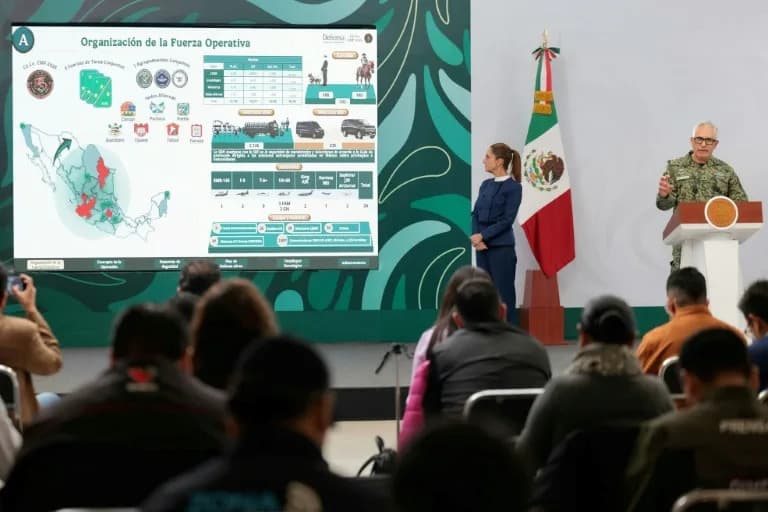
President Claudia Sheinbaum unveiled the Mexico's World Cup security plan less than two weeks after an explosion of violence in Guadalajara, which will host four games (Handout)(Handout/Mexican Presidency/AFP)
Mexico announced a major security operation on Friday to protect fans and venues during the 2026 FIFA World Cup, deploying just over 99,000 personnel across three host cities after a recent surge of cartel-related violence.
Plan Kukulkan, named after the Mayan serpent deity, will cover Guadalajara, Mexico City and Monterrey as well as nearby tourist areas for the month-long tournament co-hosted with the United States and Canada (June 11–July 19).
Deployment Details
General Román Villalvazo Barrios, head of Mexico's World Cup coordination centre, said the operation comprises about 20,000 military personnel (including National Guard troops), 55,000 police officers and members of private security firms — "a total of just over 99,000 personnel." The plan will draw on roughly 2,500 military and civilian vehicles, 24 aircraft, anti-drone systems and specially trained dogs to detect explosives and other threats. Authorities said they are coordinating security efforts with the United States and Canada.
Context: Cartel Violence After 'El Mencho' Raid
The announcement came less than two weeks after an army raid on February 22 killed Nemesio "El Mencho" Oseguera, the leader of the Jalisco New Generation Cartel (JNGC). The operation and ensuing clashes reportedly left more than 70 dead and triggered violent reprisals by cartel members, including road blockages across 20 of Mexico's 32 states and arson attacks on vehicles and businesses in Guadalajara and the Jalisco resort of Puerto Vallarta.
Officials say the unrest has not affected planned World Cup matches. Guadalajara, Mexico City and Monterrey will host 13 matches between them, with the tournament opening at Mexico City's Azteca Stadium on June 11. Guadalajara is set to stage four games.
Reassurances From Officials And FIFA
Both FIFA and Mexican authorities have emphasized that the violence will not disrupt the World Cup. FIFA president Gianni Infantino told AFP he was "very reassured" following discussions with President Claudia Sheinbaum, who unveiled the plan at a military base in Zapopan, a suburb of Guadalajara. Security Secretary Omar García Harfuch also met FIFA representatives to review arrangements.
Local authorities note that Jalisco remains heavily affected by organized crime: more than 12,575 people are reported missing in the state, many believed abducted or killed by armed groups. The security operation aims to protect visiting fans, players and venues while addressing these broader public-safety challenges.
What To Watch: Implementation of Plan Kukulkan in the host cities, coordination with U.S. and Canadian security teams, and ongoing stability in Jalisco in the run-up to the tournament.
Help us improve.