
The NPC’s announcement of a 7% defense spending rise and tougher rhetoric on Taiwan coincided with a high-tempo U.S. campaign in the Middle East, raising short-term worries in Taipei about U.S. readiness. But the U.S. operation’s demonstration of reach and precision, reports of shortcomings with some Chinese-made systems, and an ongoing PLA personnel purge have complicated Beijing’s options. With Taiwan’s domestic politics in flux and U.S. strategic commitments to the First Island Chain, analysts judge a near-term invasion unlikely despite hawkish messaging.
How the U.S. Campaign in Iran Reshapes the Strategic Calculus Over Taiwan
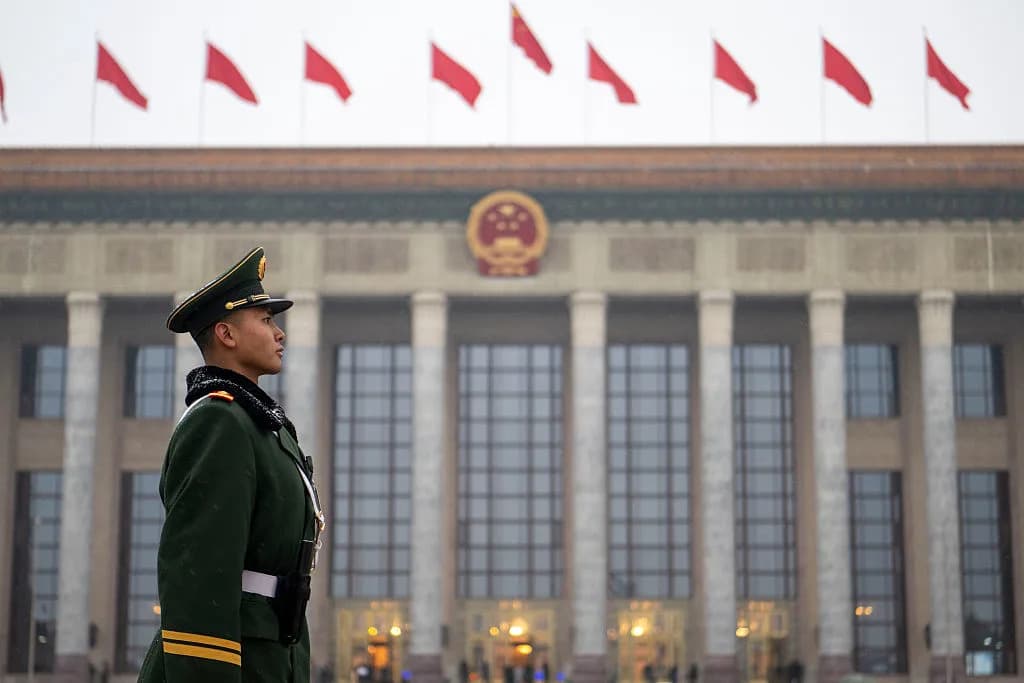
A security officer stood guard near Beijing’s Great Hall of the People as China opened its annual National People’s Congress (NPC). From that podium, Premier Li Qiang announced a 7% rise in defense spending and used firmer rhetoric toward Taiwan, the self-governing island Beijing claims as its own.
Li pledged the People’s Liberation Army (PLA) would “accelerate the development of advanced combat capabilities” and said Beijing would “resolutely crack down on separatist activities” in Taiwan — language that marked an escalation from last year’s pledge merely to “oppose” such moves.
Why the Timing Raised Alarm
At first glance, the announcement alarmed Taipei. U.S. operations in the Middle East—driven by a high-tempo campaign against Iranian forces—have consumed sophisticated munitions that would be critical in a Taiwan contingency. Sources told TIME that senior U.S. officials privately briefed members of Congress on the state of U.S. weapons reserves, stoking concerns in Taipei, Kyiv and Washington about short-term readiness.
Some analysts argued that with American forces and stocks engaged far from East Asia, Xi Jinping might see a temporary window to act against Taiwan, which Beijing insists must be “reunified.” Others warned that the perceived transactional posture of the current U.S. administration could be misread as permissive.
Why the Campaign Might Actually Deter Aggression
Yet several developments stemming from the U.S. campaign complicate that dour reading. Operationally, U.S. strikes demonstrated long-range reach and complex coordination. Media reports and official statements described strikes on many targets across the region during the campaign’s opening days; independent verification of some specific claims varied, and several high-profile assertions circulated in the press remain contested or unconfirmed.
What stood out to many observers was the demonstration of precision, real-time intelligence, and complex combined operations — capabilities that underscore the difficulty any adversary would face in attempting a surprise conquest of a well-defended island like Taiwan. As one analyst put it, the perceived feasibility of a “decapitation” strike against an adversary’s top leadership has become more salient, and China must reckon with that risk.
At the same time, reports of performance issues with some Chinese military systems sold to allies in crisis zones have raised questions about the maturity and reliability of Beijing’s defense exports. Whether those reports accurately reflect systemic failings or are isolated incidents, they have dented the perception of unassailable Chinese hardware and provided a cautionary signal for PLA planners.
Internal Chinese Constraints
Beijing also faces internal constraints. The NPC-approved defense increase of 7% exceeds China’s modest GDP growth target but is slightly smaller than the defensive spending pace of recent years. The PLA is undergoing a sweeping personnel shake-up: the NPC removed several senior military figures from public lists, part of a broader anti-corruption and “political rectification” campaign intended to tighten Party control over the armed forces. Such purges can improve discipline but also raise short-term questions about command cohesion and readiness.
Diplomatically and economically, China’s position is not immune to the fallout from regional instability. Beijing’s diplomatic prestige was tested by how the crisis unfolded, and disruptions to Middle Eastern shipping and energy flows underscore China’s ongoing exposure to foreign oil and LNG supplies despite large reserves and longer-term green-energy ambitions.
Taiwan’s Domestic Politics And Strategic Calculus
Taiwan’s political scene complicates Beijing’s calculus as well. The ruling Democratic Progressive Party (DPP) struggles with low approval ratings, legislative stalemate and internal divisions, while the opposition Kuomintang (KMT) has regained traction by emphasizing stability and closer ties with the mainland. Those shifts could reduce domestic willingness in Taiwan for confrontational policies — or at least make Beijing more cautious about timing any coercive move.
Finally, despite concerns about U.S. policy volatility, Washington’s recent National Defense Strategy reaffirms a focus on building a strong denial posture along the First Island Chain, which includes Taiwan. Most analysts conclude that, given the risks, costs and uncertainties, Beijing is unlikely to launch an invasion unless it is confident the U.S. cannot intervene and that victory would be decisive and affordable.
Bottom line: Li Qiang’s tougher words and a larger defense budget signal Beijing’s intent to keep pressure on Taiwan, but operational lessons from the Middle East, questions about Chinese equipment performance, internal PLA shake-ups, Taiwan’s domestic politics, and continued U.S. deterrence efforts together make an immediate invasion less likely — at least for now.
Help us improve.





















