
President Claudia Sheinbaum has intensified operations against the Jalisco New Generation Cartel following the killing of its leader, El Mencho, prompting deadly and widespread cartel retaliation. Her strategy combines targeted strikes on leadership with deeper operational cooperation and accelerated extraditions to the United States. The authors argue that disciplined U.S. support — not public threats of unilateral action — will preserve intelligence cooperation, strengthen Mexico’s credibility, and better disrupt transnational narcoterrorism. Long-term success will also require addiction treatment, anti-corruption measures and economic resilience.
Sheinbaum’s Calculated Push Against Narcoterrorism: Why U.S. Support Matters
When Mexican security forces killed Nemesio Oseguera Cervantes — widely known as “El Mencho,” the longtime leader of the Jalisco New Generation Cartel — the cartel’s response was immediate, widespread and violent. Streets became battlegrounds, highways were blockaded with burning vehicles, and armed convoys menaced neighborhoods. In the first 24 hours after the operation, coordinated counterattacks killed dozens of Mexican National Guard members, underscoring that Jalisco New Generation operates with paramilitary capability rather than as a conventional street gang.
An Assertive Strategy
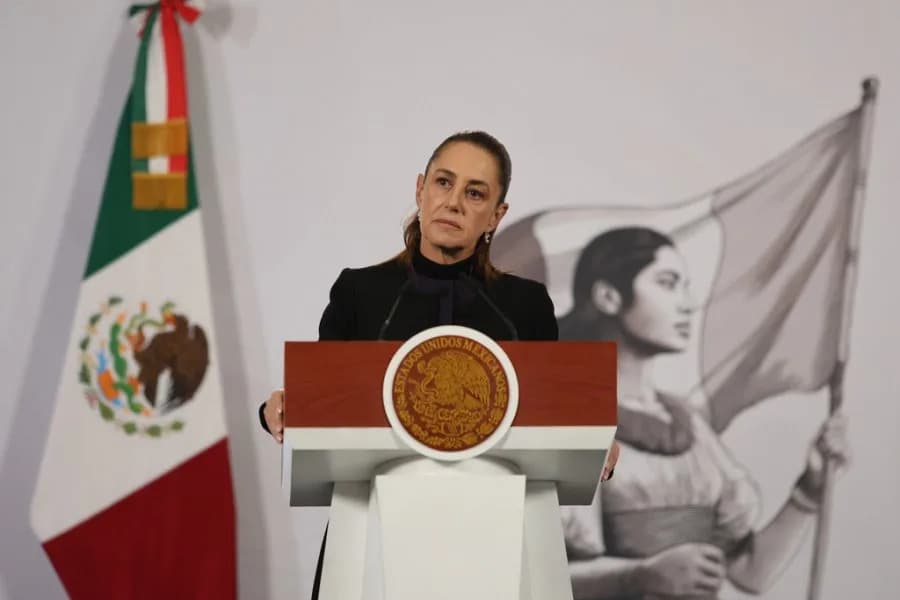
President Claudia Sheinbaum has pursued a two-track approach since taking office: direct operations targeting cartel leadership, and deeper operational cooperation with U.S. counterparts. These moves include coordinated intelligence-sharing, synchronized targeting of senior figures and an acceleration of extraditions of high-level operatives to U.S. courts — steps intended to disrupt command structures and degrade transnational networks.
Partnership, Not Isolation
This was not a unilateral Mexican operation conducted in isolation. Targeting cartel leadership depended on close collaboration with U.S. law-enforcement partners: shared intelligence, coordinated operational planning and joint investigative work. Recent high‑level visits by U.S. officials — including senior law-enforcement representatives — highlighted a more operational, intelligence-driven partnership that now defines much of the bilateral security relationship.
The Stakes and the Risks
Groups like Jalisco New Generation possess armored vehicles, military-grade weapons and the capacity to intimidate or co-opt officials. Authorizing strikes against senior leadership invites brutal retaliation that threatens civilians, security forces and political stability. The violent backlash after El Mencho’s death demonstrates both the scale of the threat and the heavy personal and political risks President Sheinbaum is undertaking.
Why Washington’s Tone Matters
Public threats or talk of unilateral military action on Mexican soil would risk undermining the very cooperation that has enabled recent gains. Disciplined public messaging, steady diplomatic backing, sustained intelligence sharing and operational support will strengthen Sheinbaum’s credibility at home and enhance joint efforts against transnational organized crime. Conversely, escalatory rhetoric can disrupt intelligence flows, encourage opportunistic criminal actors and weaken a crucial partner.
Supply, Demand, and The Broader Fight
Fentanyl and other illicit drugs devastate American communities, but U.S. demand and the flow of precursor chemicals and weapons across the border fuel cartel operations. Meaningful progress therefore requires a comprehensive strategy: sustained enforcement, addiction treatment, anti‑corruption efforts, institutional reform and economic resilience in affected regions. Still, removing leadership, severing logistics and dismantling financial pipelines remain essential prerequisites for long-term reform.
Conclusion: An Ally, Not An Adversary
President Sheinbaum’s campaign against powerful criminal organizations demonstrates political will and a readiness to accept significant risks. The United States benefits when Mexico acts decisively, and Mexico benefits when the bilateral partnership is steady, professional and predictable. In the face of transnational narcoterrorism, Washington should reinforce Mexico’s efforts with practical support, robust intelligence cooperation and disciplined public messaging — the most effective alternative to unilateral threats.
Authors: Richard Swett served as U.S. Representative for New Hampshire’s 2nd District (1991–1995) and as U.S. Ambassador to Denmark (1998–2001). Christopher Shays served as U.S. Representative for Connecticut’s 4th District (1987–2009).
Help us improve.





















