
Senior U.S. officials have warned that Iran poses a growing threat as negotiators prepare to meet in Geneva for the third round of nuclear talks. Washington has increased its military presence in the region amid concerns about Iran's nuclear and missile programs. U.S. leaders, including President Trump and Sen. Marco Rubio, say Tehran is rebuilding nuclear capabilities and expanding missile reach, while Iran insists missile issues be kept out of the Geneva talks. Diplomats from both sides will meet to assess whether a negotiated agreement is possible.
U.S. Officials Warn Of Growing Iranian Threat Ahead Of Geneva Nuclear Talks
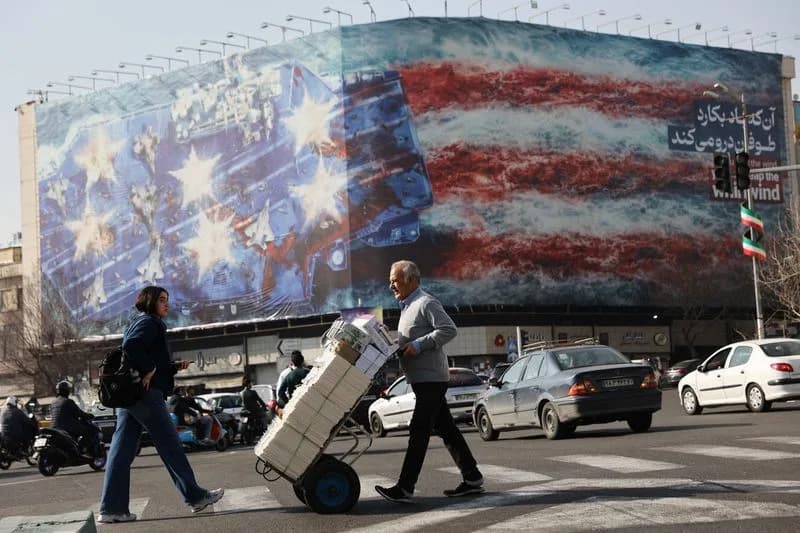
People walk past an anti-U.S. billboard in Tehran, Iran, February 19, 2026. Majid Asgaripour/WANA (West Asia News Agency) via REUTERS
Senior Trump administration officials and lawmakers warned on Wednesday that Iran poses a growing threat to the United States as delegations prepare to meet in Geneva for the third round of nuclear negotiations this year.
U.S. and Iranian negotiators are due to meet in Geneva on Thursday. Washington has amassed one of its largest military deployments in the Middle East amid concerns about possible strikes and rising tensions with Tehran.
In his State of the Union address, President Donald Trump accused Iran of restarting parts of its nuclear program, pursuing missile development that he said could soon reach the United States, and of responsibility for roadside bombings that have killed U.S. service members and civilians. He warned it would be "a very bad day" for Iran if no workable agreement is reached.

U.S. Vice President JD Vance attends U.S. President Donald Trump's State of the Union address in the House Chamber of the U.S. Capitol in Washington, D.C., U.S., February 24, 2026. REUTERS/NATHAN HOWARD
Sen. Marco Rubio, speaking from Basseterre, St. Kitts and Nevis, echoed the administration's concerns, saying Iran appears to be rebuilding elements of its nuclear effort and expanding its missile capabilities. "After their nuclear program was obliterated, they were told not to try to restart it, and here they are," Rubio said.
Administration officials have said in recent months that Tehran may be close to the capability needed to build a nuclear weapon; those assessments are attributed to U.S. officials and remain contested by other parties.
U.S. lawmakers and aides also highlighted Iran's extensive ballistic missile inventory. U.S. intelligence agencies assess Iran has the largest stockpile of ballistic missiles in the Middle East. Iran has an informal, self-imposed missile range limit of roughly 2,000 km (1,240 miles), a distance officials have said is intended to cover regional threats, including Israel.
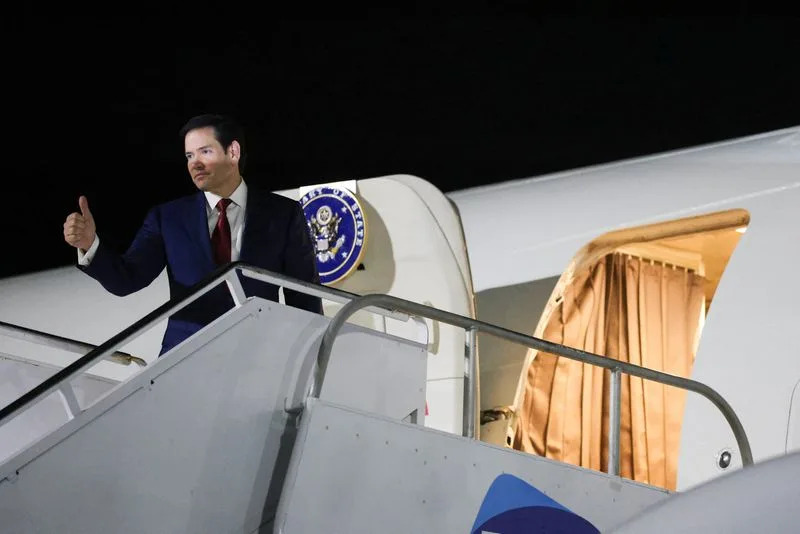
U.S. Secretary of State Marco Rubio gives a thumbs up as he boards his plane to return to Washington after meetings with Caribbean Community (CARICOM) leaders, from Robert L. Bradshaw International Airport in Basseterre, Saint Kitts and Nevis, February 25, 2026. REUTERS/Jonathan Ernst/Pool
Diplomacy Ahead Of Talks
Vice President J.D. Vance said U.S. envoys would meet an Iranian delegation in Geneva to evaluate whether an agreement can be reached, summarizing the administration's position as: "Iran cannot have a nuclear weapon."
Iranian Foreign Minister Abbas Araqchi arrived in Geneva and met with Oman's foreign minister, Badr al-Busaidi, ahead of the talks. Iran's Press TV reported that Araqchi outlined Tehran's views on the nuclear issue and called for the lifting of what he described as U.S. illegal and unilateral sanctions.
Tehran has insisted ballistic missiles not be part of the Geneva agenda, a stance U.S. officials describe as a significant obstacle to broader progress.
"The talks are the next opportunity to talk," Rubio said, urging that discussions eventually expand beyond the nuclear issue to address regional security concerns.
The reporting was compiled from multiple Reuters correspondents. Claims and assessments cited in this article are attributed to officials and media reports referenced in the original coverage.
Help us improve.





















