President Donald Trump’s first State of the Union since returning to the White House set a new record as the longest presidential address to Congress — a distinction that may prove to be the speech’s most lasting legacy.
Across nearly two hours, the address swung between bright, declarative optimism — including the repeated claim that this is “the golden age of America” — and stark, foreboding language that echoed the dystopian warnings of his first inaugural, when he spoke of “American carnage.” The result was a speech heavy on rhetoric and ceremony but light on concrete policy detail.
On substance, there were only a few new proposals: one notable item called for artificial intelligence data centers to build their own power plants, and the president urged the GOP-controlled Congress to pass legislation while Republicans retain unified control of the White House and both chambers of Congress (a so-called trifecta).
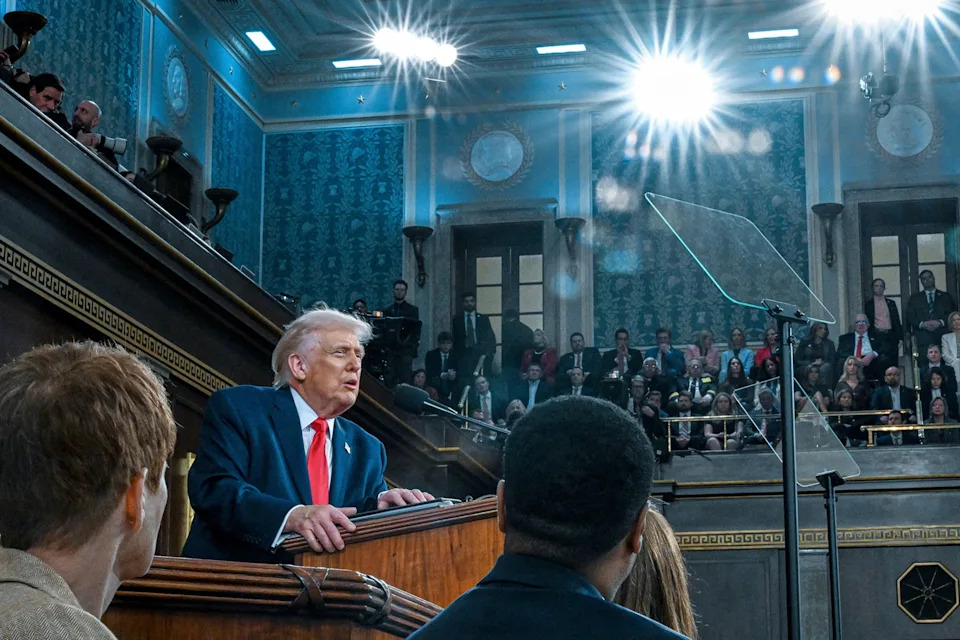
President Donald Trump delivers the State of the Union address to a joint session of Congress in the House chamber at the U.S. Capitol in Washington, Tuesday, Feb. 24, 2026. (Kenny Holston/The New York Times via AP, Pool)(Kenny Holston / The New York Times via AP, Pool)
Much of the evening was devoted to pageantry. The president presented an unusually large number of medals, spotlighted the U.S. men’s Olympic hockey team and staged multiple feel-good moments designed to underscore national achievements. In his telling, the economy was booming, Americans were safer than ever, and global tensions were easing — all credited to his leadership.
Yet the upbeat narrative was frequently undercut by repeated, troubling anecdotes. In one after another, the president highlighted tragic crimes and murders in ways that framed immigrants as threats and cast Democrats as complicit, returning repeatedly to grim imagery rather than policy specifics. That tension between celebration and alarm both weakened the optimistic message and refocused attention on civil-rights concerns critics say have been exacerbated by his administration.
Bottom line: The speech prioritized image and theatrical moments over legislative detail, relying on a blend of triumphal claims and fear-based anecdotes that may deepen political polarization and raise questions about the administration’s approach to civil liberties.
Originally published on MS NOW.