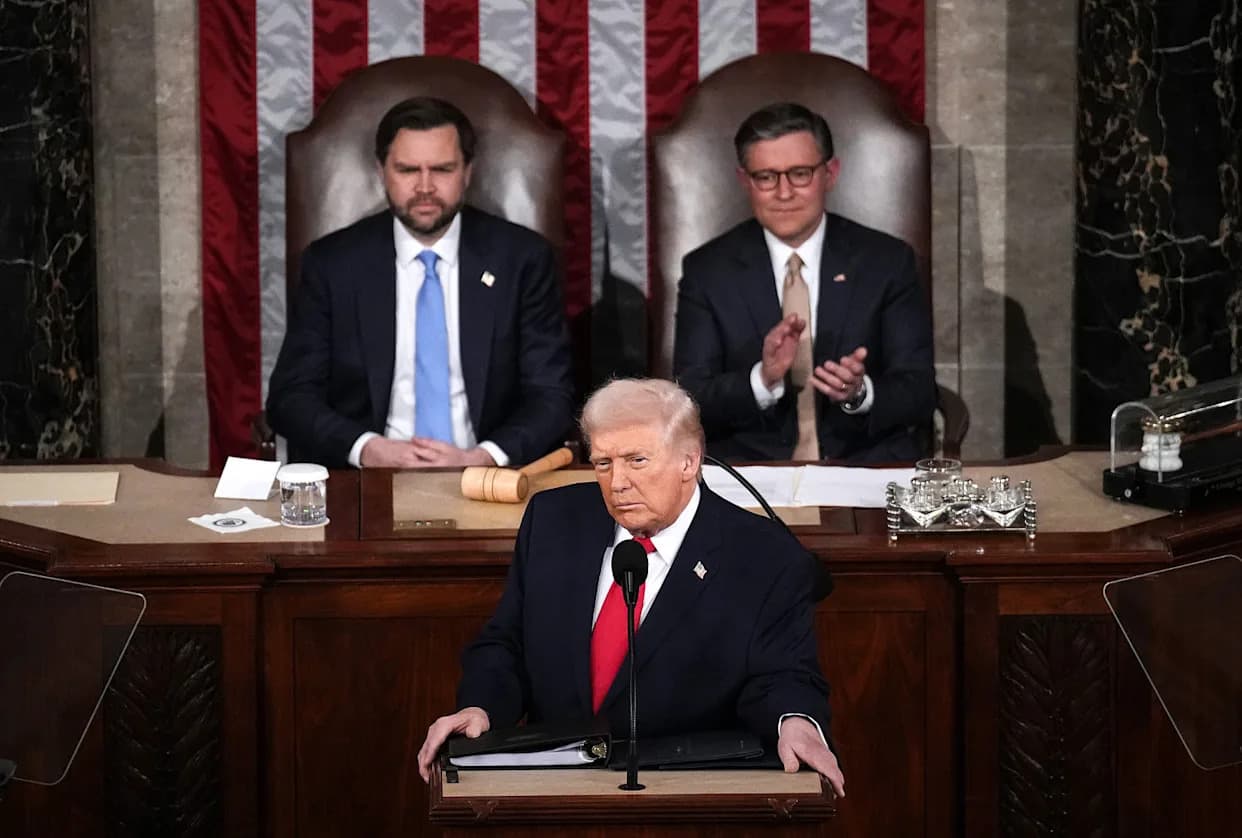
President Donald Trump used Tuesday night’s State of the Union to paint an emphatic picture of American renewal — describing a "roaring economy," defending his tariff strategy and promoting a suite of policies including a contested 2025 tax plan and investment accounts for newborns.
Economy And Tax Promises
Wearing a navy suit, a red tie and a flag pin, Trump delivered a record-length address to a joint session of Congress in which he repeatedly framed the nation as "back bigger, better, richer and stronger than ever before" — even calling it a "golden age of America." Early in the 1-hour, 47-minute speech he declared the economy "roaring like never before" and touted stock-market gains and job statistics to bolster that claim.
He defended keeping unilateral tariffs on foreign goods despite an adverse Supreme Court decision, promising the levies would remain in place under "fully approved and tested alternative legal statutes." Trump argued the tariffs would ultimately replace the income tax — a proposal most economists say would be highly disruptive and that critics say would largely be borne by American consumers.
The president also highlighted elements of his contested 2025 tax plan, including ending taxes on tips and creating investment accounts for newborns dubbed "Trump accounts," which he said could grow to roughly $100,000 by age 18 with modest additional contributions.
Immigration, Deportations And A Heated Floor Exchange
Immigration and deportation were central themes, and the address produced tense, vocal exchanges on the House floor. Trump took credit for tightening the U.S.-Mexico border and defended plans for large-scale deportations, telling Democrats they "should be ashamed of yourselves" for not standing when he said, "The first duty of the American government is to protect American citizens, not illegal aliens." Representatives Ilhan Omar and Rashida Tlaib shouted back, at one point accusing the administration of having "killed Americans," referencing recent violent enforcement actions in Minneapolis.
Policy Proposals That Need Congress
Many of the president's proposals would require legislation from an evenly divided and polarized Congress. Trump proposed annual $1,000 employer contributions to workers' retirement accounts and urged passage of the so-called "Dalilah law," which would bar states from issuing commercial driver’s licenses to undocumented immigrants — citing a guest at the address, Dalilah Coleman, who was seriously injured in a crash involving an undocumented driver.
Foreign Policy And Iran
Trump revisited foreign policy near the end of his remarks, praising a June mission he said degraded Iran's nuclear capabilities and warning that Tehran continues to pursue "sinister nuclear ambitions." He said diplomacy was his preference but reiterated that he would not allow Iran to develop a nuclear weapon and restated his long-used line of "peace through strength." Top congressional leaders had received a classified briefing on Iran earlier in the day.
Reactions And Unaddressed Questions
Republican leaders offered strong praise and pledged to continue advancing the party agenda. Democrats criticized the address as short on substance and noted that the president did not address lingering questions about his administration's compliance with a law requiring release of certain records related to Jeffrey Epstein. Some lawmakers described the speech as heavy on rhetoric and light on actionable detail.
Takeaway: Trump presented an optimistic vision of the nation’s economy and security, but his claims and proposals face skepticism from poll-tested voters, Democratic critics and many economists — and most would require congressional approval to take effect.