The U.S. presented declassified seismic data alleging a June 22, 2020, underground explosion at China’s Lop Nur test site and urged other nations to press China and Russia for deeper nuclear disarmament after New START expired. Washington described the event as a magnitude 2.75 signal consistent with an explosion; Beijing denied the claim and defended its compliance with the Comprehensive Nuclear Test Ban Treaty. Analysts warned the dispute could rekindle arguments for renewed U.S. testing and underscored the diplomatic challenges ahead.
U.S. Releases Declassified Evidence Of Alleged 2020 Chinese Underground Nuclear Test, Urges Global Push For Disarmament
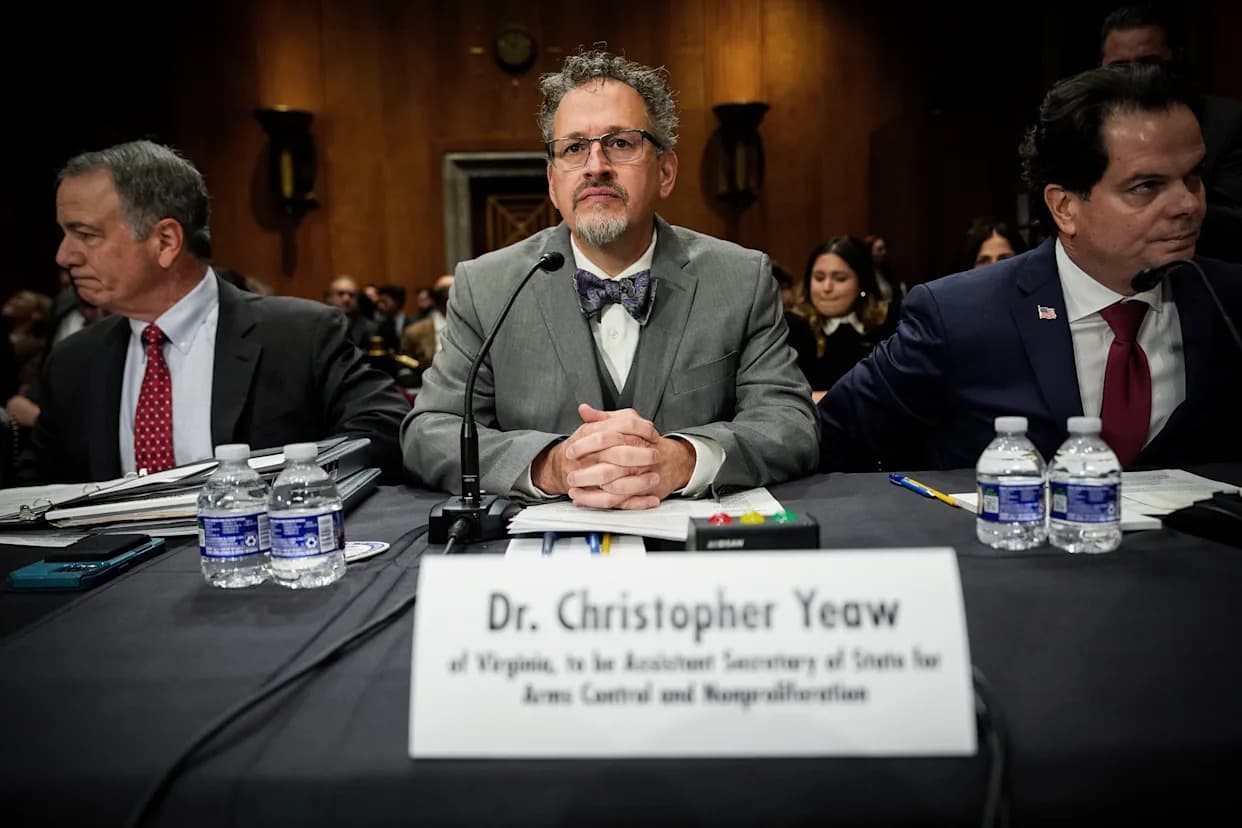
FILE - Christopher Yeaw, center, arrives to a Senate Foreign Relations Committee confirmation hearing on his nomination to be an assistant Secretary of State, Nov. 19, 2025, on Capitol Hill in Washington. (AP Photo/Julia Demaree Nikhinson, File)(ASSOCIATED PRESS)
GENEVA — The United States on Monday presented newly declassified information to a U.N.-backed disarmament forum alleging that China conducted an underground nuclear test on June 22, 2020, and called on other nations to press Beijing and Moscow to pursue deeper nuclear reductions after the recent expiration of the New START treaty.
Declassified Evidence and What It Shows
Christopher Yeaw, Assistant Secretary of State for the Bureau of Arms Control and Nonproliferation, told the Conference on Disarmament that seismic data from an international monitoring station in neighboring Kazakhstan recorded a magnitude 2.75 event at the Lop Nur test site on June 22, 2020. Yeaw described the signal as "indicative of a single high-energy explosion" and said analysts compared the pattern with historical explosions and earthquakes to reach a "probable explosion" assessment.
Why This Matters
Yeaw argued the allegation highlights broader problems following the lapse of New START, which previously placed limits on U.S. and Russian strategic arsenals. He noted the treaty did not address Russia's extensive nonstrategic arsenal—estimated by U.S. officials at as many as 2,000 warheads—and said it failed to account for what Washington calls China’s rapid and opaque nuclear expansion.
"We believe China may achieve parity within the next four or five years," Yeaw said, warning that China has "deliberately, and without constraint, massively expanded its nuclear arsenal."
Responses and Diplomatic Context
China’s ambassador to the conference, Jian Shen, firmly rejected the accusation, calling it "completely unfounded" and accusing the U.S. of distorting China’s nuclear policy. Shen reiterated China’s support for the objectives of the Comprehensive Nuclear Test Ban Treaty and said Beijing has "never" engaged in activities that violate it. He added that China’s arsenal remains smaller than those of the largest nuclear powers and that its security environment differs from the U.S.’s.
Yeaw met with a Russian delegation in Geneva and planned talks with Chinese and other delegations. U.S. officials have also consulted with partners including Britain and France as they consider diplomatic options ranging from bilateral negotiations to multilateral processes.
Expert Views and Risks
Tong Zhao, a senior fellow at the Carnegie Endowment for International Peace, said that if China had conducted a yield-producing nuclear explosive test, it would damage Beijing’s reputation as a responsible nuclear power and could provide ammunition to those in the United States advocating a return to nuclear testing. Some U.S. experts have argued in private and public forums that future testing might be needed to ensure long-term reliability of the U.S. arsenal.
The article also recalled previous U.S. discussions about testing: President Donald Trump signaled possible intent in October to consider resuming nuclear tests for the first time since 1992, though Energy Department officials later said any testing plan would not include nuclear detonations.
What Comes Next
The United States said it will pursue multiple diplomatic avenues to address these concerns, calling on other countries to encourage China and Russia to engage in meaningful arms-control talks. The Conference on Disarmament, which brings together about 65 countries on nuclear, biological and chemical weapons issues, will be a central forum for these discussions.
Key factual points: the U.S. assertion centers on a 2020 seismic event at Lop Nur; China denies the allegation and emphasizes adherence to the Comprehensive Nuclear Test Ban Treaty; and the lapse of New START has raised renewed urgency around how to address the nuclear capabilities and doctrines of the world’s largest powers.
Associated Press reporters Didi Tang and Ben Finley contributed to the reporting.
Help us improve.