More than 200 political detainees at Rodeo I prison near Caracas launched a hunger strike after a newly approved amnesty law excluded many cases, particularly those involving security-force members and terrorism charges. Approximately 214 prisoners are reported to be participating, while some inmates have been released under the law and ICRC teams made a first visit to the facility. The legislation — advanced by interim leader Delcy Rodriguez after a Jan. 3 U.S. operation that removed Nicolás Maduro from power — has drawn criticism for its carve-outs, even as authorities say over 1,500 prisoners have applied and the law could affect some 11,000 people paroled or under house arrest over recent decades.
Over 200 Venezuelan Political Prisoners Launch Hunger Strike After Amnesty Exclusions
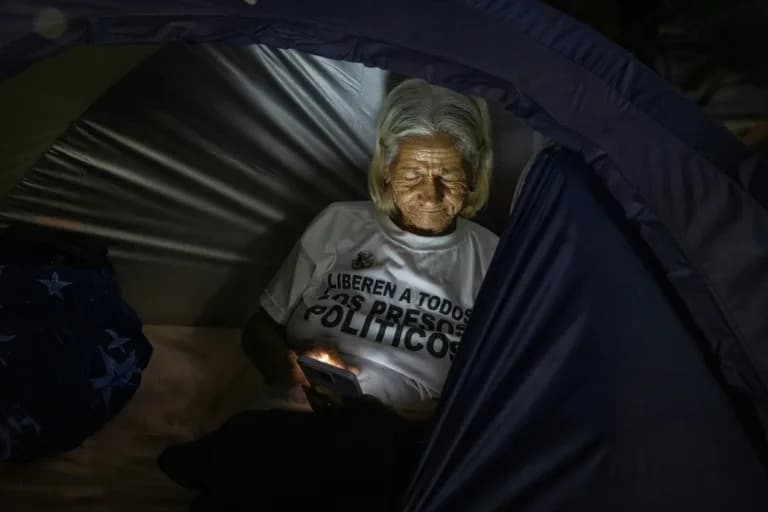
A relative of a political prisoner watches a livestream of lawmakers debating an amnesty bill, in her tent outside Rodeo I prison, on February 19 (Maryorin Mendez)(Maryorin Mendez/AFP/AFP)
More than 200 people detained as political prisoners in Venezuela began a hunger strike on Sunday at Rodeo I prison, near Caracas, protesting their exclusion from a newly approved amnesty law.
The protest began Friday night after detainees learned the law carved out categories that would likely keep many of them behind bars — most notably cases involving members of the security forces and accusations of terrorism. Relatives and rights groups said the vast majority of inmates at Rodeo I face military- or security-related charges and therefore do not expect to benefit from the measure.
"Approximately 214 people in total, including Venezuelans and foreigners, are on hunger strike," said Yalitza Garcia, mother-in-law of detainee Nahuel Agustin Gallo. Gallo, an Argentine police officer, is accused of terrorism, a charge excluded from the amnesty.
Shakira Ibarreto, whose father was arrested in 2024, said:
"They decided Friday to go on hunger strike because of the scope of the amnesty law, which excludes many of them."
On Sunday, the International Committee of the Red Cross (ICRC) conducted its first permitted visit to Rodeo I. Filippo Gatti, the ICRC's health coordinator for Venezuela, told relatives, "This is the first time they have allowed us to approach that prison. It's a first step, and I think we're on the right track." Relatives added that not all inmates at the facility joined the strike.
Amnesty Law And Political Context
The amnesty measure was approved by Venezuela's congress as part of a package of reforms promoted after a U.S. operation on Jan. 3 that removed former president Nicolás Maduro from power and brought him to the United States to face drug-trafficking charges. The bill was advanced by interim leader Delcy Rodriguez amid intense international scrutiny and domestic debate.
Opposition figures and rights advocates have criticized the law for including explicit exclusions. It does not apply to people prosecuted for "promoting" or "facilitating... armed or forceful actions" against Venezuelan sovereignty when foreign actors are alleged to be involved. Rodriguez has used similar language in accusations against opposition leader Maria Corina Machado, who has indicated she may return from the United States.
The law also excludes members of the security forces convicted of activities the government classifies as terrorism. At the same time, officials say the legislation could extend to roughly 11,000 people who were paroled or placed under house arrest as political detainees over the past three decades; more than 1,500 have already applied for amnesty, the legislature's speaker said.
Releases And Reactions
Authorities and rights groups reported several releases around Rodeo I after the bill's passage. On Sunday, five inmates walked out of the prison holding official release documents and were greeted with applause. Robin Colina, one of those released, said excitedly into a mobile phone, "I'm out, I love you so much, my queen! I'm doing well." Armando Fusil, a 55-year-old police commissioner from Maracaibo who was freed, told AFP many detainees began the hunger strike because "they want to get out." Foro Penal, an NGO that advocates for political prisoners, recorded 23 releases that day.
The situation remains tense: relatives and rights groups are pressing for clearer, more inclusive criteria so detainees who were prosecuted for political reasons can be considered for release. The ICRC's access to the facility marks a notable development in monitoring detainee welfare amid the protests.
Background note: Nicolás Maduro governed Venezuela from March 2013 until January 2026; he and his wife remain in U.S. custody awaiting trial and have pleaded not guilty to drug trafficking charges.
Help us improve.