Summary: The two-hour interview between Tucker Carlson and U.S. Ambassador Mike Huckabee at Ben Gurion airport exposed a deep split in the Republican right over support for Israel. Carlson represented a younger, isolationist MAGA faction increasingly critical of U.S. aid to Israel, while Huckabee defended a hardline Christian Zionist perspective — at one point saying, "It would be fine if they took it all," then backtracking. The exchange underscores generational and ideological tensions that could shape future U.S. policy on Israel, the West Bank and potential actions toward Iran.
Brawl at Ben Gurion: Carlson–Huckabee Interview Exposes Deep GOP Rift Over Israel
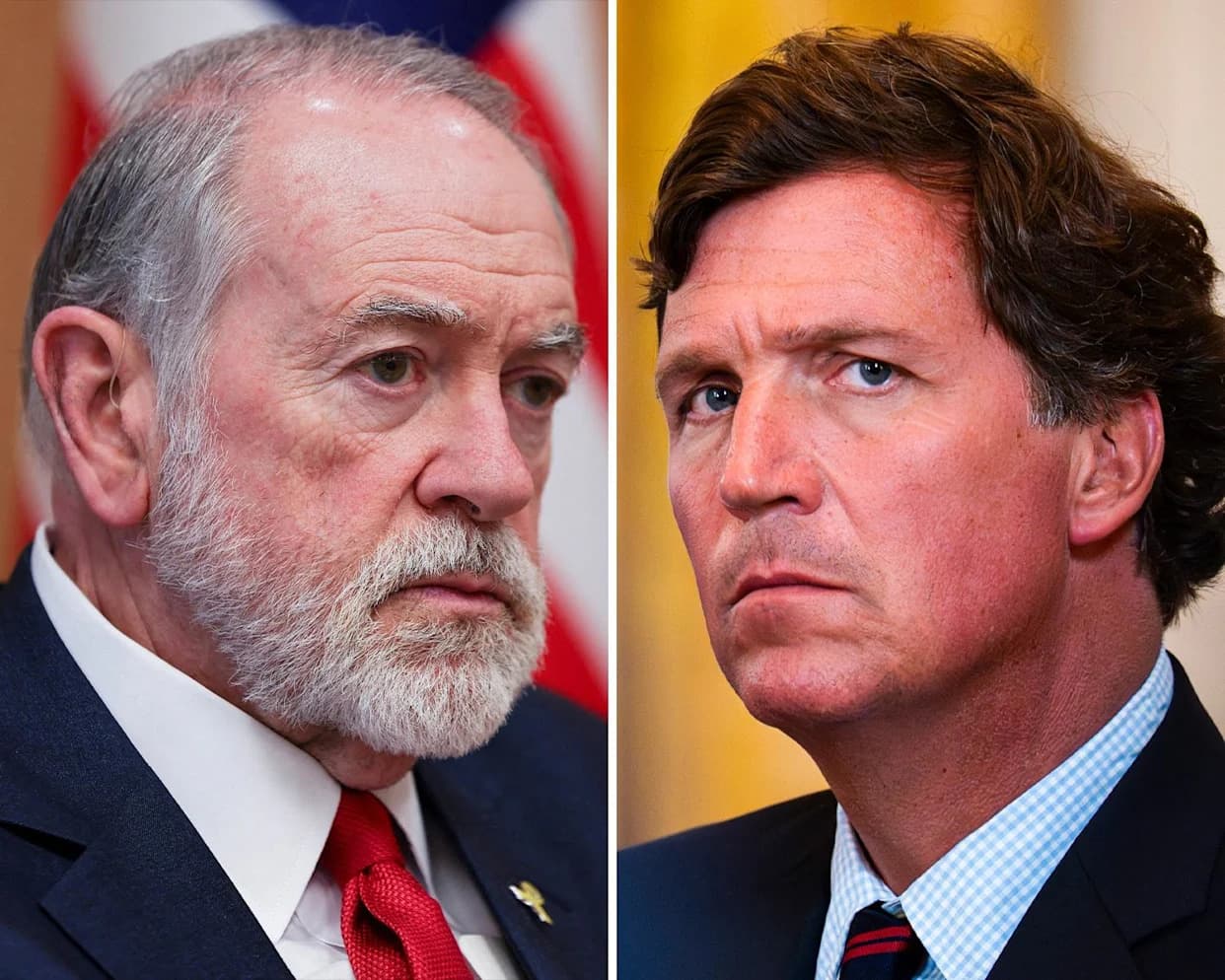
Tucker Carlson interviewed Mike Huckabee on his show.Composite: Reuters/Getty Images(Composite: Reuters/Getty Images)
An unvarnished, two-hour interview between Tucker Carlson and U.S. Ambassador to Israel Mike Huckabee at Ben Gurion airport laid bare a growing schism within the Republican right over America’s relationship with Israel. The wide-ranging exchange highlighted tensions between a younger, isolationist MAGA current skeptical of longtime U.S. support for Israel and an older Christian conservative establishment that defends that alliance — sometimes on theological grounds.
The Exchange
Carlson published the confrontational video on Friday. He repeatedly suggested that Huckabee, a prominent Christian Zionist, was more committed to defending Israeli interests than those of the United States. Huckabee forcefully rejected the implication and defended continued U.S. military and financial support for Israel.
"It would be fine if they took it all," Huckabee said at one point in response to a hypothetical question about a literal reading of scripture. He later softened the remark, saying the hypothetical was irrelevant to Israel’s stated intentions.
Key Topics Covered
The interview touched on several contentious issues: perceptions of U.S. foreign-policy priorities, the Israel–Gaza war and its humanitarian toll, Israel’s tightening control in parts of the West Bank, threats to regional stability including the prospect of strikes on Iran, and a series of personal and diplomatic controversies — from Huckabee’s meeting with convicted spy Jonathan Pollard to alleged links between Jeffrey Epstein and Israeli figures.
Carlson cited polling showing only about 20% of Americans support a war with Iran, arguing public sentiment should factor into policy. Huckabee countered that polls cannot always determine U.S. responses to threats and suggested the public might not fully appreciate some security dangers, though he did not identify a specific direct threat from Iran to the United States.
Tone and Aftermath
The back-and-forth was often testy but largely civil, with frequent interruptions and sharp rebuttals as each challenged the other's premises. Tension preceded the interview’s release: Carlson alleged that he and his crew were briefly detained by Ben Gurion security after the conversation; Huckabee described the encounter as routine security screening given the airport’s strict procedures.
Broader Significance
Observers say the exchange reflects a generational and ideological shift inside the GOP. While Republican voters broadly remain supportive of Israel, younger conservatives are growing more skeptical of unconditional U.S. backing and more sympathetic to Carlson’s critiques. Scholars note that the alliance between the Israeli right and U.S. Christian conservatives — cultivated over recent decades — may be more fragile than assumed because Protestant support is politically fluid.
As long as former President Donald Trump remains the dominant force in Republican politics, critics of Israel within MAGA are likely to remain peripheral to official policy-making. But if Trump’s influence wanes, the internal dispute over Israel could complicate the conservative movement’s unity and its approach to Middle East policy.
What This Means
The Carlson–Huckabee interview is a vivid snapshot of a party wrestling with competing instincts: ideological and theological commitments to Israel, pragmatic foreign-policy considerations, and rising populist skepticism about traditional alliances. How Republican leaders reconcile these currents will shape U.S. policy toward Israel and the broader Middle East in the years ahead.
Help us improve.