Reverend Jesse Jackson, who died on 17 February, advanced a "radically inclusive" politics that reshaped the Democratic Party by centering marginalized communities. Through Operation PUSH and the National Rainbow Coalition he organized across race and class, helping register roughly 2 million Black voters and contributing to Democratic electoral gains in the 1980s. He pushed the party leftward on social issues—publicly naming "lesbian" and "gay" at the 1984 convention—and broadened debate on Palestinian self-determination. Jackson’s coalition model and economic populism left a durable imprint on modern Democratic strategy.
How Jesse Jackson’s “Radically Inclusive” Vision Reshaped the Modern Democratic Party
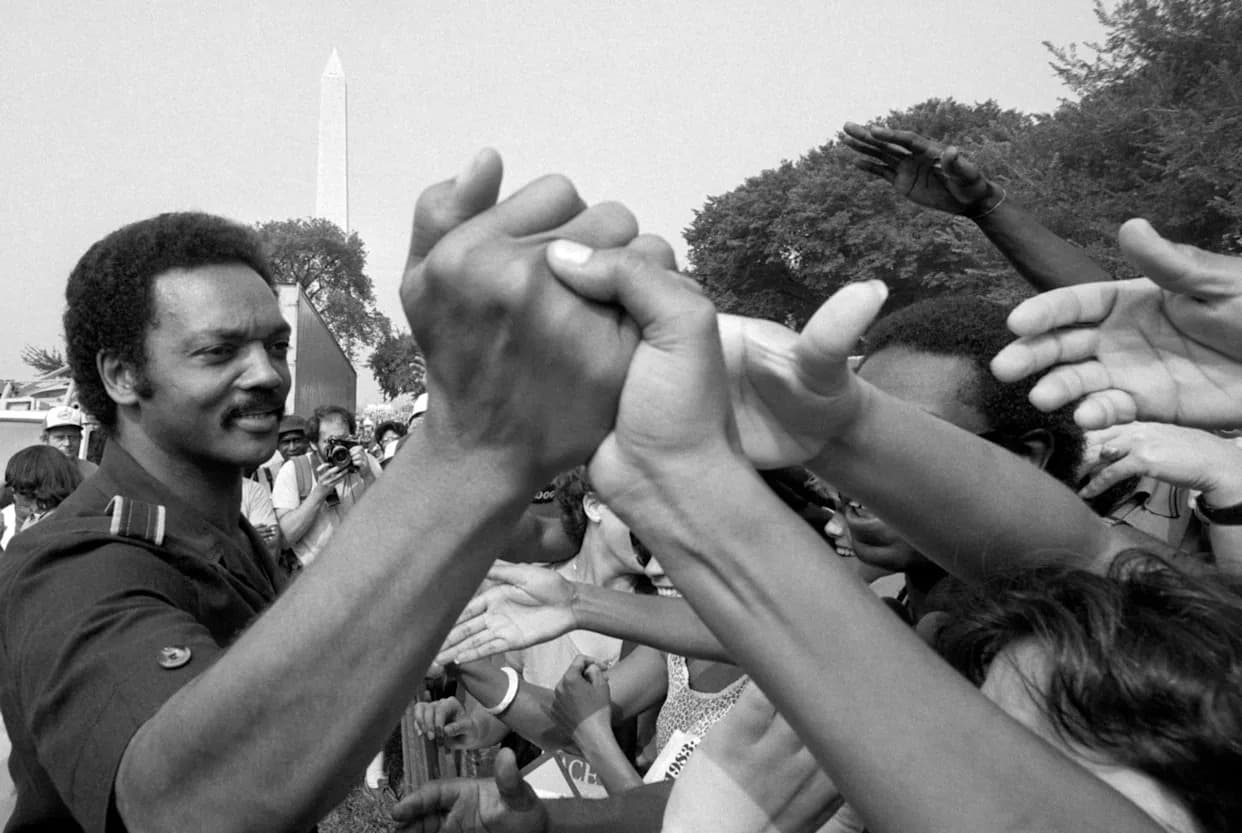
Rev Jesse Jackson shakes hands at the 20th anniversary commemoration of the Martin Luther King Jr’s March on Washington.Photograph: Bettmann/Bettmann Archive(Photograph: Bettmann/Bettmann Archive)
Reverend Jesse Jackson, the civil- and human-rights leader who died on 17 February, championed a politics that put marginalized communities at the center of national life. More progressive than many in the post–civil rights Democratic Party believed possible, Jackson used his campaigns and the National Rainbow Coalition to expand the party’s coalition across race, class and issue areas—leaving a lasting imprint on contemporary Democratic politics.
From Sit-Ins to Economic Organizing
Jackson’s early years in the civil-rights movement shaped his worldview and tactics. As a student at North Carolina A&T he took part in the Greensboro sit-ins and later became one of the youngest lieutenants in Martin Luther King Jr.'s Southern Christian Leadership Conference (SCLC). In 1966, King appointed Jackson the first director of Operation Breadbasket in Chicago, an initiative focused on improving economic conditions for Black communities through job campaigns and targeted boycotts. Jackson later transformed Operation Breadbasket into Operation PUSH, which became the organizing base for his national coalition work.
Building A Multiracial, Cross-Class Coalition
During the conservative turn of the 1980s, Jackson saw an opening to craft a multiracial, cross-class Democratic majority. He argued that working-class whites and Blacks, progressive whites and even college-educated voters shared common economic interests—and he campaigned as their voice within the party. His 1984 and 1988 presidential bids were historic: in 1984 he became the first African American to mount a serious challenge for the Democratic nomination, and in 1988 he scored a surprising victory in the Michigan Democratic caucus.
"This Rainbow Coalition is the embodiment of a national politics that is radically inclusive," said Charles McKinney, a history professor at Rhodes College. "He had something to offer the middle class, the elite and working-class people—he tried to build a politics that represented them all."
Voting Rights and Electoral Impact
Jackson prioritized voter registration and grassroots organizing, particularly in the South. Organizers associated with him helped register roughly 2 million Black voters—work credited with boosting Black turnout and contributing to Democratic gains such as retaking the Senate in 1986. By tying registration to a message of collective political power, Jackson helped make Black voters a backbone of modern Democratic electoral strategy.
Progressive Stances on Social and International Issues
Jackson pushed the Democratic Party leftward on social issues ahead of many of his contemporaries. In his 1984 Democratic National Convention speech he became the first speaker there to say the words "lesbian" and "gay," declaring: "The rainbow includes lesbians and gays. No American citizen ought be denied equal protection from the law." He continued to support LGBTQ equality for decades—speaking at the 1993 March on Washington for LGBTQ rights, backing Massachusetts as the first state to legalize same-sex marriage, and praising later leaders who endorsed marriage equality.
Jackson’s coalition-building also extended to foreign policy: his 1984 campaign included the first Arab American committee, and his delegates pushed for Democratic platform language supporting Palestinian self-determination. Though an explicit national plank failed in 1984, by 1988 eleven state parties had adopted platforms affirming Palestinian rights, and the issue was debated from the convention floor—an early signal of the party’s widening debate on international human-rights questions.
Legacy
Jackson’s combination of economic populism, multiracial organizing and early advocacy for LGBTQ and Palestinian rights moved parts of the Democratic Party in new directions. Elements of his approach—broad coalitions, explicit economic critiques of inequality, and inclusive rhetoric—can be seen in later figures and movements. Whether hailed as prophetic or contentious, Jackson’s career reshaped expectations about who could be the Democratic base and how politics could mobilize the previously marginalized.
Help us improve.