
The U.S. has deployed one of its largest concentrations of naval and air power near Iran in decades, structured for sustained, weeks-long operations rather than a single strike. Two carrier strike groups, stealth fighters (F-22/F-35), strike fighters (F-15E/F/A-18) and long-range B-2 bombers — capable of delivering the 30,000-lb GBU-57 MOP — are in position, supported by regional missile defenses. Satellite imagery shows Iran hardening sites at Parchin (Taleghan 2) and Natanz, a development that would complicate battle-damage assessment and increase the need for repeated strikes. Analysts warn forward munitions could be depleted in about three to four weeks without major resupply, while diplomacy and political constraints continue to shape options.
Built For Weeks, Not Hours: The U.S. Firepower Massed Near Iran
The U.S. military has deployed one of its largest concentrations of naval and air assets to the Middle East in decades — a posture designed for sustained, weeks-long combat operations rather than a single, limited strike. While negotiators continue discussions in Geneva, the Pentagon has shifted beyond a symbolic show of force to an operational stance that could sustain high-tempo air campaigns if authorized.
What’s In Place
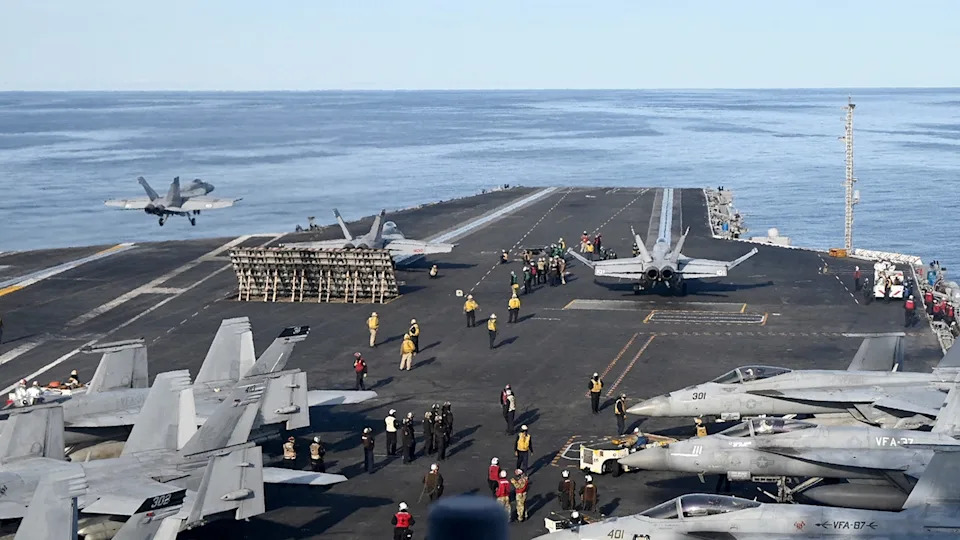
Two carrier strike groups now anchor the U.S. presence. The USS Abraham Lincoln is operating in the Arabian Sea with Arleigh Burke–class destroyers including USS Spruance, USS Michael Murphy, USS Frank E. Petersen Jr. and USS Pinckney. The USS Gerald R. Ford strike group is transiting the Mediterranean escorted by USS Bainbridge and USS Mahan; when the Ford arrives, the Navy will have a rare dual-carrier strike posture.
Airpower And Sortie Capacity
Under sustained, high-tempo conditions, a single carrier air wing can generate more than 100 sorties in 24 hours depending on tanker support and target distance. Two carriers operating in tandem allow continuous strike cycles by rotating decks — launching from one carrier while the other recovers, refuels and re-arms — enabling persistent pressure over multiple days rather than discrete waves.
Stealth fighters such as F-22 Raptors and F-35 Lightning IIs have been repositioned to regional hubs to help suppress Iranian air defenses (S-300 and domestically produced Bavar-373 systems). Once those defenses are degraded, F-15E Strike Eagles and carrier-based F/A-18 Super Hornets would be expected to conduct follow-on strikes against missile infrastructure, command-and-control nodes and Islamic Revolutionary Guard Corps facilities.
Long-Range Strike And Deep Penetration
Long-range bombers add operational depth. B-2 Spirit stealth bombers, operating from Whiteman Air Force Base with aerial refueling, can fly round trips measured in tens of hours and are the only U.S. platform configured to deliver the 30,000-pound GBU-57 Massive Ordnance Penetrator (MOP) against deeply buried targets.
Logistics, Munitions And Campaign Duration
Senior U.S. officials have said planners are preparing for "sustained, weeks-long operations" if conflict breaks out — a different scale than the short, in-and-out strikes conducted earlier. Defense analysts note forward-positioned precision munitions could be significantly depleted in roughly three to four weeks depending on sortie tempo and target density. After that point, forces would rely increasingly on resupply from the continental United States, a process that can take additional weeks to establish a full maritime logistics bridge. Campaign duration would therefore hinge on replenishment cycles and industrial production as much as on aircraft availability.
Iran’s Defensive Hardening
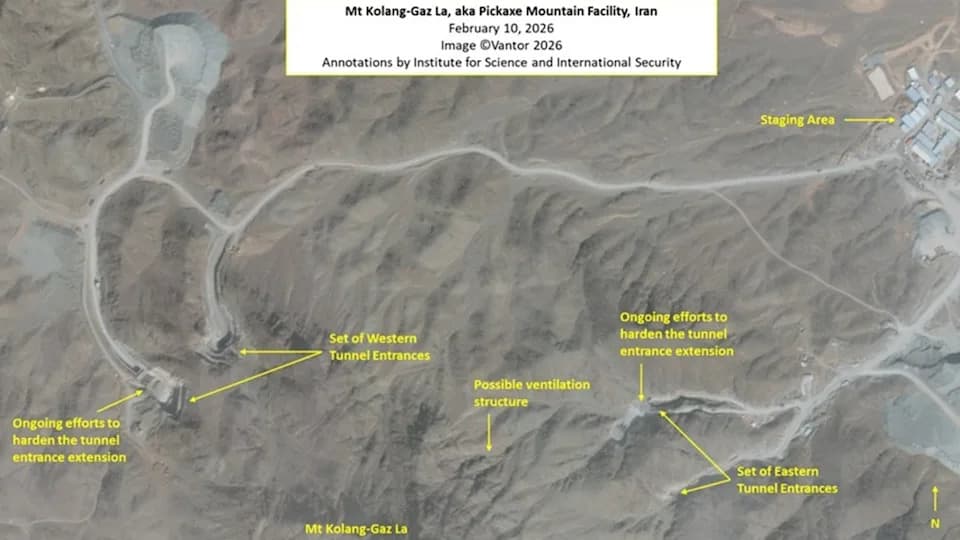
Commercial satellite imagery cited by the Institute for Science and International Security (ISIS) shows Iran accelerating hardening efforts at facilities such as Taleghan 2 at Parchin and reinforcing tunnel entrances near Natanz. Defense analyst Can Kasapoğlu warned that hardened subterranean targets complicate battle-damage assessment (BDA) and typically require repeated strikes and follow-up confirmation missions.
"All these efforts would complicate the battle damage assessment in a post-strike environment," said Can Kasapoğlu.
Regional Defenses, Politics And Diplomacy
To protect forward assets, the U.S. has distributed Patriot and THAAD missile-defense batteries across regional hubs. Iran has warned that U.S. bases in Saudi Arabia, the UAE and Turkey could be targeted in the event of an attack, and Iranian commanders have described any strike as potentially escalating to "all-out war."
Despite the robust military posture, diplomatic talks continue. Iranian officials say they will return to negotiations with additional proposals within weeks. President Donald Trump has publicly urged a deal, warning of traumatic consequences if diplomacy fails. As former U.S. ambassador Susan Ziadeh observed, "The presence of so much firepower in the region creates a momentum of its own. Sometimes that momentum is a little hard to just put the brakes on."
Force Posture, Not Occupation
Notably, there is no large-scale U.S. troop buildup for a ground invasion: no major Army combat formations are massing in Kuwait or Iraq for occupation. The emphasis remains on stand-off strikes and precision airpower to degrade targets at distance — a posture with important political as well as military implications, given public resistance to ground intervention.
Bottom line: The force assembled near Iran is organized for endurance and sustained strike operations. Whether it is used, and for how long, will depend on political decisions, diplomatic outcomes and the logistics of munitions resupply.
Help us improve.





















