The NTSB's nearly 400-page final report found a chain of policy, procedural and operational failures that caused the Jan. 29, 2025 midair collision near Reagan National Airport, killing 67. The board blamed FAA route placement, an overreliance on visual sighting, degraded air-traffic-control performance after position consolidation, and insufficient Army pilot training on altimeters. Investigators issued 50 recommendations — 33 for the FAA — including broader use of ADS-B In collision-warning systems. Federal officials have announced route changes and pledged system upgrades while the NTSB presses for implementation.
NTSB: Chain Of Failures Caused Deadly Midair Collision Near Washington, D.C.; 67 Killed
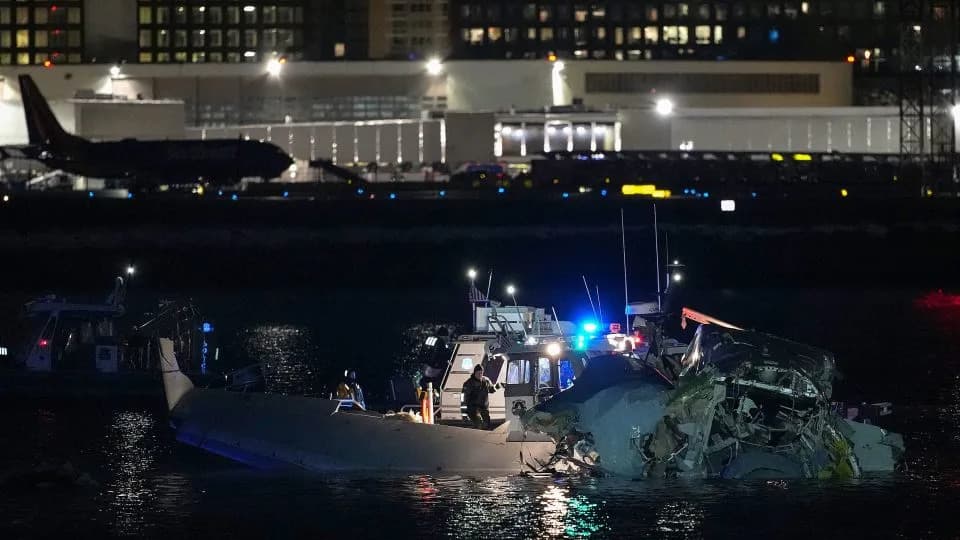
Emergency response units assess airplane wreckage in the Potomac River near Ronald Reagan Washington Airport on January 30, 2025. - Andrew Harnik/Getty Images
The National Transportation Safety Board concluded in a nearly 400-page final report that a series of policy, procedural and operational failures across multiple agencies led to the Jan. 29, 2025 midair collision near Ronald Reagan Washington National Airport that killed 67 people. The accident — involving an Army Black Hawk helicopter and an American Airlines regional jet operated by PSA Airlines — was the deadliest U.S. commercial aviation crash in more than two decades.
Key Findings
The NTSB identified a chain of errors that together produced the tragedy. Investigators faulted the Federal Aviation Administration for placing a helicopter route too close to an aircraft approach path, failing to routinely review and evaluate helicopter routes and related data, and not acting on prior recommendations to reduce midair-collision risk. The board also cited an overreliance on visual 'see-and-avoid' practices without sufficient recognition of their limitations.
Air traffic control performance was described as 'degraded' after two tower positions were consolidated without a formal risk assessment. That consolidation contributed to misprioritized duties, inadequate traffic advisories and the absence of critical safety alerts to both flight crews. The Army was assigned part of the blame for insufficient pilot training on altimeter margin-of-error, which contributed to the helicopter flying above its authorized altitude.
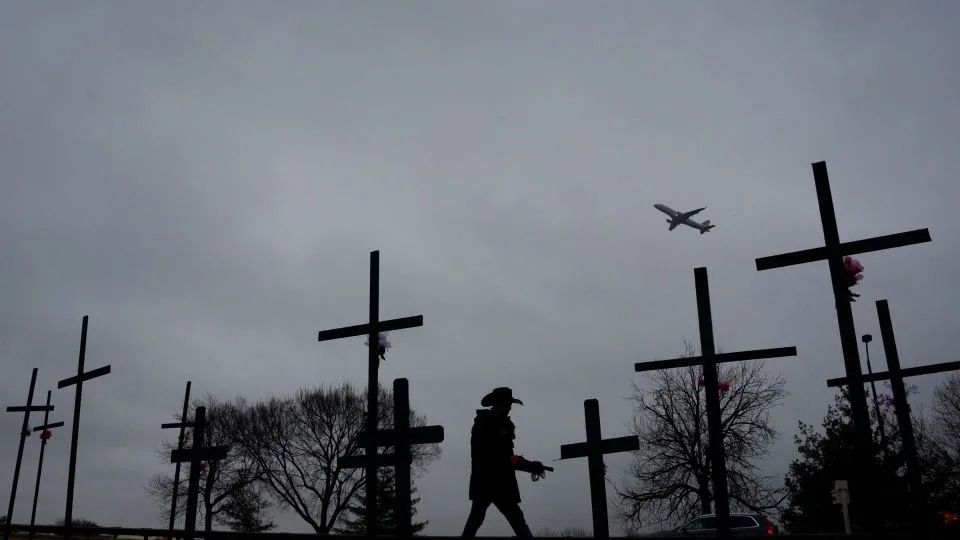
An airplane takes off from Reagan National Airport behind a memorial for the victims of the midair collision between an American Airlines plane and a military helicopter. - Andrew Harnik/Getty Images
Collision-Avoidance Technology
Investigators found limitations in the collision-alerting systems on both aircraft. The Army helicopter had ADS-B Out capability but it was turned off; the regional jet was transmitting position data but neither aircraft had ADS-B In to receive the other's transmissions. The NTSB has long recommended equipping aircraft with ADS-B In so pilots receive electronic warnings of nearby traffic. According to the board, ADS-B In would have alerted the jet crew about 59 seconds before impact and the helicopter crew about 48 seconds before impact — windows the NTSB says would likely have allowed evasive action.
Recommendations and Response
The final report included 50 safety recommendations, 33 of them directed to the FAA. Recommendations call for time limits on air traffic control supervisory duties, improved controller and pilot training, restrictions on certain commercial traffic at congested airports, updated helicopter route-design criteria and broader deployment of collision-avoidance technology.
Within weeks of the crash, federal officials announced changes to helicopter routes around Washington to address some urgent recommendations and pledged a multibillion-dollar overhaul of the aging air-traffic control system. The NTSB cannot compel agencies to adopt its recommendations, but it continues to advocate implementation to prevent future accidents.
NTSB Chair Jennifer Homendy: 'This was preventable. This was 100% preventable.'
Sen. Maria Cantwell: 'These answers demonstrate that this tragedy was a result of many systematic failures.'
Sen. Ted Cruz: 'ADS-B In would have warned pilots nearly one minute before impact. Sixty-seven people would still be alive today.'
What This Means For Travelers
The report has renewed scrutiny of aviation safety protocols and technology gaps. If adopted, the NTSB's recommendations could change how helicopter routes near airports are designed, tighten tower staffing and supervisory practices, and accelerate requirements for onboard collision-avoidance systems. For now, the findings serve as a detailed roadmap of failures and proposed fixes intended to prevent a repeat of this tragedy.
Help us improve.