
Reports say U.S. strikes in Venezuela resulted in the reported capture of President Nicolás Maduro and his wife, Cilia Flores, raising immediate questions about possible betrayal within Maduro’s inner circle. Senior figures such as Diosdado Cabello and General Vladimir Padrino López condemned the strikes, yet the military’s apparent lack of resistance has fueled speculation about inside cooperation. Maduro and Flores are reportedly aboard the U.S. warship Iwo Jima, en route to New York to face weapons and drug charges, while a complex political struggle looms at home.
Maduro’s Reported Capture Fuels Questions of Betrayal Within Venezuela’s Ruling Circle

Vladimir Padrino López, Venezuela's defense minister, speaks during a news conference accompanied by the military high command at the Ministry of Defense in Caracas, Venezuela,Jan. 24, 2019.
Reports that U.S. forces struck targets in Venezuela and that President Nicolás Maduro and his wife, Cilia Flores, were captured have prompted intense speculation about whether someone inside Maduro’s close inner circle betrayed him. The operation’s apparent speed and the lack of visible military resistance have focused attention on senior regime figures and possible local cooperation with U.S. intelligence.
Key Figures and Reactions
Diosdado Cabello, Venezuela’s minister of interior, justice and peace and a long-time Chavista power broker, is widely viewed as one of the most influential figures in the regime. General Vladimir Padrino López, the long-serving defense minister and head of the armed forces, also commands enormous influence.
Both Cabello and Padrino López publicly condemned the U.S. strikes. In an early-morning video posted on X, Padrino López called the attacks a “criminal military aggression by the government of the United States.” He accused foreign forces of bringing “death, pain and destruction” and described the operation as an invasion motivated by a desire for Venezuela’s resources.
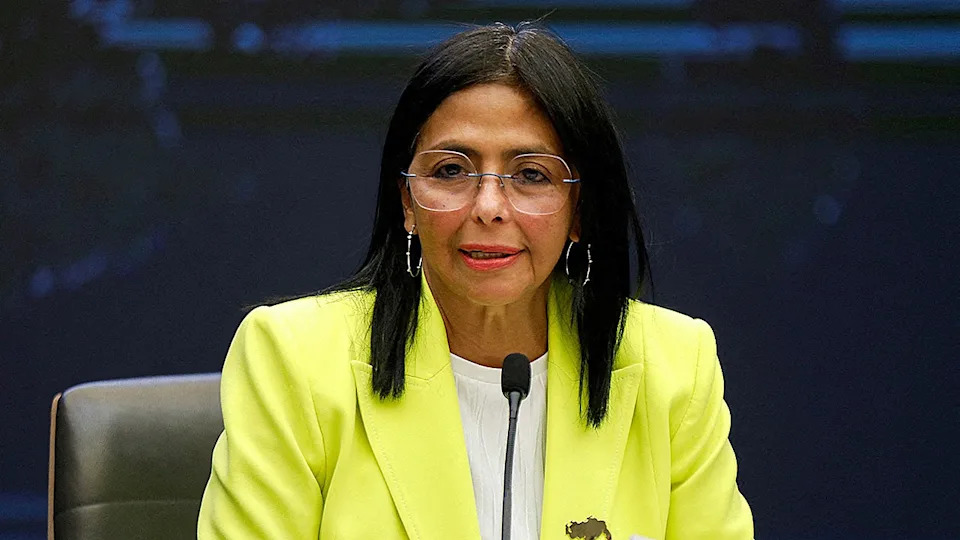
Venezuelan Vice President Delcy Rodríguez addresses the media in Caracas, Venezuela, March 10, 2025.
U.S. Custody and Legal Exposure
U.S. officials have reportedly placed Maduro and Flores aboard the amphibious assault ship Iwo Jima, bound for New York, where Maduro faces weapons- and drug-related charges. If confirmed, the transfer would mark an extraordinary turn in Venezuela’s long-running political crisis.
Questions About How the Operation Succeeded
Analysts say the operation’s smooth execution suggests strong on-the-ground intelligence and possible cooperation by elements within Venezuela. Jorge Jraissati, head of the Economic Inclusion Group, praised the operation and said its speed pointed to excellent intelligence and local cooperation, calling it a potential opening for a new era in Venezuela.
Political Fallout and Power Struggle
Delcy Rodríguez, Venezuela’s vice president and the formal successor in the event of Maduro’s removal, demanded a “proof of life” for Maduro on X and has become the subject of intense speculation regarding her whereabouts; reports that she was in Russia have been denied by Moscow. Meanwhile, opposition leader Maria Corina Machado—who has recently attracted significant international attention—remains a central figure in the expected post-Maduro political contest. Her whereabouts have been unclear since she left Norway in mid-December after receiving international recognition.
What Comes Next
Observers warn that removing Maduro while leaving the rest of the Chavista power structure intact could complicate a transition. Cabello, Padrino López and other loyalists could choose to resist, attempt to retain influence inside Venezuela, or negotiate exile in countries such as Cuba or Russia. Investigations are likely to focus on who provided the intelligence that enabled the capture, including reports of a long-standing CIA asset who tracked Maduro’s movements.
Impact on Venezuelans: Uncertainty has driven many citizens to stock up on food and fuel as the country faces a potentially volatile power struggle.
Help us improve.


