
Violent protests across Iran, driven by economic collapse and long-running grievances, have continued for more than ten days, leaving at least 45 people dead and prompting widescale arrests and a nationwide internet blackout. Demonstrations that began in Tehran’s Grand Bazaar have spread to all 31 provinces, with HRANA reporting 348+ locations and over 2,200 arrests. Iranian leaders have responded with hardline rhetoric and limited subsidies, while former President Trump’s warnings of possible U.S. action have heightened international tensions.
Iran’s Nationwide Protests: Deadly Unrest, Internet Blackout and Trump’s Warning of Possible U.S. Intervention

Violent protests over Iran’s worsening economy have entered a second week-plus, leaving at least 45 people dead and placing intense pressure on the Islamic Republic as it faces its most sustained unrest in three years.
What Happened
Rights groups say the fatalities include eight children and at least two members of Iran’s security forces. Hundreds more have been detained as authorities move to suppress demonstrations that show little sign of abating. The Human Rights Activists News Agency (HRANA) reported that protests have spread to more than 348 locations across all 31 provinces and has documented over 2,200 arrests; Iranian officials have not published a comprehensive official tally.
Communications Blackout
On Thursday the government cut internet access and telephone services nationwide after anti-government unrest flared in Tehran, producing a near-blackout in connectivity, according to monitoring groups including NetBlocks and the Georgia Institute of Technology’s internet observatory. Officials have not publicly explained the outage; Tehran has used similar shutdowns during past unrest, saying they are security measures to prevent foreign interference.
Underlying Causes
Sanctions tied to Iran’s nuclear program, together with the lingering economic fallout from a 12-day conflict last summer with Israel and reported strikes on nuclear sites, have severely damaged the economy. The rial has tumbled to roughly 1.4 million to the U.S. dollar, driving inflation that has pushed basic goods out of reach for many families. Longstanding corruption and mismanagement have compounded the hardship, while capital flight and the avoidance of foreign investment have created liquidity pressures.
From Bazaar Protests to Nationwide Dissent
The current wave of demonstrations began in Tehran’s Grand Bazaar, where shopkeepers protested the rial’s free fall. What started as economic anger quickly broadened into wider anti-regime sentiment. Videos circulating on social media show protests from Tehran to provincial cities and university campuses. In Tehran, a sit-in at the Grand Bazaar prompted security forces to deploy tear gas and temporarily shut the market.
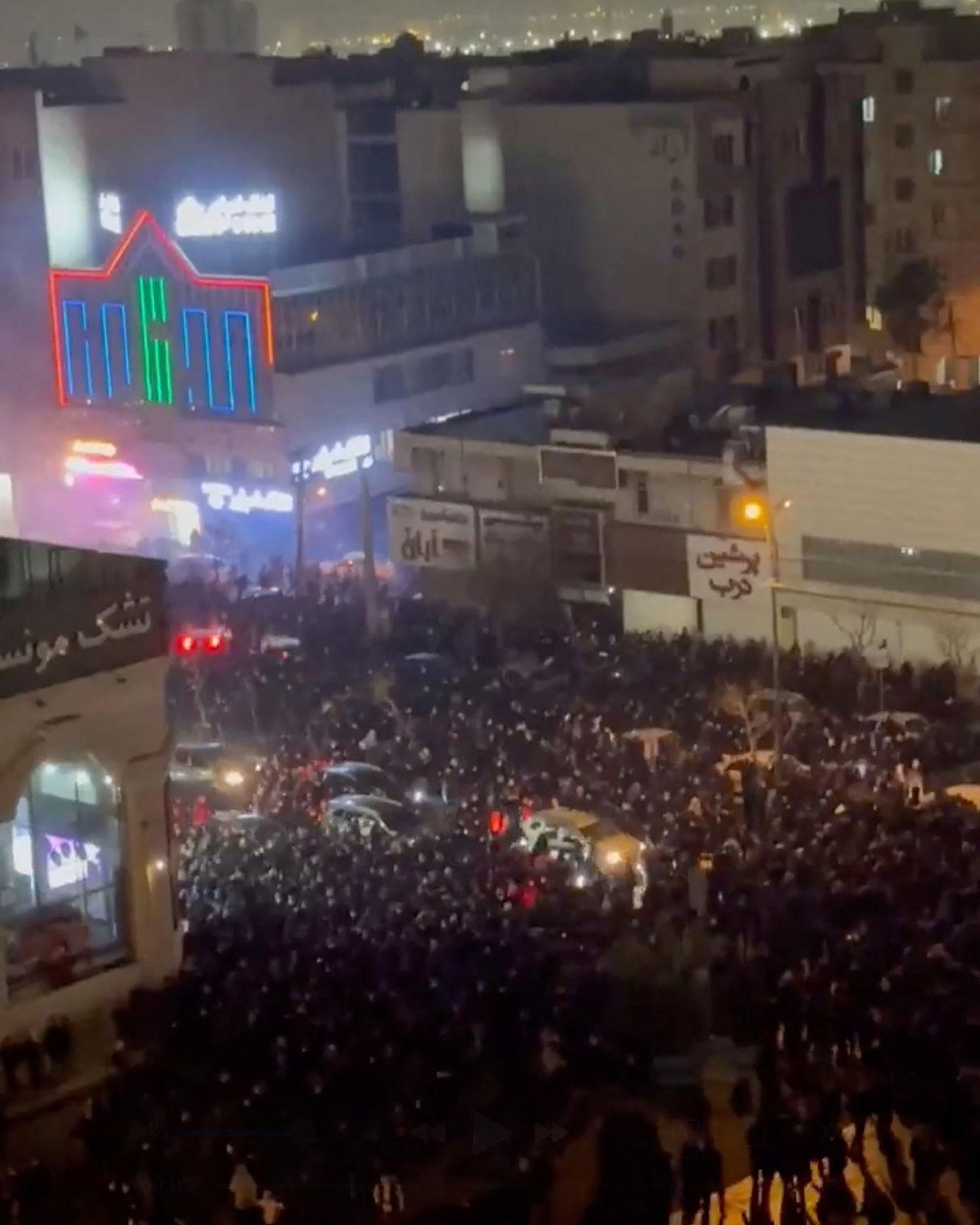
People gather on the streets amid anti-government unrest in Tehran, Iran, in this still image obtained from social media video released on Jan. 8, 2026. Social Media/Reuters
Government Response
Iranian leaders have responded with a mix of rhetoric, limited economic measures and security operations. Judiciary chief Gholamhossein Mohseni Ejei vowed there would be "no leniency" for anyone accused of aiding Iran’s enemies, framing the unrest as part of an externally backed campaign. Supreme Leader Ayatollah Ali Khamenei declared that "rioters must be put in their place," language analysts say can be interpreted as greenlighting harsher tactics by security forces.
"The system has so far stuck to what's been its typical playbook: modest concessions alongside overwhelming repression," said Naysan Rafati, senior Iran analyst at the International Crisis Group.
Officials have offered modest economic relief: the government announced a small monthly subsidy for food staples of roughly $7 per household, intended to reach more than 70 million people. Mohammad Ja'far Ghaempanah, the president’s deputy for executive affairs, described the situation as a "full-fledged economic war" and called for what he termed "economic surgery." Analysts warn such limited measures are unlikely by themselves to resolve deep, systemic grievances.
International Dimension
Former President Donald Trump renewed threats last week, saying that if Iran "violently kills peaceful protesters...the United States of America will come to their rescue," and warning: "We are locked and loaded and ready to go." His comments added a volatile international dimension to the unrest and were widely watched in Tehran. Analysts note that prior U.S. actions and strikes have increased the credibility of such threats for some observers.
Iranian commanders have responded with blunt warnings. Maj. Gen. Amir Hatami, the army chief, said the intensification of hostile rhetoric directed at Iran would be treated as a threat and would not be left unanswered, a remark broadly interpreted as a message to Washington.
What Comes Next
Whether Iran’s leadership can weather the current unrest is uncertain. The protests have exposed broad societal fractures and the combination of economic pain, perceived misrule and heavy-handed security responses risks further escalation. The decisions by both Tehran and Washington in the coming days and weeks could shape Iran’s political and economic trajectory for years to come.
Help us improve.


