
Two late-December meetings — Turkish-Syrian talks in Damascus and Israel’s trilateral summit with Greece and Cyprus — exposed divergent regional strategies. The Israel-Greece-Cyprus forum has shifted from energy cooperation toward deeper security and defence ties, a move Turkey sees as an exclusionary containment effort. Rising defence deals, Israeli strikes in Syria and Turkey’s naval buildup risk crystallising a sustained security competition across the Eastern Mediterranean. Analysts urge Ankara to pursue decisive, outcome-focused responses to blunt a widening strategic squeeze.
Is the Eastern Mediterranean Becoming Israel’s New Front Against Turkey?

A map showing Eastern Mediterranean states: Turkiye, Cyprus, Israel and Greece [Al Jazeera]
Two near-simultaneous meetings in late December highlighted competing strategic blueprints reshaping the Eastern Mediterranean and the Levant. One took place in Damascus, where senior Turkish officials met Syrian counterparts as Ankara presses efforts to restore central authority and stabilise parts of Syria after years of conflict. The other saw Israel host Greece and Cyprus for a trilateral summit that, while framed around energy and connectivity, is increasingly focused on security coordination and military alignment.
Two Meetings, Divergent Agendas
On 22 December, Turkey’s foreign, defence and intelligence chiefs travelled to Damascus for talks with Syrian officials. That same day Israel convened its trilateral forum with Greece and Cyprus — shortly after carrying out another airstrike in Syria, one of more than 600 strikes reported in 2025. The coincidence underscored competing approaches to regional order: Ankara emphasises state restoration and stabilisation in Syria; Israel and its partners appear to prioritise measures that limit the influence of rivals and protect maritime and security interests.
From Energy Cooperation To Strategic Containment
What began as a trilateral collaboration on energy and connectivity has steadily broadened to include security cooperation, joint exercises and closer defence ties. Retired Turkish admiral Cem Gurdeniz — an architect of Turkey’s "Blue Homeland" maritime doctrine — described the partnership as an attempt "to exclude and encircle Turkey," arguing that the aim is indirect containment to alter Ankara’s behaviour without provoking full-scale conflict.
Cem Gurdeniz: "The objective is not war, but behavioural change — narrowing Turkey's strategic space to induce withdrawal without conflict."
From Israel’s perspective, closer coordination with Greece and Cyprus is a response to Turkey’s posture in Syria and the Eastern Mediterranean. Greece and Cyprus see the trilateral as a way to strengthen maritime claims and energy corridors that could sideline Turkey. Analysts note the inclusion of the United States as a "like-minded partner" in a 3+1 format further signals an implied strategic message directed at Ankara.
Legal, Diplomatic And Military Pressures
The decision to hold the meeting in Israel was shaped in part by diplomatic constraints on Israeli leaders. Prime Minister Benjamin Netanyahu faces an arrest warrant from the International Criminal Court (ICC) related to allegations connected to the Gaza conflict — a factor that complicates travel to some ICC signatory states. Hosting Greek and Cypriot leaders in Israel reflected both practical considerations and how legal pressures are nudging Israel toward security-centric partnerships.
Defence cooperation is deepening: Greece approved the purchase of 36 PULS rocket artillery systems from Israel (about $760m) and is negotiating a larger defence package — reported at roughly $3.5bn — for an Israeli-built multi-layered air-defence system. Cyprus has also taken delivery of Israeli-made air-defence equipment. In response, Turkey has launched an ambitious naval procurement programme estimated at around $8bn, with dozens of vessels under construction to safeguard its Eastern Mediterranean interests.
(Al Jazeera)
Maritime Disputes And Regional Flashpoints
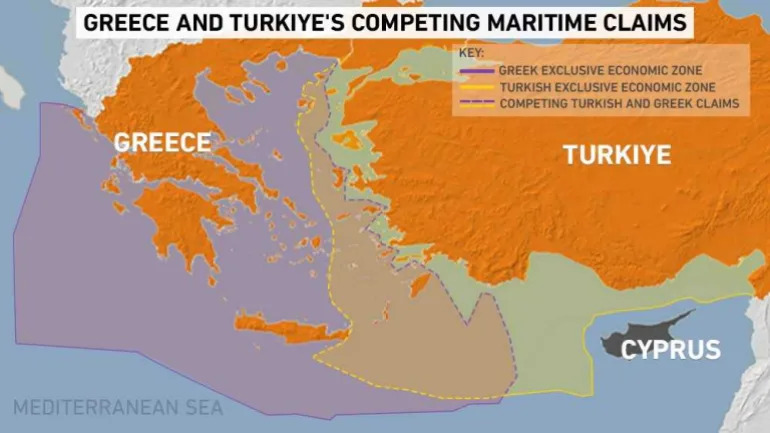
Maritime law disputes underpin much of the tension: Greece asserts that its Aegean islands generate their own exclusive economic zones (EEZs), while Turkey maintains that maritime boundaries should be measured from the mainland and that islands cannot create full EEZ entitlements. Cyprus remains divided since 1974, and competing claims over offshore gas exploration have long fuelled confrontation.
Operations Beyond The Sea
Analysts warn that Israeli operations from Syria to the Horn of Africa — including recognition of Somaliland — reflect a pattern of exploiting political fractures to limit state consolidation in areas where Turkey seeks influence. Israeli strikes in Syria, including attacks on key installations in Damascus, have been read by some observers as attempts to constrain Syrian recovery at moments of diplomatic engagement.
Figures such as Yoram Hazony, who advocates for fragmentation of regional states, are cited as intellectual currents that align with policies favouring division over consolidation. Observers argue that Israel’s strategy appears to combine naval positioning with indirect pressure in neighbouring theatres to narrow Turkey’s strategic options.
Choices For Ankara
Analysts recommend Turkey respond with coordinated, outcome-focused measures rather than rhetorical escalation. Suggestions include deepening ties with Middle Eastern partners such as Egypt and Saudi Arabia, creating commercially attractive alternative formats for cooperation in energy and defence, and exposing influence operations that seek to legitimise breakaway entities.
As one analyst put it, Turkey’s strategic objective should be explicit: block a permanent Israeli security carve-out in southern Syria and prevent an Eastern Mediterranean order that boxes in Ankara.
Note: This article summarises reporting and expert commentary on evolving strategic dynamics in the Eastern Mediterranean. Figures and quotes are drawn from public reporting and analyst interviews.
Help us improve.


