Five Stanford students will go on trial in San Jose on felony conspiracy and vandalism charges stemming from a one‑hour occupation of the university president’s office in June 2024. Santa Clara County DA Jeff Rosen brought the charges in April 2025 amid heightened scrutiny of elite universities’ responses to campus protests. The defendants plead not guilty, face more than three years in prison if convicted, and say they intend to use the trial to spotlight Stanford’s ties to Gaza‑related harms. Pre‑trial rulings have limited expert testimony and barred a First Amendment defense, while Stanford seeks roughly $329,000 in restitution despite a facilities estimate of under $10,000 in direct damage.
Five Stanford Students Face Felony Trial Over June 2024 Pro‑Palestinian Occupation
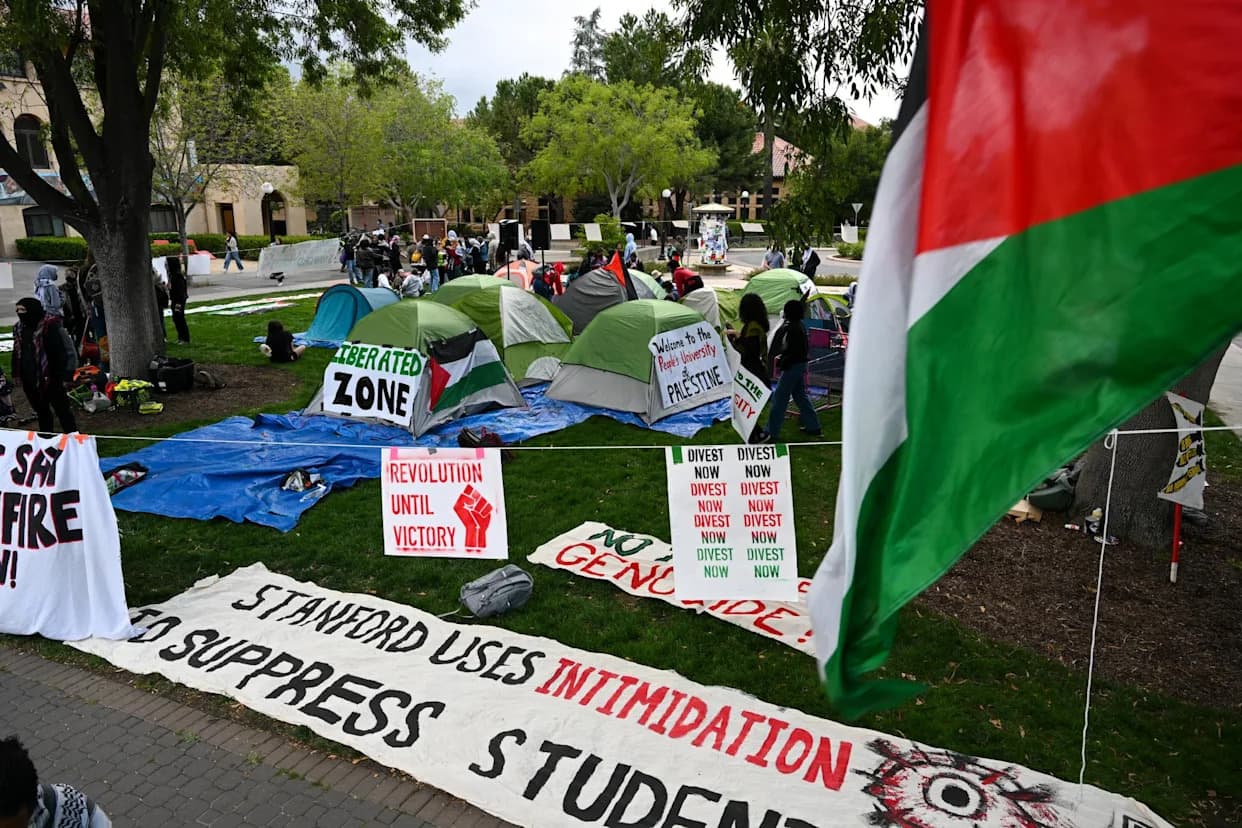
An encampment of protesters at Stanford University, in Stanford, California on 25 April 2024.Photograph: Anadolu/Getty Images
Five Stanford University students are scheduled to stand trial in San Jose beginning Monday on felony charges tied to a June 2024 pro‑Palestinian occupation of the university president’s office. The case is among the most serious criminal actions brought against participants in the nationwide wave of campus protests opposing Israel’s war in Gaza.
The students are part of a broader group of 12 who were charged with felony conspiracy to trespass and felony vandalism after occupying the president’s office for roughly an hour. Protesters barricaded themselves inside the office and demanded that Stanford consider a student resolution calling for divestment from Israel and other institutional changes. During the occupation, demonstrators unofficially renamed the building for Adnan al‑Bursh, a Palestinian surgeon whom supporters say died in Israeli detention.
Stanford immediately suspended the students and barred them from campus for two academic terms while an internal disciplinary process took place; the students were later allowed to return that fall. Nearly a year after the occupation, in April 2025, Santa Clara County District Attorney Jeff Rosen announced criminal charges against the group amid broader political pressure on elite U.S. universities over allegations of insufficient responses to antisemitism on campus.
Prosecution, Defense Positions and Quotations
At a press conference announcing the charges, DA Rosen said, “Dissent is American, vandalism is criminal.” He emphasized that chants and online speech were not the issue, contrasting social‑media invective with on‑site actions such as pouring fake blood inside an office. Rosen’s office has declined to detail why the case was brought as felonies or why it was timed as it was, saying the office is focused on the criminal allegations as the trial proceeds.
The five defendants have pleaded not guilty and said they intend to use the trial to spotlight what they describe as Stanford’s role in the violence in Gaza. “This is all just a distraction from the very real property destruction and crimes that are occurring in Gaza every day because of Stanford University’s investments and actions,” said German Gonzalez, a sophomore at the time of the occupation. Fellow defendant Amy Zhai said the trial should focus on what she called Stanford’s institutional responsibility, not damage to a campus office.
Legal Stakes and Pre‑Trial Rulings
The five students face felony charges that carry the possibility of more than three years in prison if convicted. Stanford is also seeking approximately $329,000 in restitution from the group for alleged damage sustained during the occupation; Stanford’s facilities director testified that direct physical damage totaled just under $10,000, according to the Stanford Daily.
Pre‑trial litigation has produced a mix of rulings: a judge denied prosecutors’ request to broadly bar discussion of “genocide” and the political motivations for the protest, but prosecutors succeeded in preventing the defendants from calling an international human‑rights expert and from invoking the First Amendment as a defense on the grounds that the alleged conduct is not protected speech. Prosecutors argued the defense planned to turn the trial into a platform to debate the Gaza war; defense attorneys and defendants maintain they should be permitted to explain their political motivations and campus context.
Wider Context
The Stanford case comes amid a national wave of pro‑Palestinian campus protests in spring 2024 that resulted in thousands of arrests and many suspensions or expulsions. In many jurisdictions, prosecutors declined to bring charges or later dropped them: for example, New York prosecutors did not pursue charges against dozens of students who occupied a campus building, Michigan’s attorney general dropped similar charges, and Los Angeles prosecutors declined to pursue charges against most students arrested in related protests.
One person initially charged in the Stanford investigation cooperated with prosecutors and was not indicted; several others accepted plea deals or diversion agreements. The five students moving forward to trial are among the first to face jury proceedings and the only ones linked to these protests charged with felonies rather than misdemeanors.
What’s next: The trial is expected to last about five weeks. Observers will be watching both the legal outcomes and whether the proceedings are used by either side to expand the public debate about campus speech, university investments, and accountability for international human‑rights concerns.
Help us improve.