
Apollo 8 circled the Moon from Dec. 21–27, 1968, and delivered a unifying Christmas Eve message as Commander Frank Borman, Jim Lovell and Bill Anders read passages from Genesis on live television. The crew captured the iconic “Earthrise” photograph, revealing Earth as a fragile oasis against the blackness of space. Assembled in roughly four months and watched by millions, the mission left a lasting cultural and visual legacy.
Apollo 8’s Christmas Broadcast: Reading Genesis and Sharing 'Earthrise' From Lunar Orbit

The front page of the Deseret News on Dec. 24, 1968, as Apollo 8 astronauts send messages of peace and joy from space.
December 1968 was a turbulent month on Earth — marked by war, riots and political turmoil — yet three U.S. astronauts offered a unifying, poignant Christmas message from 240,000 miles away. The Apollo 8 mission, launched on Dec. 21 and splashing down on Dec. 27, combined high-stakes spaceflight with a culturally resonant broadcast that millions watched on Christmas Eve.
Mission, Risk and a Rapid Timeline
As contemporary accounts from The Associated Press noted, Apollo 8 was NASA’s boldest and most hazardous undertaking to that date: three men atop a new, powerful rocket sent on the first human voyage to another world. The mission was assembled in roughly four months to meet a year-end target and to stay ahead of the Soviet program — an unprecedented schedule that amplified both pressure and risk.
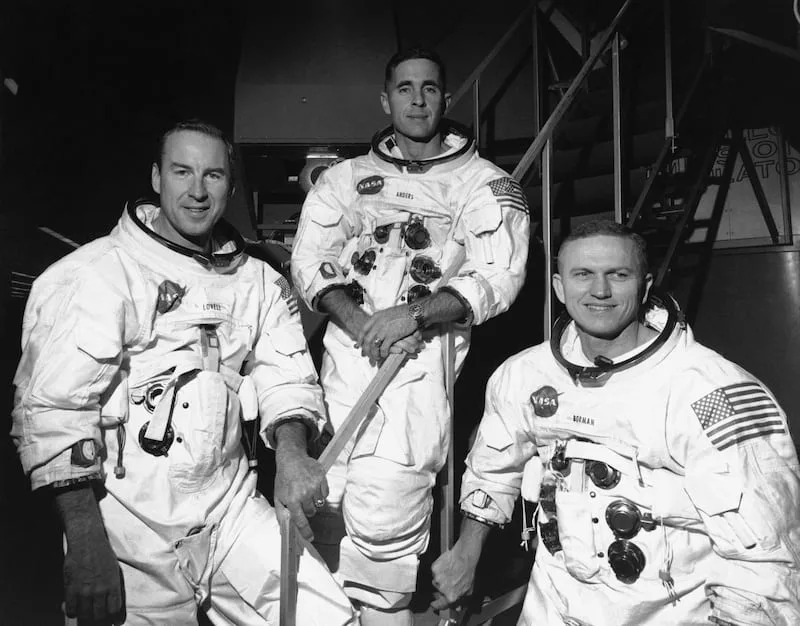
In this Dec. 18, 1968, file photo, Apollo 8 astronauts, from left, James Lovell, command module pilot; William Anders, lunar module pilot; and Frank Borman, commander, stand in front of mission simulator prior to training in exercise for their scheduled six-day lunar orbital mission at the Kennedy Space Center in Florida. | Associated Press
A Christmas Eve Broadcast From Lunar Orbit
On their tenth orbit around the Moon, Commander Frank Borman, Jim Lovell and Bill Anders transmitted live television images and a reading from the Book of Genesis describing the creation of Earth. Millions of viewers tuned in as the crew alternated between images of the cratered lunar surface and the astronauts’ measured, reflective words.
“It’s a foundation of Christianity, Judaism and Islam,” Lovell later explained about choosing Genesis. “It is the foundation of most of the world’s religions... The idea of bringing people together by a flight to the Moon where we encompassed everybody in our thoughts is still very valid today.”
The Birth of 'Earthrise'
During the mission, Bill Anders captured the now-iconic photograph known as “Earthrise,” showing Earth’s blue-and-white disk rising above the stark, gray lunar landscape. That image reframed humanity’s view of our planet: a fragile oasis floating in the blackness of space. At the time, humans had never seen the Moon’s far side or Earth from that perspective; in the decades since, only 24 U.S. astronauts who traveled to the Moon experienced those views firsthand.
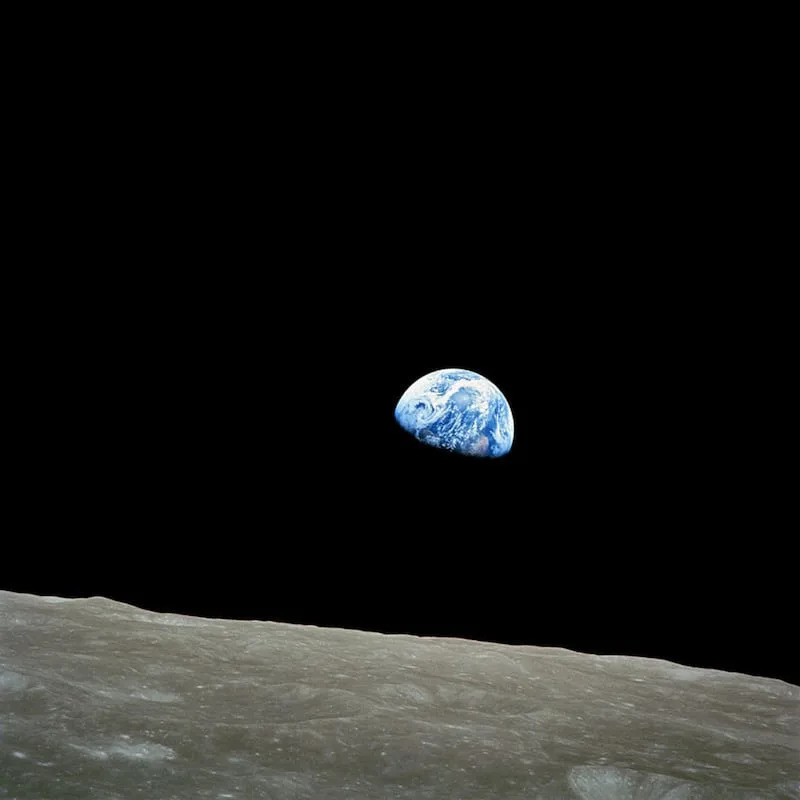
This famous photo, known as "Earthrise," was taken by the crew of Apollo 8 as they orbited the moon in late December 1968. | National Aeronautics and Space Administration
Cultural Legacy and Newspaper Coverage
Beyond the technical achievement, Apollo 8 left lasting cultural and visual legacies: a Christmas message that transcended borders, a photograph that shaped environmental and philosophical thinking, and a renewed public fascination with space exploration. Selected Deseret News archive pieces on the mission include:
- “Apollo 8 Astronaut Marks 1968 Christmastime Broadcast to Earth”
- “NASA’s 1st Flight to Moon, Apollo 8, Marks 50th Anniversary”
- “Inside the Newsroom: Reaching for the Moon and Finding Something Greater”
- “Should Faith Groups Have a Say in the Future of Space Travel?”
- “Lovell Never Got to Be the Man on Moon”
- “New Crisis, Old Debate — What Shall NASA Do?”
- “Ex-Astronaut Borman Sees No Moon in Future”
- “Where the Love Light Gleams”
- “Apollo 13 Commander Speaks at BYU on Successful Failure”
- Opinion: “We Honor 6 Utahns Who Put America in Space”
- Opinion: “The ‘Giant Leap’ Wasn’t Just About Man’s Achievements”
- “One Giant Leap: 40 Years Later, Apollo Moon Landing Remains Pivotal”
Apollo 8 stands as a milestone in human exploration: technically daring, culturally resonant and visually transformative. The mission’s Christmas Eve broadcast and the “Earthrise” photograph remain touchstones in the story of how spaceflight altered humanity’s self-image.


