
“Fiddler on the Moon: Judaism in Space,” directed by Seth Kramer, Daniel Miller and Jeremy Newberger, asks how Jewish ritual and timekeeping could be reimagined as people live off Earth. Using the case of astronaut Ilan Ramon, rabbinic precedents and voices like Neil deGrasse Tyson, the film shows that Jewish law and community practice have long adapted to new realities. It explores practical responses for the Moon and Mars, highlights personal stories such as Jessica Meir’s Chanukah photo and the first all-woman spacewalk, and argues that adaptation—and communal models like kibbutzim—could guide future off-world Jewish life.
Fiddler on the Moon: How Judaism Might Adapt as Humanity Moves Into Space

The new documentary discusses what Judaism looks like in a world of space exploration. . | Credit: Fiddler on the Moon
“Fiddler on the Moon: Judaism in Space,” a short documentary by directors Seth Kramer, Daniel Miller and Jeremy Newberger, explores a striking question: what will Jewish life and ritual look like when communities live and work off Earth?
Tradition Meets the Final Frontier
The film gathers Jewish astronauts, rabbis, scientists studying lunar and Martian habitats, and public voices such as astrophysicist Neil deGrasse Tyson to examine how religious observance—rooted in Earth-based celestial cues like sunset and lunar months—might be maintained, reinterpreted or adapted in space. Rather than presenting sharp doctrinal splits, the documentary finds a broad consensus among its interviewees: Jewish practice has historically adapted to new realities, and it can do so again.
Practical Questions and Precedents
A central thread of the documentary follows Israeli astronaut Ilan Ramon and his STS-107 mission aboard the space shuttle Columbia, which was lost during reentry on Feb. 1–3, 2003. Before flight, Ramon asked Rabbi Zvi Konikov—of Chabad of the Space and Treasure Coasts—how to observe the Sabbath in orbit. Konikov recommended following the time kept by mission control in Houston, mirroring earlier rabbinic responses to unusual environments.
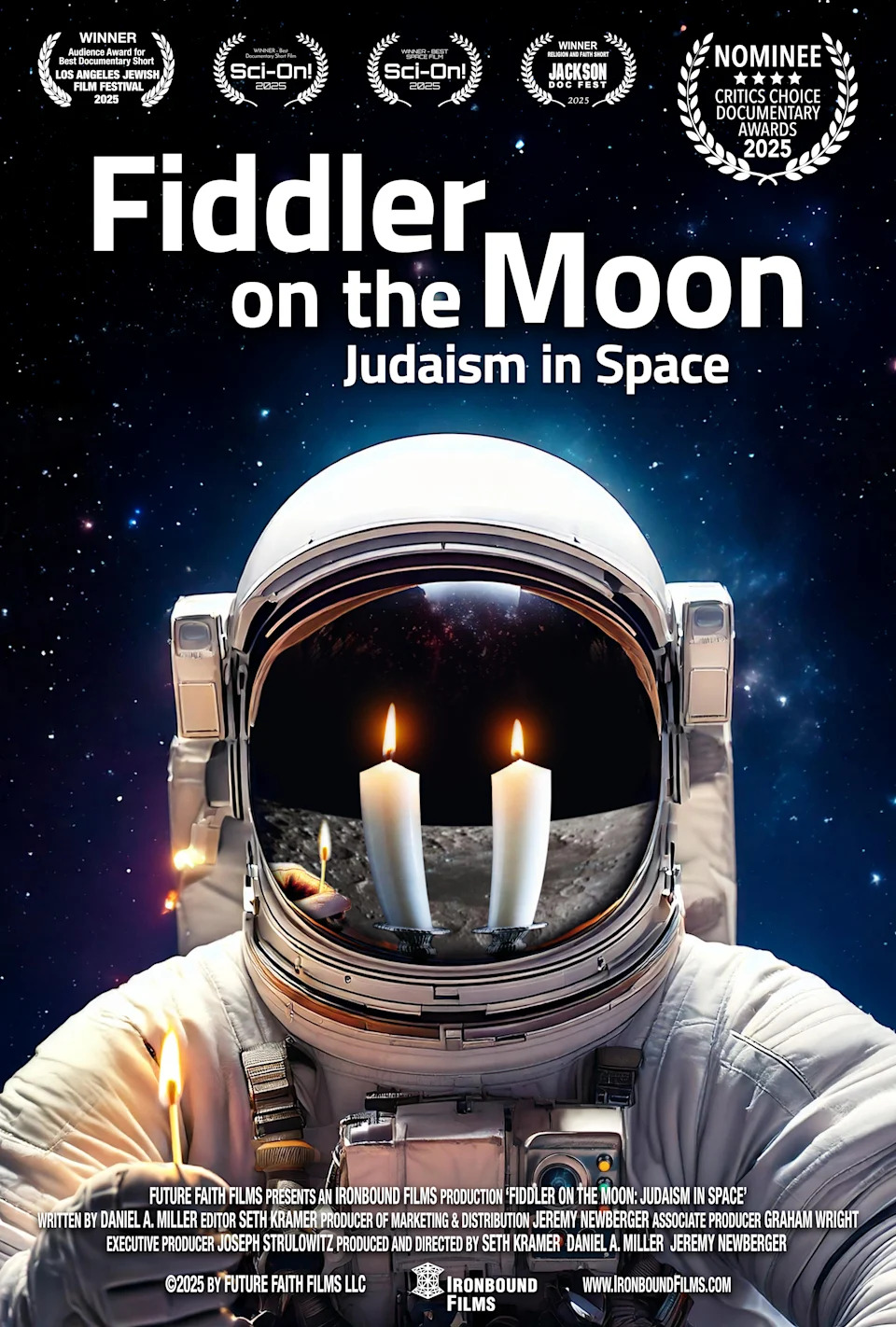
The movie poster for the documentary "Fiddler on the Moon" | Credit: Fiddler on the Moon
“All of our reckoning of time owes its foundations to astronomical observations that are Earth-centered,” Tyson notes in the film, emphasizing why religious timekeeping becomes complicated off-planet.
The filmmakers cite historical precedent: during World War II, rabbis advised Jewish servicemembers near the poles to use the time of the nearest habitable city (Anchorage, Alaska, in that case) to determine Shabbat observance—a practical solution that informed later space-focused rulings.
Moon, Mars and the Calendar Challenge
The documentary examines how the Jewish lunar calendar and daily rituals could be managed on the Moon and Mars. A Martian day (sol) is roughly 40 minutes longer than an Earth day, and Mars’ two tiny moons are poor substitutes for Earth’s visible lunar phases—issues that could slowly desynchronize off-world communities from Earth-based timing.
Rabbi Ben-Tzion Spitz, creator of a proposed Mars Jewish calendar, argues the community has a long history of adapting ritual practice to new environments. “Jews have a genius for adapting under the harshest conditions,” he says in the film.

NASA astronaut Jessica Meir shows off some colorful, Hanukkah socks on the International Space Station on the first night of Hanukkah, Dec. 22, 2019. | Credit: Astro_Jessica/Twitter
Faith, Community Rhythm and Identity
Tyson and several rabbis stress that synchronized ritual often creates a communal rhythm—prayers, holidays and shared observance can unify far-flung people. The film also highlights cross-faith parallels: synchronized practices matter for Muslims, Catholics and others, too, and preserving or re-creating shared rhythms could be socially important in space settlements.
Personal Stories and Cultural Continuity
Small, human moments illustrate the issue: Ilan Ramon marking Shabbat on STS-107 and NASA astronaut Jessica Meir posting a photo of Chanukah socks aboard the International Space Station (ISS). On the same 2019 mission Meir participated in the first-ever all-woman spacewalk with Christina Koch. Koch is slated to fly around the Moon on Artemis 2, currently targeted as early as February 2026, and NASA’s Artemis 3 aims for a lunar surface landing in 2028 as part of a broader plan for sustained human presence.
The film draws historical parallels to migrations and communal experiments on Earth—such as the kibbutzim in early 20th-century Israel/Palestine—which may offer social models for sharing resources and preserving culture in isolated, hostile environments off Earth.
Reception and Touring
“Fiddler on the Moon” premiered at the Boca International Jewish Film Festival in Florida and has won multiple awards for best documentary short. It was nominated for the 2025 Critics Choice Documentary Awards and is touring the United States with screenings scheduled coast to coast through April 2026. The directors say the film has sparked conversations across Jewish, scientific and faith communities.
Ultimately, the documentary argues, Judaism’s long history of legal reasoning and practical adaptation gives it tools to navigate the ethical and ritual questions that will arise as humanity moves beyond Earth—while also asking whether space settlement might finally allow some communities to move beyond past traumas.


