
More than 10,000 people gathered at Bondi Beach to mark one week since a deadly antisemitic attack on a Jewish festival that killed 15 people and wounded many others. The vigil featured national leaders, projected images of victims aged 10–87, and moments of silence across the country in a government-declared Day of Reflection. Authorities said the attack was inspired by the Islamic State group; leaders have launched reviews of security agencies and pledged to tighten gun and hate‑speech laws.
Over 10,000 Mourn at Bondi Beach One Week After Antisemitic Massacre; Calls Intensify for Tougher Gun Laws

People attend a ceremony to mark the National Day of Reflection for victims and survivors, at Bondi Beach in Sydney, Sunday, Dec. 21, 2025, following the Bondi shooting on Dec. 14. (AP Photo/Mark Baker)(ASSOCIATED PRESS)
Thousands of people gathered under heavy police protection at Sydney’s iconic Bondi Beach on Sunday evening to mark one week since two gunmen opened fire at a Jewish festival, killing 15 people and wounding dozens. The vigil, attended by more than 10,000 mourners, brought national attention to rising antisemitism in Australia and renewed demands for tighter firearms regulation and improved security measures.
Ceremony and Dignitaries
Among the dignitaries at the commemoration were Prime Minister Anthony Albanese, former prime ministers John Howard and Scott Morrison, and Governor-General Sam Mostyn, representing King Charles III. Images of victims, whose ages ranged from 10 to 87, were projected during the service. The crowd sang "Waltzing Matilda" in tribute to the youngest victim, an Australian-born girl of Ukrainian parentage.
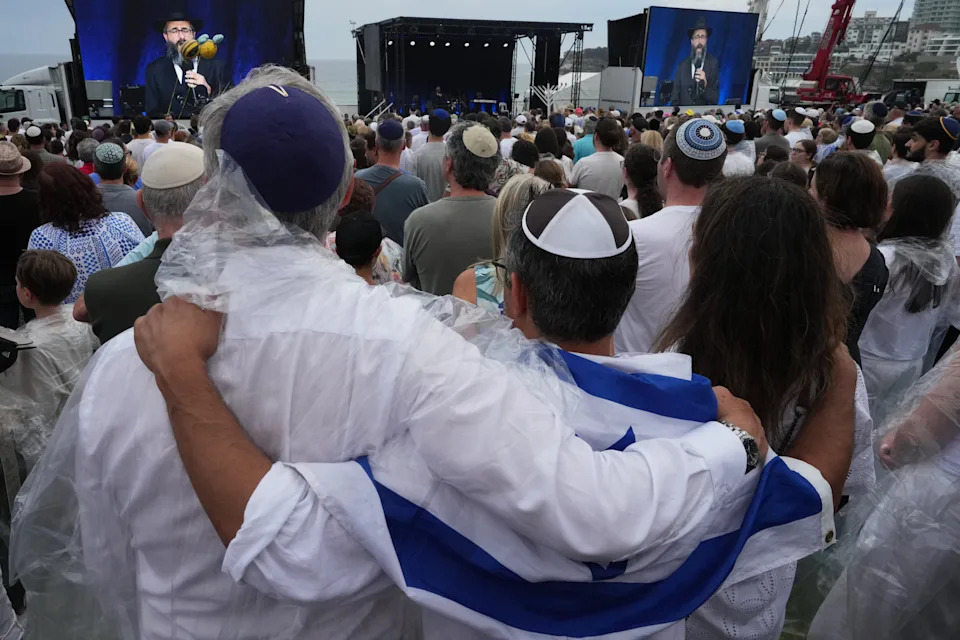
People attend a ceremony to mark the National Day of Reflection for victims and survivors, at Bondi Beach in Sydney, Sunday, Dec. 21, 2025, following the Bondi shooting on Dec. 14. (AP Photo/Mark Baker)(ASSOCIATED PRESS)
“This has to be the nadir of antisemitism in our country,” David Ossip, president of the New South Wales Jewish Board of Deputies, told the crowd. “This has to be the moment when light starts to eclipse the darkness.”
The crowd reacted strongly at times: some booed when the prime minister was acknowledged, while Opposition Leader Sussan Ley received cheers after expressing views on national policy regarding recognition of a Palestinian state.
Heroes, Rituals and Reflection Nationwide
Ahmed al Ahmed, a Syrian-born immigrant widely praised for disarming one attacker, sent a message of support from his hospital bed: “The Lord is close to the broken-hearted. Today I stand with you, my brothers and sisters.” His father was invited to light a candle on the menorah during the final night of Hannukah.
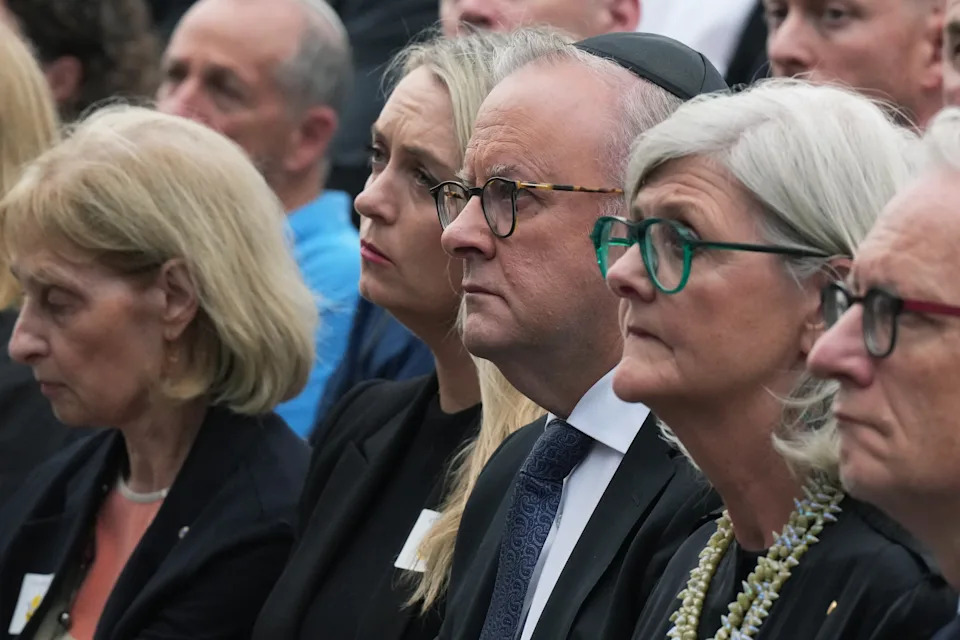
Australia's Prime Minister Anthony Albanese, center right, his wife Jodie Haydon, center left, and other guests participate in a ceremony to mark the National Day of Reflection for victims and survivors, at Bondi Beach in Sydney, Sunday, Dec. 21, 2025, following the Bondi shooting on Dec. 14. (AP Photo/Mark Baker)(ASSOCIATED PRESS)
Across Australia, communities observed a national Day of Reflection. At 6:47 p.m.—the moment the massacre began—people lit candles and observed a minute of silence at home and at public memorials. Television and radio services nationwide fell silent. Flags flew at half-staff on the Sydney Harbour Bridge and many government buildings were lit in yellow as a show of solidarity with the Jewish community.
Security, Investigation and Legal Response
Police bolstered security around Bondi on the day of the vigil, deploying officers armed with rifles. One suspect, 24-year-old Naveed Akram, was shot by police and has been charged with 15 counts of murder and 40 counts of causing harm with intent to murder. His father, 50-year-old Sajid Akram, was shot dead by police at the scene. Authorities said Sajid Akram legally owned six firearms, including the two shotguns and two bolt-action rifles used in the attack.
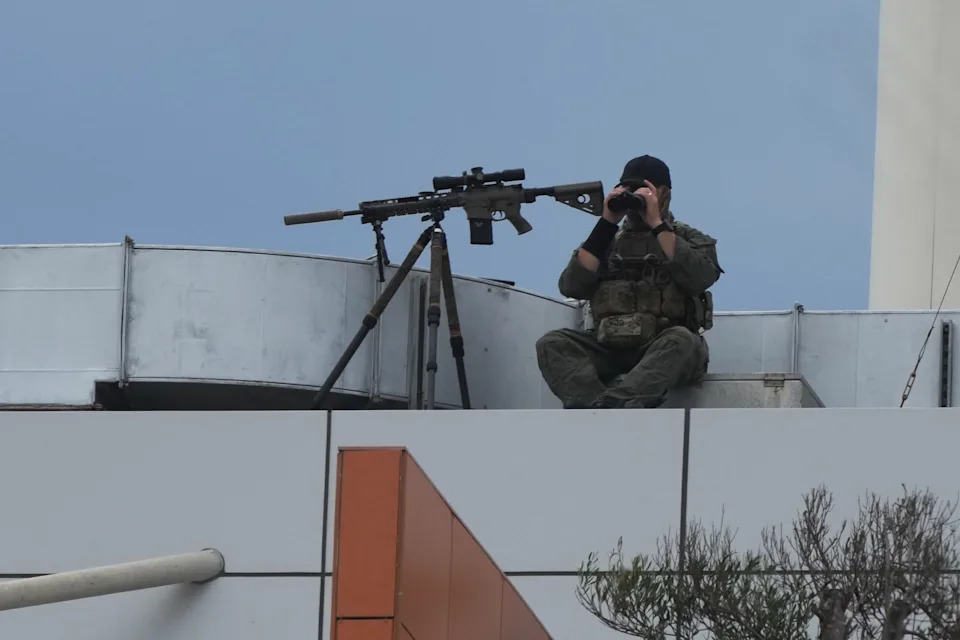
A masked man with the authorities sits with a firearm on the roof of a building at Bondi Beach in Sydney, Sunday, Dec. 21, 2025, ahead of a ceremony to mark the National Day of Reflection for victims and survivors from the Bondi shooting on Dec. 14. (AP Photo/Mark Baker)(ASSOCIATED PRESS)
The Health Department reported that 13 of those wounded remained hospitalized in Sydney. Two police officers were critically injured during the incident, and there has been public criticism that initial responding officers were armed only with pistols, which lacked the range of the attackers’ weapons.
Prime Minister Albanese announced a review of federal law enforcement and intelligence agencies following authorities’ assessment that the attack was inspired by the Islamic State group. Federal and New South Wales leaders subsequently held emergency talks and pledged to tighten gun laws, including proposals to limit the number of firearms an individual can legally own and to strengthen provisions on hate speech.
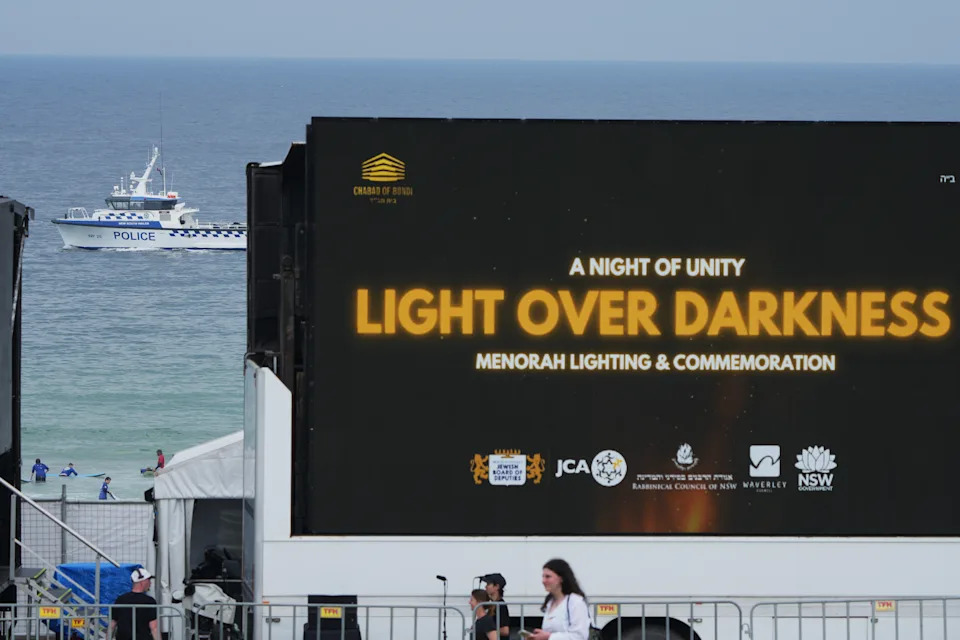
A police boat patrols Bondi Beach in Sydney, Sunday, Dec. 21, 2025, ahead of a ceremony to mark the National Day of Reflection for victims and survivors from the Bondi shooting on Dec. 14. (AP Photo/Mark Baker)(ASSOCIATED PRESS)
Community Impact and Next Steps
An impromptu memorial of flowers and messages at the Bondi Pavilion was visited by hundreds, including a morning smoking ceremony conducted by Indigenous leaders. Officials plan to clear the memorial in the days following the vigil. New South Wales parliament is scheduled to debate draft hate speech and firearms legislation as part of a broader national response to the massacre.
The tragedy has intensified debate across Australia about how to combat antisemitism, how to ensure public safety at community events, and how to balance lawful gun ownership with stronger public protections.


