
The Geminid meteor shower peaked around Dec. 13, and a relatively dim moon made viewing favorable. Astrophotographer Josh Dury captured the display over the Yucatán Peninsula, producing a dramatic image beneath a green-tinged sky likely caused by atmospheric airglow. The Geminids radiate from the constellation Gemini near Castor and originate from asteroid 3200 Phaethon, an object with comet-like activity. Dury said photographing the shower above fossilized dinosaur tracks evoked the Chicxulub impact that ended the dinosaurs.
Geminid Meteors Trace Green-Tinged Sky Over Yucatán — Photo Captures Cosmic Show and Paleontological Echoes

The Geminids are on full display in this image from astrophotographer Josh Dury. . | Credit: Josh Dury
Every December, Earth plows through a dense band of debris left in space, and the night sky is often streaked with bright meteors. This year's Geminid meteor shower peaked around Dec. 13, and a relatively dim moon provided generally favorable viewing conditions for observers and photographers alike.
Noted astrophotographer Josh Dury captured a striking image of the shower near the Yucatán Peninsula in Mexico, where multiple meteors arc across a sky tinged with green. The green coloration likely comes from atmospheric airglow or other natural emissions that can appear in long-exposure nightscapes, adding an unusual and dramatic backdrop to the meteor display.
A meteor is not a "falling star" but a small fragment of space material — often no larger than a grain of sand — that enters Earth's atmosphere at tens of miles per second and vaporizes in a bright, short-lived flash.
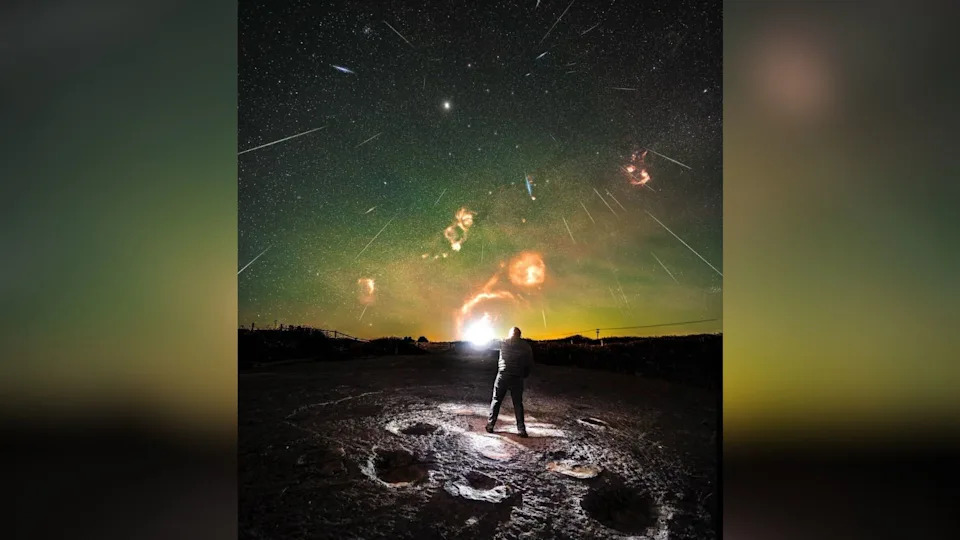
This image shows fossils and meteors in one shot. | Credit: Josh Dury
The Geminids appear to radiate from a point in the constellation Gemini, near the bright star Castor. That apparent origin, called the radiant, is why observers call the event the Geminids.
Unlike many meteor showers that originate from comets, the Geminid stream comes from asteroid 3200 Phaethon — a curious object that displays some comet-like behavior. As Dury noted in an Instagram post, "Unlike most meteor showers, they are not debris from a comet, but rather — an asteroid."
Artist’s reflection: Dury said the image, shot over fossilized dinosaur tracks, evoked the catastrophic Chicxulub impact that helped end the age of dinosaurs. He used the scene to imagine the morbid final moments before life on Earth changed dramatically.
This photograph combines astronomical spectacle with geological context, reminding viewers of both the beauty of the night sky and the deep-time events recorded on Earth. For those interested in seeing the Geminids next year, look for peak activity around mid-December and seek a dark site away from city lights; long-exposure photography can reveal colors and faint meteors that the eye alone might miss.
Learn more: Explore resources on meteor showers and astrophotography to plan future observing and imaging sessions.


