
The Hebrew University team trained machine-learning models on seven years of direct, lysimeter-based transpiration data from tomato, wheat and barley to predict daily crop water use. An XGBoost model achieved an R² of 0.82 and generalized across climates and facilities, with plant biomass and daily temperature as the most influential predictors. Because the model predicts expected healthy behavior, measured deviations can flag stress early — offering research-grade tools today and a path toward field-ready precision irrigation systems in the future.
Israeli Scientists Use AI to Predict Crop Water Use and Spot Plant Stress Earlier

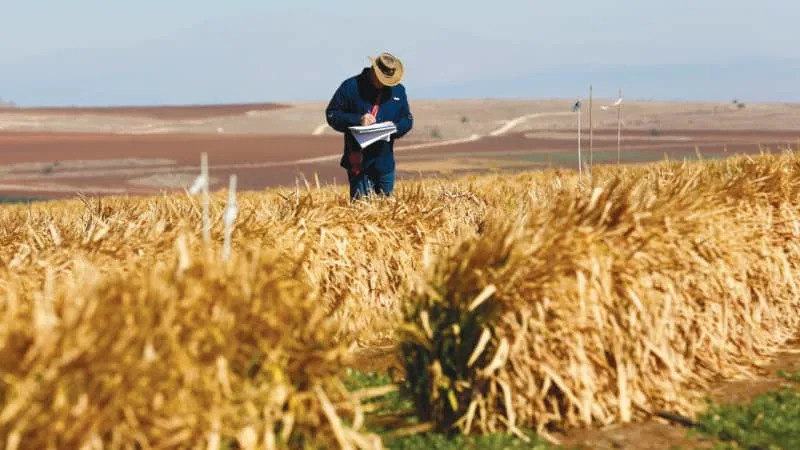
Crop irrigation illustrative. (photo credit: Yoav Dudkevitch/TPS-IL)
A new study from the Hebrew University of Jerusalem shows that machine-learning models trained on direct plant measurements can predict daily crop water use with high accuracy and flag early signs of plant stress.
Researchers led by Shani Friedman and Nir Averbuch, supervised by Prof. Menachem Moshelion, compiled seven years of continuous, high-resolution data from tomato, wheat and barley grown under semi-commercial greenhouse conditions. Using a high-precision load-cell lysimeter system, the team recorded minute-by-minute changes in plant weight to measure daily transpiration directly and with exceptional precision.
From Physiology to Prediction
Rather than relying on indirect proxies such as soil moisture or weather data alone, the team trained machine-learning algorithms on the physiological behavior of healthy, well-irrigated plants. By combining plant-level traits and environmental inputs and feeding them into models including Random Forest and XGBoost, the researchers demonstrated reliable prediction of daily transpiration across multiple crops.
Robust Validation and Key Drivers
In independent validations the XGBoost model reached an R² of 0.82, closely matching measured transpiration even when applied under different climates and at a separate research facility. This cross-site performance suggests the models capture core physiological signals rather than only crop- or site-specific noise. Plant biomass and daily temperature emerged as the strongest predictors shaping daily water use.
Early-Warning Potential
Because the model forecasts how a healthy plant should transpire, deviations between predicted and measured transpiration can serve as early indicators of stress — from drought or salinity to disease or root damage — often before visual symptoms appear.
The authors stress that the approach is conceptually important even though it currently depends on lysimeter data that most growers do not have. In the near term, the method is most useful in research and controlled environments — for benchmarking crop water use, validating irrigation algorithms, and improving greenhouse management. In the long term, similar models could be adapted to work with practical, field-ready sensors to support precision irrigation, water savings, and automated early-warning systems.
The study was peer-reviewed and published in Plant, Cell & Environment. The findings were reinforced by successful testing on plants grown in an independent research greenhouse at Tel Aviv University, supporting broader applicability across climates and production systems.


