
New genetic data from the duckDNA Project and Ducks Unlimited show game-farm mallard ancestry is widespread across North America and heavily concentrated in the Atlantic Flyway. Researchers estimate about 74% of hunter-harvested Atlantic Flyway mallards carry captive-bred genes and only roughly 2% are fully wild. Scientists warn hybrid birds often have poorer migration, feeding, and nesting traits, and they say continued monitoring and changes in release practices are needed to protect wild mallard populations.
Most Atlantic Flyway Mallards Carry Game-Farm Genes — Only ~2% Are Fully Wild

A pair of mallard drakes in the snow
Duck hunters prize the sight of a fully plumed greenhead returning from migration, but new genetics research shows many mallards taken in the field are not 100% wild. Decades of releases from game farms and subsequent hybridization have reshaped wild populations across North America.
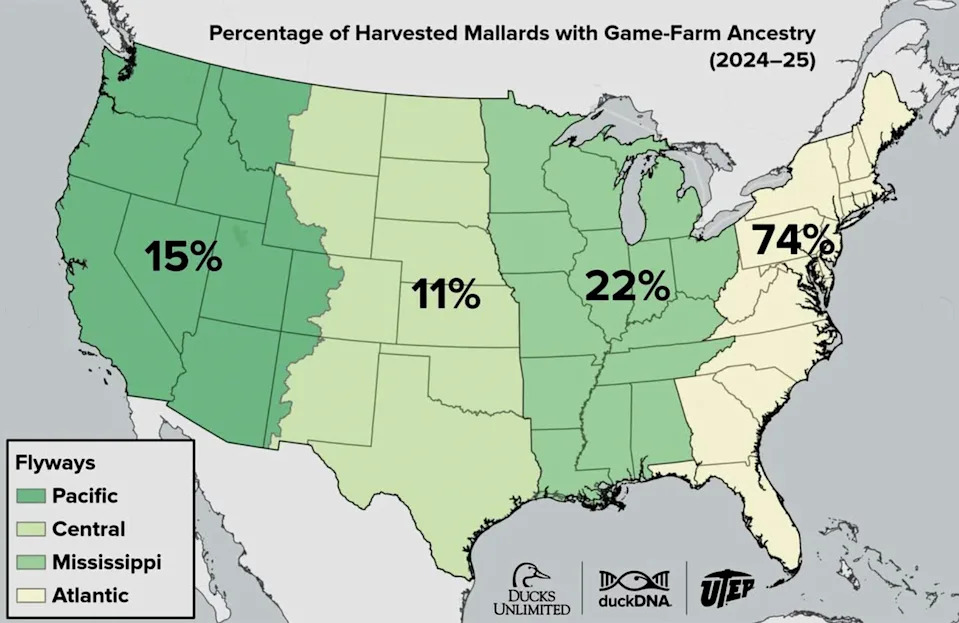
Map by DuckDNA / via Instagram
Widespread Game-Farm Influence
Recent data from the duckDNA Project, analyzed with Ducks Unlimited, reveal game-farm mallard ancestry in birds from 45 of the Lower 48 states. Influence varies by region: in the Atlantic Flyway roughly 74% of hunter-harvested mallards show evidence of captive-bred ancestry, while only about 2% appear to be completely wild. Other regions, such as parts of the Central Flyway, show much lower prevalence — nearer 10% — but sampling continues to fill geographic gaps.
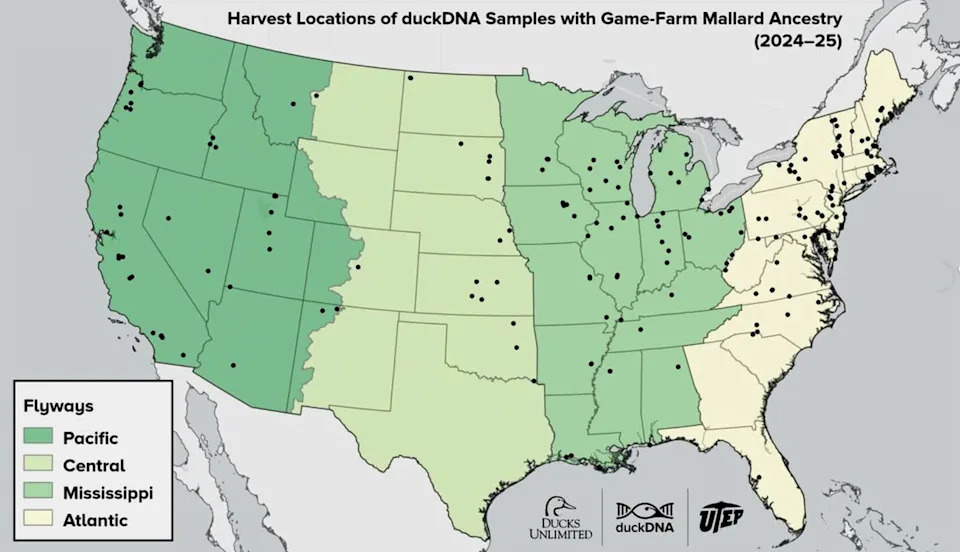
This map show the locations where hunters have submitted DNA, adding to the existing data around mallard genetics. Map by DuckDNA / via Instagram
How We Know
“Game-farm mallards have a distinct genetic signature,” says Dr. Phillip Lavretsky, associate professor at the University of Texas at El Paso and a lead scientist on the duckDNA Project. The team assembled samples spanning from the 1800s to the present and has tested more than 4,000 hunter-submitted birds to map ancestry patterns across flyways.
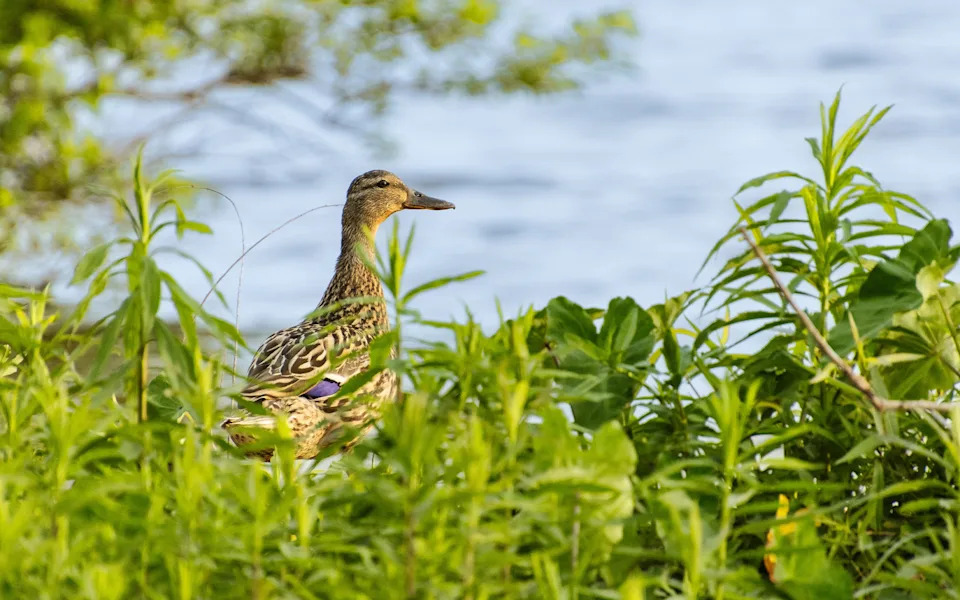
Waterfowl biologists have found that hybrid mallards have less nesting success than wild birds. Photo by Wade / Adobe Stock
“Our analyses indicate crossbreeding has been so extensive that in the Atlantic Flyway today you have roughly a 2% chance of harvesting a completely wild mallard,” Lavretsky says.
Why This Matters
Genetic mixing with captive-bred birds can reduce the fitness of wild populations. Researchers report that game-farm genetics are associated with traits less suited to survival in the wild: lower body fat (affecting migration), altered bill shape (changing feeding efficiency), poorer nesting and incubation behaviors, and greater susceptibility to disease and predation. In shrinking or degraded habitats, these disadvantages can compound population declines.
Long History, Ongoing Practice
Captive-bred mallard releases began in earnest in the early 20th century to supplement populations depleted by market hunting. Since the 1920s, federal, state and private releases — more than 90% concentrated along the East Coast historically — have continued; hundreds of thousands of game-farm mallards are still released annually in some areas. What began as a well-intentioned tactic to support hunting opportunities now presents conservation trade-offs.
Research and Next Steps
Scientists and conservation organizations are expanding genetics and ecological studies to better quantify impacts and guide management. Ducks Unlimited and the duckDNA Project are relying on continued hunter participation to broaden sample coverage and refine prevalence estimates. As Mike Brasher, Senior Waterfowl Scientist at Ducks Unlimited, notes, the community is still in an information-gathering phase — but awareness is already growing.
Bottom line: Hybridization with game-farm mallards is widespread and concentrated in the Atlantic Flyway, where fully wild mallards appear to be rare. Continued monitoring, targeted research, and changes in release practices will be needed to protect wild mallard genetics and long-term population health.


