
The US Air Force received its first Boeing T-7 Red Hawk trainer at Joint Base San Antonio–Randolph as the service begins replacing the roughly 60-year-old T-38 Talon. Designed with an open, updatable architecture, the T-7 will train pilots for fifth-generation fighters (F-22, F-35) and future platforms like the B-21 Raider and Boeing’s planned sixth-generation F-47. Paired with modern ground systems and live-virtual-constructive training, the jet aims to close the gap between basic flight training and modern, sensor-driven combat. Initial operational capability is expected in August 2027, with 14 jets slated for the 99th Flying Training Squadron that year.
US Air Force Unveils T-7 Red Hawk — A Modern Trainer Built For Stealth-Era Pilots

The T-7 Red Hawk is the Air Force's new training jet.US Air Force photo by 2nd Lt. Connor Brezenski
The US Air Force has received its first Boeing T-7 Red Hawk trainer at Joint Base San Antonio–Randolph, Texas, marking a milestone in a long-running effort to replace the aging Northrop Grumman T-38 Talon. The new jet is designed to prepare pilots to operate fifth-generation fighters like the F-22 and F-35, to train crews for stealth bombers such as the B-21 Raider, and to accommodate future sixth-generation platforms.
Why the T-7 Matters
The T-38 has served for roughly 60 years but has been repeatedly life-extended and, according to Air Force leaders and a 2023 Government Accountability Office report, is increasingly expensive to maintain and no longer reflective of modern combat aircraft. The T-7 Red Hawk brings an updatable, open modular architecture and advanced training integration that better reflects the sensor-rich, data-driven environments pilots will face.
Training For A Data-Driven Battlefield
Major Gen. Gregory Kreuder, commander of the 19th Air Force, emphasized that the new trainer shifts focus beyond basic stick-and-rudder skills. "From day one, students won't just be learning to fly," he said. "They'll learn to manage information, interpret advanced sensor data, and make rapid decisions in complex environments." The Air Force intends to pair the jet with modern ground and maintenance training systems and a live-virtual-constructive (LVC) environment that links real flights and simulators into shared scenarios.
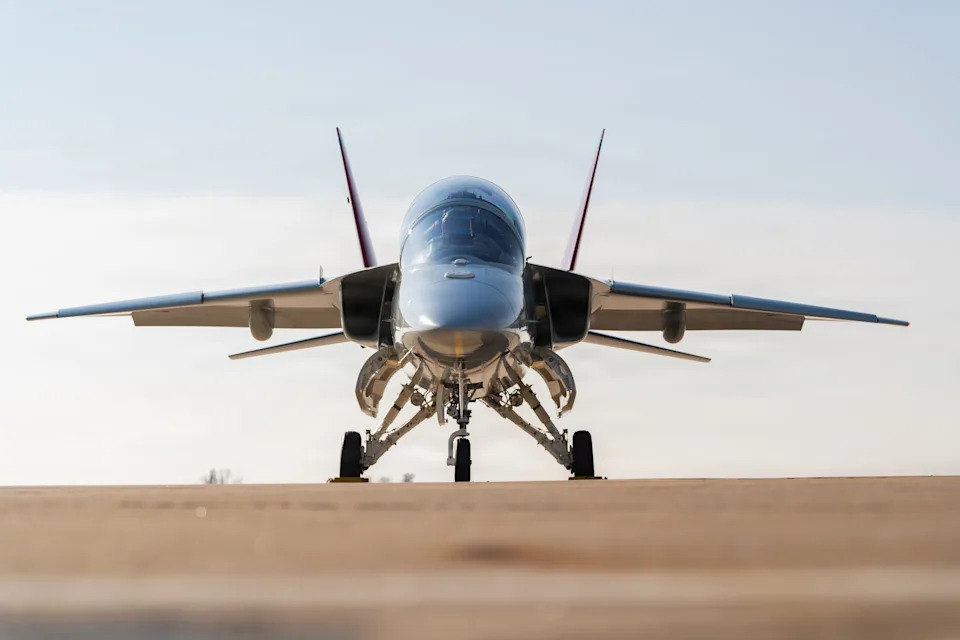
The T-7 Red Hawk will teach pilots how to fly fifth-generation fighters as well as the Air Force's new stealth bomber and F-47.US Air Force photo by 2nd Lt. Connor Brezenski
Program Status And Fielding Timeline
The aircraft delivered this month represents the program's progress, but the T-7 is not yet fully operational. Instructor pilots and maintenance crews must complete qualification training before students begin flying the type. The Air Force expects the T-7 to reach initial operational capability (IOC) in August 2027, with 14 jets planned for the 99th Flying Training Squadron at Randolph later that year. In the meantime, students will continue primary training on the T-6 Texan II, and additional bases — including Columbus (MS), Laughlin (TX), Vance (OK), and Sheppard (TX) — will receive T-7s in the years that follow.
Modularity and Future-Proofing
The T-7's open, software-centric design is intended to allow frequent updates to avionics, sensor emulation, and training scenarios without replacing the airframe. This adaptability, together with LVC capabilities, will let the Air Force refresh training to reflect evolving threats, platforms and weapons systems more quickly and cost-effectively.
“The aircraft delivery is the first physical representation of progress within the program,” said Brig. Gen. Matthew Leard, director of plans, programs, requirements and international affairs for Air Education and Training Command.
Overall, the T-7 Red Hawk represents a generational shift in pilot training — from teaching how to fly an airplane to training how to operate as an information manager and decision-maker in increasingly complex, networked combat environments.


