
The newly described dwarf mantis Ameles serpentiscauda, discovered on a Sardinian shoreline in summer 2024, performs a striking courtship in which males move their abdomens like serpent coils or a rattlesnake tail. Genetic, morphological and behavioral evidence confirm it as a new species. Lab observations recorded no sexual cannibalism among reared pairs, and researchers warn the insect occupies a tiny coastal range and may warrant IUCN Critically Endangered status.
New 'Snake‑Tail' Dwarf Mantis Discovered: Males Perform Serpent‑Like Dance to Avoid Post‑Mating Death

This male snake-tail mantis, Ameles serpentiscauda, has three simple eyes (ocelli) visible between its antennae, which mantises usually use during night flights to navigate using starlight. The short, non-functional wings, characteristic of this species, do not allow this mantis to fly at all.Roberto Scherini
Scientists have identified a striking new dwarf praying mantis on a Sardinian shoreline whose males perform a dramatic, snake‑like courtship display that may help them avoid being eaten after mating. The species has been named Ameles serpentiscauda and was described in a paper published in Ethology Ecology & Evolution.
A Strange Courtship
Male snake‑tail mantises move their abdomens in a range of motions during courtship: at times flowing and sinuous like serpent coils, and at other times jerking sharply like a rattlesnake's tail. These distinctive motions inspired the species name and drew researchers’ attention to an otherwise tiny, hard‑to‑find insect.
How It Was Found
The discovery began in summer 2024 when Oscar Maioglio, while on holiday on a remote Sardinian beach, noticed minute mantises on coastal shrubs. Although they initially resembled the known dwarf species Ameles andreae, their unusually short wings prompted him to collect several individuals and rear them in the lab.
“We were aware that some dwarf mantises perform courtship displays, but we never saw anything like this,” said Roberto Battiston, Naturalist Curator at the Museo di Archeologia e Scienze Naturali “G. Zannato” and a co‑discoverer.
Evidence They Are A New Species
The team used an integrative approach — combining morphology, genetic (phylogenetic) analyses and behavior — to confirm the specimens represent a species new to science. Their small wings, unique abdominal movements in courtship, and genetic distinctiveness all supported the classification as Ameles serpentiscauda.
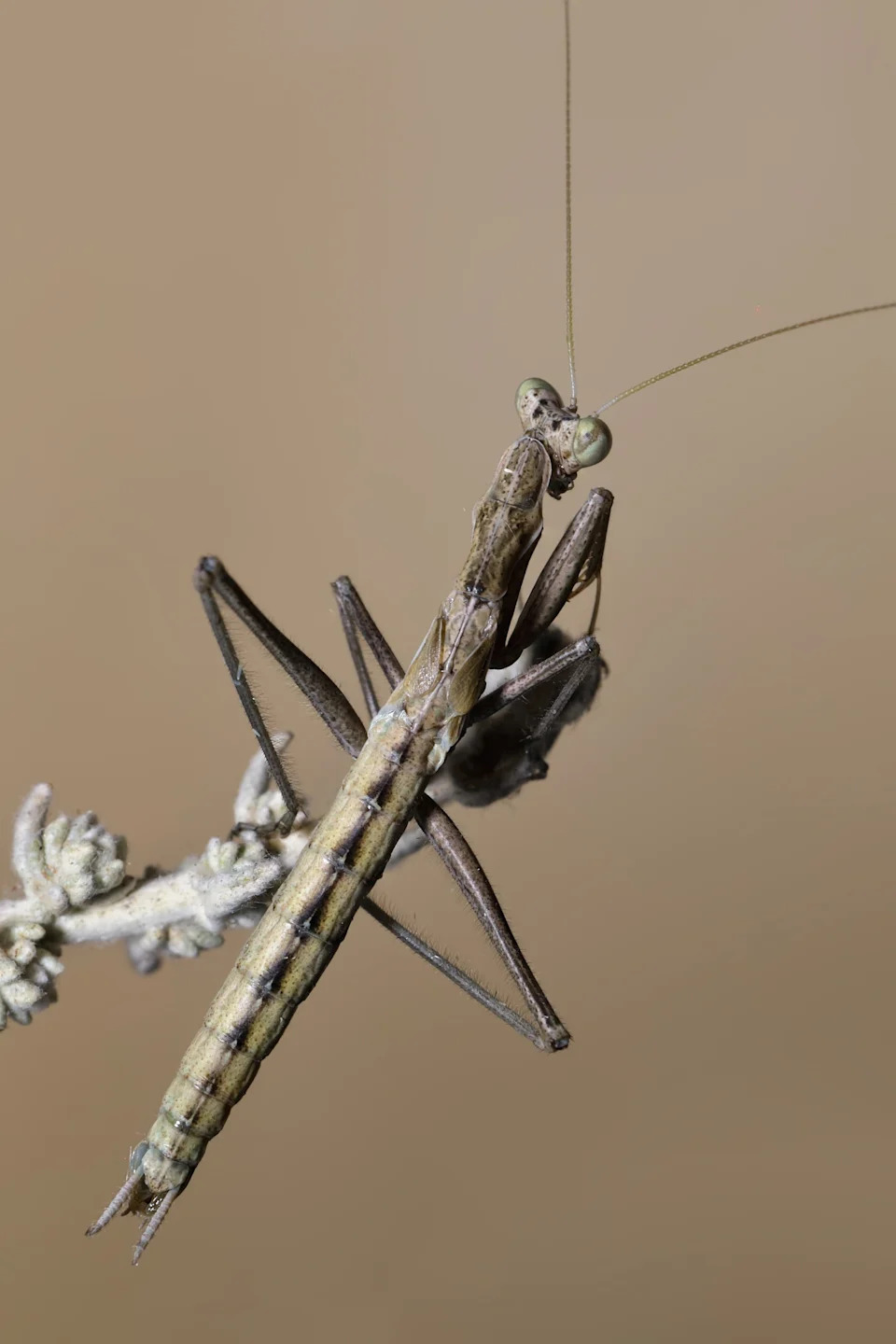
Adult male individual of the snake-tail mantis species (Ameles serpentiscauda). The two pairs of extremely small, non-overlapping wings are a distinctive characteristic for this species of dwarf mantis.Roberto Scherini
Possible Function: Avoiding Sexual Cannibalism
Praying mantises are famous for occasional sexual cannibalism. Researchers propose the elaborate male display may serve several possible functions: helping females recognize a conspecific mate, calming or distracting females, or signaling male quality. In lab‑reared pairs of the new species, scientists reported no instances of females eating males, suggesting the dance might reduce the risk of sexual cannibalism.
Why It Matters
Experts note the discovery highlights how much remains unknown about mantis behavior and diversity. "Mantises have some of the most diverse camouflage and behavioral strategies in the animal kingdom," said Christopher Oufiero of Towson University, who praised the study's combination of behavior, morphology and genetics. Lohitashwa Garikipati of the American Museum of Natural History added that these insects are often difficult to observe in the wild, so new behavioral records are especially valuable.
Conservation Concerns
So far, the snake‑tail mantis is known only from a narrow coastal strip of a few hundred yards in Sardinia. Much of that area lies within a protected zone, but increasing tourism and overgrazing by sheep and goats threaten its habitat. Battiston has proposed the species be assessed as Critically Endangered on the IUCN Red List and recommended stricter protections for its coastal habitat.
Key details: Ameles serpentiscauda — discovered summer 2024 in Sardinia; characterized by small wings and a unique serpentine courtship dance; confirmed as a new species through integrative taxonomy; no sexual cannibalism observed in lab pairs; occupies a very restricted range and may be threatened by human activity and grazing.


