
Restoration teams and volunteers across the U.S. Southeast are reintroducing rivercane, a native bamboo whose rhizome networks stabilize stream banks and reduce flood erosion. A 2024 planting of 300 stalks at Tuckabum Creek survived a nine-foot rise in water and preserved the bank, highlighting cane’s resilience. The Rivercane Restoration Alliance secured a $3.8 million grant to scale projects across 12 states, while low-cost methods like the “cane train” make local participation feasible.
A Native Bamboo's Comeback: How Rivercane Could Shield the U.S. South From Floods

In early 2024, environmental anthropologist Michael Fedoroff and a volunteer crew planted 300 stalks of rivercane on a badly eroded stretch of wetland at Tuckabum Creek in York County, Alabama. They left the shoots mulched with hay and returned days later to find the creek had risen nine feet — but the new cane and the stream bank remained intact. That dramatic test illustrates why a growing coalition is working to restore this native bamboo across the Southeast.
Why Rivercane Matters
Rivercane (Arundinaria spp.) once formed dense canebrakes from the Blue Ridge to the Mississippi Delta, with stalks up to 20 feet tall and extensive underground rhizome networks that bound soil and stabilized banks. After European settlement, agricultural clearing and grazing destroyed most stands. Today, more than 98% of historical rivercane is gone and only roughly a dozen large canebrakes remain nationwide.
Ecological Benefits: Rivercane helps hold stream banks in place during high flows, filters nitrates and other pollutants from water, and provides specialized habitat for native insects and other wildlife.
Restoration Efforts and Partnerships
Enthusiasts and scientists call this movement a “cane renaissance.” The Rivercane Restoration Alliance (RRA), hosted by the University of Alabama, coordinates restoration, protection of existing stands, public education, and research. The RRA and partners recently secured a $3.8 million grant from the National Fish and Wildlife Foundation to support rivercane projects across 12 Southeastern states.
Large projects often bring together diverse partners. The Tuckabum Creek effort included the RRA, Westervelt (a timber and land management firm), the U.S. Army Corps of Engineers, and the Choctaw Nation of Oklahoma. Tribal consultation and participation are emphasized because rivercane also carries deep cultural importance for many Native nations.
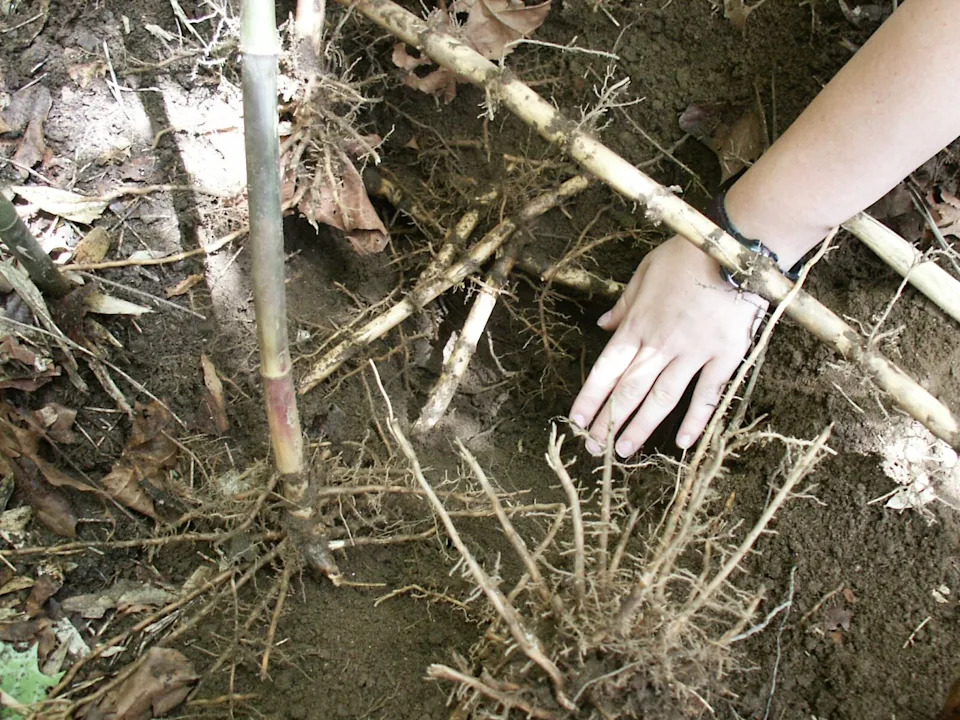
A photo shows a hand in a patch of soil along with a dense network of roots and stems, with bamboo-like stalks shooting up from the ground
The Cultural Role of Cane
Historically, Southeastern Native peoples used rivercane for baskets, blowguns, arrows and other crafts. As cane disappeared, many artisans switched to synthetic materials. Tribal programs are now teaching both the ecology and craft techniques to reintegrate rivercane into cultural practice and local economies.
Low-Cost Propagation: The “Cane Train”
Nursery plants can be expensive and scarce — often $50–$60 or more each. To overcome cost barriers, Virginia conservationist Laura Young developed the “cane train” technique: harvesting rhizome sections, packing them in soil-filled sandwich bags, and propagating shoots for roughly $6 per plant. The method is inexpensive and accessible for volunteers and landowners, though survival varies.
Challenges and Ongoing Science
The cane-train approach has limits: different rivercane genotypes are adapted to different microhabitats (sunny vs. wet sites), so transplants moved without guidance may fail. Fedoroff’s lab and other researchers are sequencing rivercane genomes to match plant varieties to site conditions and improve long-term success. Public education is also crucial: rivercane is often mistaken for invasive Asian bamboo and removed unnecessarily.
Local Actions and Impact
After Hurricane Helene, waterways lined with rivercane generally fared better than those without, motivating renewed restoration activity. In Yancey County, North Carolina, volunteers harvested thousands of rhizomes and planted nearly 700 shoots along eroded streams, with follow-up plantings planned. Small, local projects like this offer an actionable way for communities to reduce erosion and rebuild resilient riparian zones.
“There’s a lot of doom and gloom when we think about climate change. We become paralyzed. But we’re trying to take a different approach… We can’t get back to that pristine past state, but we can envision a future ecology that’s better.” — Michael Fedoroff
How To Get Involved: Volunteer with local watershed groups or the Rivercane Restoration Alliance, learn to identify native rivercane vs. invasive bamboo, and consider low-cost propagation techniques for small-scale bank stabilization projects.
This article is adapted from reporting originally published by Grist (Dec 11, 2025).


