
ESA's XMM-Newton and Japan's XRISM simultaneously observed a rare X-ray flare from the supermassive black hole in NGC 3783 that launched winds at about 134 million mph (~0.2c or ~216 million km/h). The black hole is estimated at roughly 30 million solar masses. Scientists note the outflow resembles solar coronal mass ejections but on a far greater scale, and studying such winds helps reveal how black holes influence galaxy growth.
Supermassive Black Hole Shoots Winds at 134 Million mph — About One-Fifth the Speed of Light

This image features NGC 3783, a bright barred spiral galaxy about 130 million light-years from Earth, that also lends its name to the eponymous NGC 3783 galaxy group. (Image credit: ESA/Hubble & NASA, M. C. Bentz, D. J. V. Rosario)
A supermassive black hole at the center of galaxy NGC 3783 produced an unusually powerful X-ray flare that launched ultra-fast winds measured at roughly 134 million miles per hour — about one-fifth the speed of light. The event was captured simultaneously by ESA's XMM-Newton and Japan's XRISM X-ray observatories while studying the galaxy's active galactic nucleus (AGN).
Rare Flare and Record-Breaking Outflow
The central black hole in NGC 3783 is estimated to have a mass near 30 million times that of the Sun. During the flare, astronomers detected outflows traveling at approximately 134,000,000 mph (~0.2c), which is about 215,650,000 km/h. These winds are faster than previously recorded for this object and provide a rare view into the violent physics near a growing supermassive black hole.
Analogy With Solar Eruptions
Researchers say the black hole's outflow resembles coronal mass ejections (CMEs) from our Sun — massive expulsions of plasma and magnetic fields — though on a vastly larger scale. For comparison, the fastest solar eruptions reach initial speeds of around 3 million mph, still far below the speeds seen in this AGN.
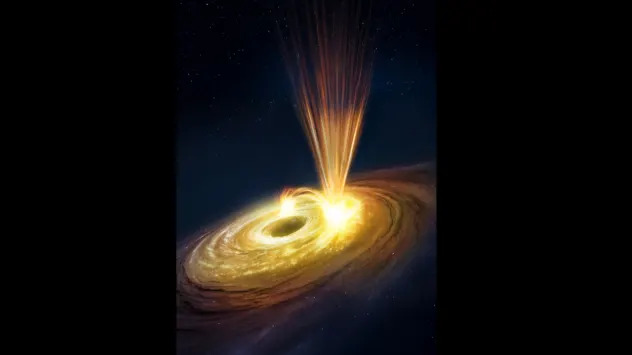
This artist’s impression depicts the black hole in question. The swirling ‘doughnut’ of golden material is known as an accretion disc: a ring of material that is circling the black hole and will ultimately be devoured, pulled in closer and closer by the black hole’s colossal gravity. The bright spot marks a superheated region of material – a ‘hotspot’ that was seen to release first a looping X-ray flare, and then the intense ‘outflow’ of winds seen shooting to the top of the frame. (Credit: ESA)
"But on a scale almost too big to imagine," said Matteo Guainazzi, ESA XRISM Project Scientist and co-author of the new study.
ESA XMM-Newton Project Scientist Erik Kuulkers added that observing the flare with two telescopes at once made it possible to spot these surprising parallels with solar phenomena. "This suggests that solar and high-energy physics may operate in unexpectedly similar ways across the universe," he said.
Why This Matters
Studying such turbulent, high-speed winds from AGNs helps astronomers understand how black holes influence their host galaxies. These outflows can heat or expel gas, regulate star formation, and shape galaxy growth over cosmic time — processes collectively known as black-hole feedback.
What scientists did: Coordinated X-ray observations with XMM-Newton and XRISM captured the flare and measured absorption and emission features that reveal the wind's speed and physical properties.
Bottom line: The detection in NGC 3783 provides fresh evidence that black hole environments can launch CME-like eruptions at relativistic speeds, offering a new laboratory to study magnetic and plasma processes at extreme scales.


