
GRB 250702B is the longest gamma-ray burst ever observed: an initial gamma-ray phase that persisted for at least seven hours after detection by NASA's Fermi telescope on July 2, 2025. Ground-based follow-up with VLT, Blanco, and Gemini located the event in a dusty, unusually massive galaxy billions of light-years away. Its properties do not fit standard GRB models, and researchers propose three possibilities — including a tidal disruption by an intermediate-mass black hole, a micro-TDE, or a helium-star disruption.
Seven-Hour Gamma-Ray Burst Breaks Record — Could an Intermediate-Mass Black Hole Be to Blame?
02:12 PM, 12/10/2025

An illustration of GRB 250702B and the dusty galaxy from which it erupted. | Credit: NOIRLab/NSF/AURA/M. Garlick
Astronomers have observed the longest gamma-ray burst (GRB) ever recorded. Catalogued as GRB 250702B and first detected on July 2, 2025, by NASA's Fermi Gamma-ray Space Telescope, the event produced an initial wave of gamma rays that lasted at least seven hours and produced repeating bursts over subsequent days.
Most GRBs last just seconds to minutes, which makes GRB 250702B extraordinary: its initial emission was nearly twice as long as the previous record, and its prolonged activity gave researchers an unusually large window to study the explosion in detail. The burst stood out among roughly 15,000 GRBs detected to date and may represent a new class of cosmic explosion.
Rapid Follow-Up Pinpoints a Dusty, Massive Host Galaxy
After Fermi's detection, teams used ground-based observatories to find and study the fading afterglow. The Very Large Telescope (VLT) on Cerro Paranal in Chile located the transient in a galaxy billions of light-years from the Milky Way. Further spectroscopy and imaging with the Víctor M. Blanco 4-meter Telescope and the twin 8.1-meter Gemini telescopes provided more detail about the environment around the burst.
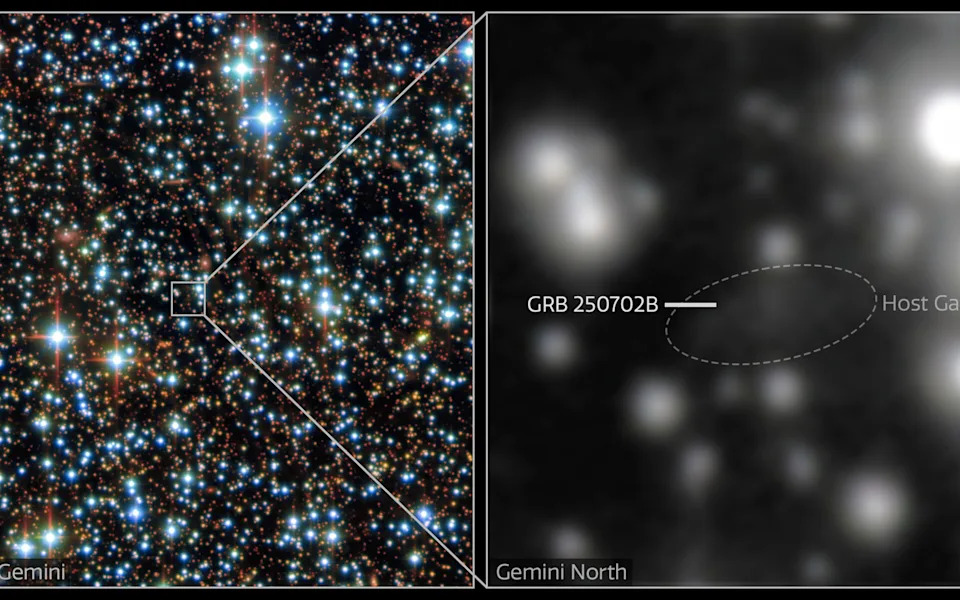
Left: The stellar field around the host galaxy of GRB 250702B — the longest gamma-ray burst that astronomers have ever observed. It comprises observations from the Gemini North telescope, one half of the International Gemini Observatory, funded in part by the U.S. National Science Foundation and operated by NSF NOIRLab, as well as the U.S. Department of Energy-fabricated Dark Energy Camera, mounted on the NSF Víctor M. Blanco 4-meter Telescope at Cerro Tololo Inter-American Observatory, a Program of NSF NOIRLab.Right: Close-up view of the host galaxy taken with the Gemini North telescope. This image is the result of over two hours of observation, yet the host galaxy appears extremely faint due to the large amount of dust surrounding it. | Credit: International Gemini Observatory/CTIO/NOIRLab/DOE/NSF/AURAImage processing: J. Miller (International Gemini Observatory/NSF NOIRLab), M. Zamani & D. de Martin (NSF NOIRLab)
Analysis of these observations indicates the gamma rays originated from a narrow, relativistic jet of plasma slamming into dense surrounding gas and dust. The host galaxy appears dust-rich and more massive than the galaxies that typically host GRBs, suggesting a different environment and possibly a different progenitor than usual GRB scenarios.
What Could Have Caused This Unusual Burst?
Gamma-ray bursts are commonly linked to a few mechanisms: core collapse of very massive stars, formation of highly magnetized neutron stars (magnetars), or tidal disruption events (TDEs) where a black hole tears apart a star. GRB 250702B does not fit neatly into any single standard model, so researchers propose three leading hypotheses:
- Helium-Star Disruption: A black hole may have encountered a star that had already lost its outer hydrogen layers and was predominantly helium, producing an extended jet-driven emission.
- Micro-Tidal Disruption Event (Micro-TDE): A smaller object — such as a low-mass star, brown dwarf, or even a planet — could have been partially disrupted by a black hole or neutron star, yielding a long-lived but lower-energy gamma-ray signal.
- Intermediate-Mass Black Hole (IMBH) TDE: The most intriguing possibility is that an intermediate-mass black hole (roughly 100–100,000 solar masses) shredded a star and launched a relativistic jet. IMBHs are expected theoretically but are seldom confirmed observationally; if true, this would be a rare detection of an IMBH producing a jet after a tidal disruption.
"The initial wave of gamma rays lasted at least seven hours — nearly twice the duration of the previous record — and we also detected several other unusual features," said Eliza Neights of George Washington University and NASA's Goddard Space Flight Center. "This is certainly an outburst unlike any other we've seen in the past 50 years."
"This work is a kind of cosmic archaeology, reconstructing the details of an event that occurred billions of light-years away," said Jonathan Carney of the University of North Carolina at Chapel Hill. "Rapid follow-up by Blanco and Gemini was crucial to capturing the transient signals and advancing our understanding."
The team's results were published in November in The Astrophysical Journal Letters. While no single explanation is yet definitive, the exceptional duration, repeated activity, and the burst's dusty, massive host galaxy make GRB 250702B a compelling target for continued observation and theoretical study.
Future observations across the electromagnetic spectrum and more detailed modeling of jet formation in different environments will help determine whether GRB 250702B reflects a new class of GRB, a rare type of TDE, or the first clear sign of an intermediate-mass black hole producing a relativistic jet.
Similar Articles

Black Hole Tears Apart a Star — And Triggers the Longest Gamma-Ray Burst Ever Recorded
On July 2 astronomers recorded GRB 250702B , a seven-hour gamma-ray burst preceded by an unusual X-ray brightening a day earl...

SVOM Captures One of the Most Distant Star Explosions — A 13‑Billion‑Year Cosmic Flash
SVOM detected a powerful gamma‑ray burst on March 14 originating from a star roughly 100 times the Sun's mass that exploded a...

Supermassive Black Hole in NGC 3783 Launches Ultra‑Fast Winds After X‑ray Flare
A coordinated observation by ESA’s XMM‑Newton and the JAXA‑led XRISM captured an unprecedented ultra‑fast wind from the super...

Supermassive Black Hole in NGC 3783 Hurls Matter at 134 Million MPH — A Magnetic Storm on an Unimaginable Scale
Scientists observed a burst of charged particles from the supermassive black hole in NGC 3783 traveling at about 134 million ...

Twin White Dwarf Eruptions Reveal Staged, Multi-Phase Novae — Challenging Long-Held Models
High-resolution interferometric images of two 2021 novae (V1674 Herculis and V1405 Cassiopeiae) reveal that white-dwarf erupt...

James Webb May Have Spotted the Earliest Supermassive Black Hole — Inside Galaxy GHZ2
JWST spectroscopy suggests the galaxy GHZ2 may host a supermassive black hole seen as it was about 350 million years after th...

Possible First Direct Signal of Dark Matter? Researcher Detects Gamma‑Ray Halo at Milky Way Center
Japanese astrophysicist Tomonori Totani reports an extended, halo‑like pattern of gamma rays near the Milky Way’s center that...

Sharper Black-Hole Images Could Put Einstein to the Test — New Study Sets Percent-Level Targets
The Event Horizon Telescope's images of M87* (2019) and Sagittarius A* (2022) enable new tests of gravity at the event-horizo...

Most Ordinary Matter Hides Between Galaxies — Fast Radio Bursts Complete the Census
The Big Bang predicts about 5% of the universe is ordinary (baryonic) matter, but visible stars account for only a small frac...

Astronomers Discover 53 Giant Radio Quasars — Jets Stretch 7.2 Million Light‑Years
A survey using the GMRT and the TGSS has uncovered 53 Giant Radio Quasars with jets reaching up to 7.2 million light‑years, a...

Record-Breaking Rotating Cosmic Filament Discovered: A 50 Million Light-Year 'Teacup Ride'
Researchers using South Africa's MeerKAT radio array have identified the largest-known rotating structure: a filament roughly...

JWST Reveals a 100-Million-Solar-Mass "Big Red Dot" — A Puzzling Black Hole from Cosmic Noon
The James Webb Space Telescope has uncovered a supermassive black hole — the BiRD (Big Red Dot) — with a mass near 100 millio...

Astronomers Capture a Supernova Shockwave Bursting Through a Star — Earliest Detailed View of Explosion Geometry
Using the VLT and spectropolarimetry, astronomers captured the earliest detailed view of a supernova shockwave as it burst th...

Gravitational-Wave Alert S251112cm: Could This Be the First Hint of a Primordial Black Hole?
The LIGO–Virgo–KAGRA network issued an alert for event S251112cm, a gravitational-wave candidate that may involve a sub-solar...

TESS Hears a Red Giant 'Sing' to Its Black Hole — Starquakes Reveal a Past Stellar Merger
TESS detected starquakes in a rapidly rotating red giant in Gaia BH2 (~3,800 light-years away), revealing an "alpha-rich" che...