
Bezymianny on Russia's Kamchatka Peninsula erupted in late November, sending ash about 32,800 ft (10 km) into the air — a sign of the volcano's steady rebuilding since its 1956 summit collapse. A 2020 study using aerial and satellite data found the mountain has nearly returned to its former height and may regain it by 2030–2035. Rebuilding has averaged roughly 932,307.2 cu ft (26,400 cu m) of rock per day (1956–2017) and involves both explosive eruptions and effusive lava flows; researchers emphasize continued monitoring because of slope-collapse risk.
Bezymianny Volcano Is Nearly Rebuilt — Eruptions Are Restoring Its Lost Summit
02:20 AM, 12/11/2025

The volcanic eruption of Bezymianny on March 30, 1956. The blast caused the volcano to collapse. | Credit: Photo by I. V. Yerov, 1956 (courtesy of G.S. Gorshkov, published in Green and Short, 1971, Creative Commons BY-NC-ND 4.0).
A restless Bezymianny volcano on Russia's Kamchatka Peninsula sent an ash column roughly 32,800 feet (10 kilometers) into the sky in late November, underscoring the mountain's ongoing recovery from a catastrophic 1956 collapse.
Before the collapse on March 30, 1956, Bezymianny rose at least 10,213 feet (3,113 meters) above sea level. That eruption removed a large part of the volcano's flank, converting the cone into a horseshoe-shaped amphitheater and destroying the summit. Almost immediately afterward, a lava dome began to form within the amphitheater, and the mountain has been rebuilding ever since.
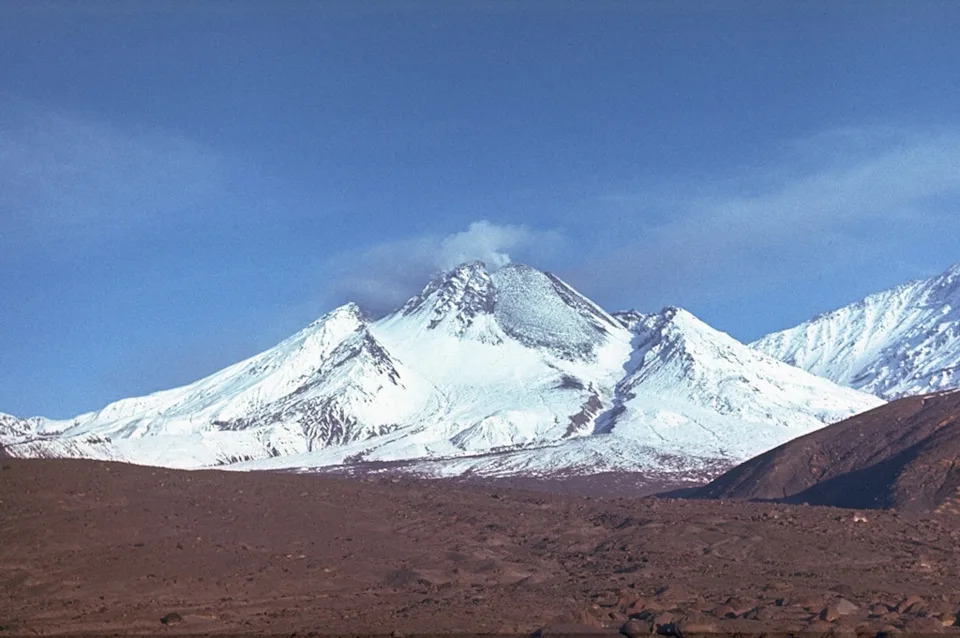
The lava dome began growing shortly after the eruption, pictured here in 1988. | Credit: Photo by Alexander Belousov, 1988 (Institute of Volcanology, Kamchatka, RussiaCreative Commons BY-NC 4.0).
How the Volcano Has Regrown
Researchers at the Institute of Volcanology and Seismology in Kamchatka (Russian Academy of Sciences) used field observations, webcams, aerial photography and satellite data to track Bezymianny's recovery. A 2020 analysis comparing aerial photographs from 1949 to 2017 found that the volcano has nearly regained its former height. From 1956 through 2017, the study estimated an average accumulation of about 932,307.2 cubic feet (26,400 cubic meters) of rock per day.
The rebuilding has involved both explosive eruptions and effusive activity. Explosive events typically occur a couple of times per year on average, producing ash plumes and pyroclastic flows. Effusive eruptions — relatively non-explosive lava flows that were first clearly recorded at Bezymianny in 1977 — have produced layered, lower-silica lava that is less viscous and able to pile up and reshape the cone.
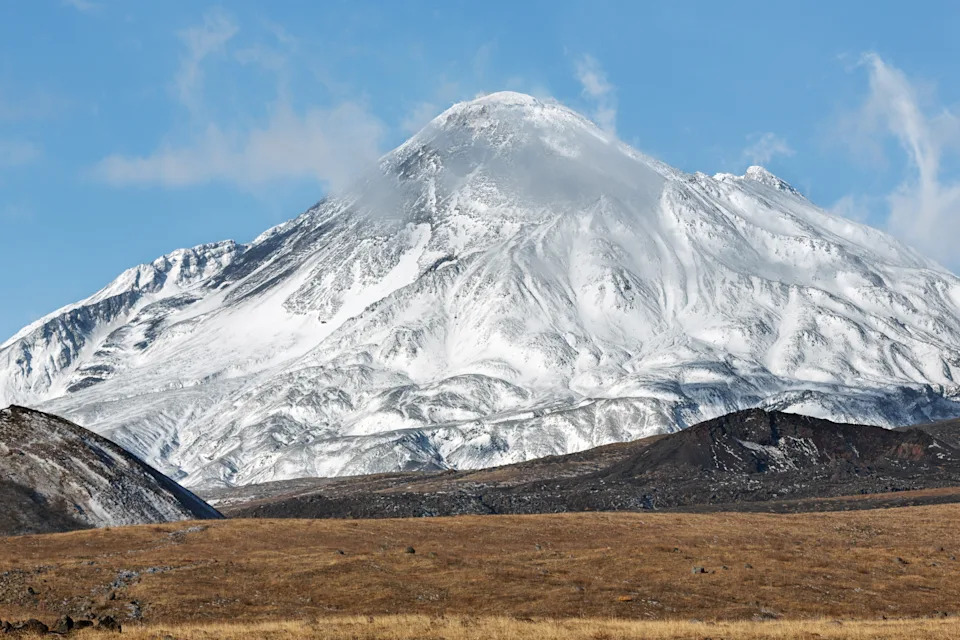
Bezymianny (pictured here in 2017) is expected to reach its pre-1956 eruption height in the next five to 10 years. | Credit: Alexandr Piragis/Getty Images
Hazards and Monitoring
Late-November activity produced a towering ash column and hot avalanches of gas and rock (pyroclastic flows), according to the Smithsonian's Global Volcanism Program. As the cone approaches its pre-collapse summit level, scientists are particularly focused on slope stability. Researchers Alexander Belousov and Marina Belousova note that volcanic edifices rebuilt inside horseshoe-shaped craters can be vulnerable to another large-scale collapse, which could trigger a major explosive eruption.
"The most surprising thing was the fast growth of the new volcanic edifice," Belousov and Belousova told Live Science, emphasizing the value of a long-term dataset for forecasting the behavior of other collapsed-and-regrown volcanoes.
Ongoing monitoring combines ground-based fieldwork, continuous webcam feeds, observation flights and satellite imagery. While each volcano follows its own path, Bezymianny's recovery offers an important comparative case — similar collapse-and-regrowth cycles have been observed at other volcanoes such as Mount St. Helens in the United States.
Outlook: The 2020 study projected that Bezymianny could reclaim its pre-1956 elevation sometime between 2030 and 2035 if current growth trends continue. Scientists warn that continued monitoring is essential to anticipate potential slope failures and large explosive events as the cone rebuilds.
Similar Articles

Six Volcanoes Scientists Are Watching — From Local Hazards to Global Risks
Six volcanic systems — Campi Flegrei, Merapi, Cumbre Vieja, Mount St. Helens, Popocatépetl and Yellowstone — are closely moni...

Axial Seamount Now Expected To Erupt Mid–Late 2026; OSU Launches New Forecasting Experiment
Axial Seamount , a submarine volcano about a mile under the Pacific and roughly 300 miles off Oregon, is now expected to erup...

13 American Volcanoes Closely Monitored for Sudden Eruptions
The U.S. contains numerous active volcanic systems—from the Yellowstone Caldera to frequently erupting Aleutian peaks—that ar...

Massive Lava Fountains at Kīlauea Destroy USGS Camera; Rare Triple Fountain Recorded
Over the weekend, towering lava fountains at Kīlauea engulfed and destroyed a USGS monitoring camera inside the closed Halema...

Kilauea Shoots 400‑Foot Lava Fountains — 37th Event Since Last December
Kilauea on Hawaii’s Big Island resumed intermittent eruptions Tuesday, launching lava fountains about 400 feet (122 meters) h...

Kīlauea Poised to Erupt Again — USGS Warns Episode 37 Could Arrive by Tuesday
Kīlauea is showing renewed activity and may erupt again as early as Tuesday, according to the USGS. Recent observations inclu...

Kilauea Erupts Again — Lava Rockets About 400 Feet Into the Air
Kilauea on Hawaii’s Big Island has been erupting intermittently since Tuesday, with the initial event sending lava about 400 ...

Over 170 Climbers Rescued After Sudden Eruption of Indonesia’s Mount Semeru
Indonesian authorities rescued and assisted more than 170 people stranded after Mount Semeru erupted suddenly in East Java. P...

Why Some Volcanoes Ooze Instead of Exploding: Shear Forces Can Let Gas Escape
Researchers report in Science that shear forces inside volcanic conduits can create and merge gas bubbles deep in rising magm...

Scientists Link 25,000 Santorini Quakes to Wave-Like Magma Intrusion
Scientists have traced a month-long swarm of about 25,000 earthquakes near Santorini to a wave-like intrusion of magma about ...

Hayli Gubbi Volcano in Ethiopia Erupts After ~10,000 Years — 45,000 ft Ash Plume Disrupts Flights
Hayli Gubbi , a volcano in Ethiopia's Afar Region, erupted on November 23, 2025, marking its first recorded activity in an es...

Mount Semeru Erupts, Sends 6,500‑ft Ash Plume; 300+ Evacuated as Red Aviation Alert Issued
Mount Semeru erupted on Nov. 19, producing an ash plume reaching about 6,500 feet (2,000 m) and prompting the evacuation of o...

Iceland's 2026 Mission: Drilling into a Magma Chamber for Direct Measurements and Near‑Magma Power
Iceland plans to drill two boreholes into a magma reservoir near the Krafla volcano in 2026 to capture the first direct measu...

Magma-Driven Quakes in Ethiopia: Why Fentale and Dofen Are Being Closely Watched
Since early 2025, seismic swarms in Ethiopia’s Afar and Oromia regions—including a magnitude-5.7 quake on 4 January—have prom...

Ethiopia’s Hayli Gubbi Volcano Erupts for First Time in ~12,000 Years, Sends Ash Plumes Nine Miles High
The Hayli Gubbi volcano in Ethiopia's Afar region erupted for several hours, launching ash plumes up to nine miles (≈14.5 km)...